


Summary: Top 10 Residential Proxies Rankings
I tested 30+ Residential proxies, and these are my top 10:
1. DatatImpulse: Best Overall.
2. Proxy-Seller: Multi-Social Media Accounts.
3. Oxylabs: Best for AI Agents.
4. Decodo: Best for Mid-level Web Scraping.
5. Bright Data: Best for Enterprise-Level Web Scraping.
6. ProxyEmpire: Unlimited Bandwidth Plans.
7. NodeMaven: Fast residential proxies with clean IPs.
8. ProxyLane: Best for Browser Automation
9. IpRoyal: Best for Long sticky sessions.
10. Gsocks: Budget Scraping Without KYC Verification.
➡️ Jump to my side-by-side comparison.
If you need residential proxies for web scraping, SEO monitoring, price tracking, ad verification, market research, or account management, choosing the right provider can make a huge difference.
The problem is that many residential proxy services look good on paper but perform very differently in real-world use. Some have high failure rates, slow response times, limited geo-targeting, or pricing that becomes expensive once you start using more bandwidth.
At BuyResidentialProxy, we test providers ourselves instead of relying only on advertised claims. We purchase proxy plans, run hands-on benchmarks, compare success rates and response times, and document the setup process with screenshots and real test data.
Our recommendations are based on first-hand experience and our own benchmark results.
Why Trust Us?
We’re fully independent and have been reviewing proxy providers since 2020. Our ratings are based on our own testing results and are unaffected by financial incentives. Learn who we are and how we test residential proxies.
What Is a Residential Proxy & How Does It Work?
If you’re new to residential proxies, I’ve broken down how they work below. Start with the simple explanation if you’re a beginner, or read the technical explanation if you want to understand IP rotation, sessions, targeting, and routing in more detail.
A residential proxy routes your internet traffic through an IP address assigned to a real household internet connection. To the website you visit, your request appears to come from that residential IP instead of your own device.
You can usually choose a country, state, or city and either rotate IPs automatically or keep the same IP for a longer sticky session.
When you connect to a residential proxy gateway, your request first goes to the proxy provider. The provider then forwards that request through an available residential IP in its network before sending it to the destination website.
The website sees the residential proxy IP rather than your original IP address. Depending on the provider, you can control geo-targeting, session duration, IP rotation, authentication, and proxy protocols such as HTTP(S) or SOCKS5.
Rotating proxies can assign a new IP on each request or after a set period, while sticky sessions keep the same IP for tasks that require a consistent connection.
Best Residential Proxies Compared & Reviewed
The residential proxy providers below performed well in our testing, but they suit different workloads. Compare success rate, response time, IP pool, geo-targeting, rotation, pricing, and best use case before choosing one.
Review Summary | Decodo  | Bright Data  | ProxyEmpire  | NodeMaven  | ProxyLane  | IpRoyal  | Gsocks  | |||
|---|---|---|---|---|---|---|---|---|---|---|
Overall Rating | 4.7/05 | 4.7/05 | 4.7/05 | 4.7/05 | 4.7/05 | 4.7/05 | 4.7/05 | 4.7/05 | 4.5/05 | 4.5/05 |
Best For | Overall | Social Media | scraping | Ad Verification | Enterprise | Unlimited Bandwidth | clean IPs | SEO tracking | non-expiring | Scraping |
Success Rate | 99.90% | 99.90% | 99.20% | 99.90% | 99.80% | 99.90% | 99.90% | 99.80% | 99.90% | 99.80% |
A.Response Time | 2.72sec | 2.91 sec | 2.68 sec | 2.12 sec | 3.19 sec | 1.94 sec | 1.92 sec | 2.10 sec | 2.33 sec | 3.29 sec |
IP Pool | 90M+ | 47M+ | 175M+ | 115M+ | 400M+ | 30M+ | 30M+ | 28M+ | 64M+ | 30M+ |
Countries | 195 | 220+ | 195+ | 195+ | 195+ | 170+ | 190+ | 195 | 195+ | 190+ |
Trial Period | No | No | up to 7 days | 3 days with 100MB | 7days with $2 credit | No | No | No | No | 100MB free trial |
Traffic Validity | Never expires | 30 days | 30 days | 30 days | Never expires | Never expires | Never expires | Never expires | Never expires | subscription cycle |
Need KYC | No | No | Conditional | Required | Required | Not | No | No | No | No |
Starting Price | $1/GB | $3.50/GB | $6/GB | $3.75/GB | $4/GB | $7/GB | $5/GB | $6.50/GB | $7/GB | $4/GB |
Official Website |



Read the Residential proxies testing methodology I used to measure each provider’s performance.
1. DataImpulse: Best Overall
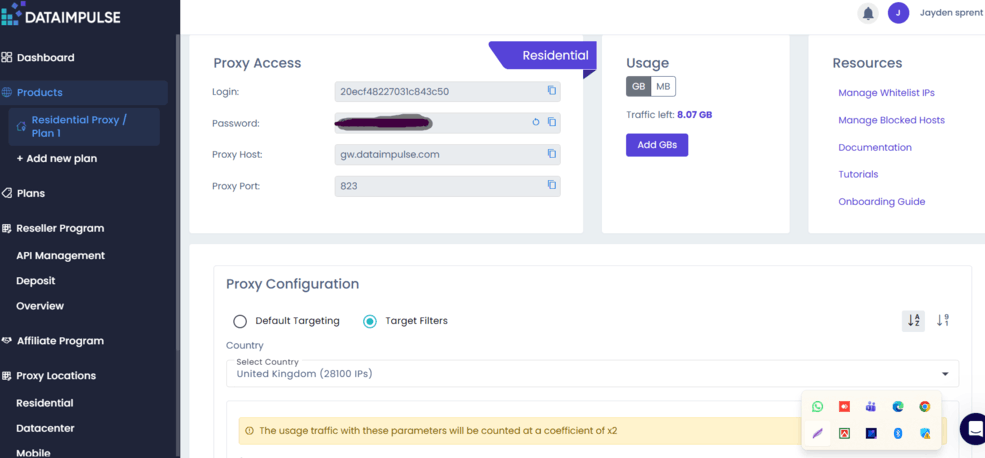
DataImpulse Dashboard

Success Rate: 99.90%
Advertised Pool: 90M IPs
Countries Coverage: 195
Average Response Time: 2.72s
Rotation: Every request, session up to 120 min
Geo-targeting: Country, state, City, ZIP code, or ASN level.
Pros:
Cons:
Pricing Plans | From $1/GB |
Minimum Purchase | $5 for 5GB |
Protocols | HTTP, HTTPS, SOCKS5 |
Traffic Validity | Never expires |
Support | 24/7, human livechat |
Payment Methods | Card payment, Cryptocurrency. |
I’ve reviewed 30+ residential proxy providers, and I’d recommend DataImpulse to almost anyone. It’s my go-to proxy company for web scraping and SEO monitoring.
DataImpulse residential proxies are one of our top picks for users looking for reliable performance at a relatively low cost. In our 1,000-request benchmark, DataImpulse completed 999 of 1,000 requests, achieving a 99.90% success rate with an average response time of 2.72 seconds.
According to DataImpulse, its residential proxy network includes 90M+ IPs across 195 countries, with support for rotating IPs and sticky sessions lasting up to 120 minutes. Pricing starts at around $1/GB for standard residential traffic. That is much cheaper than Bright Data or Oxylabs.
We have been using it with our anti-detect browsers, Adspower and Multilogin, to manage multiple social media accounts. It works smoothly without any issues.
Based on our testing, DataImpulse is best suited to web scraping, SEO monitoring, price tracking, market research, and other large-scale data collection tasks where reliability and cost matter more than premium scraping tools or advanced built-in automation features.
You can also watch my video review:
2. Proxy-Seller: Best for Multi-Social Media Accounts

Success Rate:
99.90%
Advertised Pool: 47M+
Countries Coverage: 220+
Average Response Time:
2.91 sec
Rotation: Sticky (up to 24h), every request, or custom time-based rotation (1 sec–60 min)
Geo-targeting: Country, state, City/ISP-level
Pros:
Cons:
Pricing Plans | From $3.50/GB |
Minimum Purchase | 1GB |
Protocols | HTTP, HTTPS, SOCKS5 |
Traffic Validity | 30 days on standard plans |
Support | 24/7, human livechat |
Payment Methods | PayPal, Card payment, USDT ( TRC-20), USDC(ERC20) all cryptocurrencies |
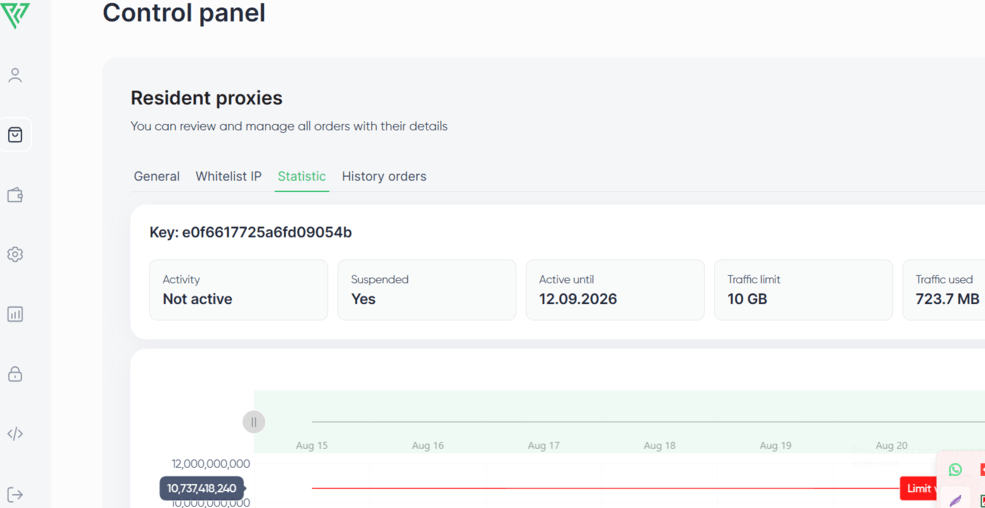
Proxy-Seller is one of the stronger residential proxy providers we tested, especially for users who need broad location coverage and flexible rotation options. I have been personally using it for multi-account management and mid-level web scraping tasks.
In our 1,000-request benchmark, Proxy-Seller completed 999 of 1,000 requests, for a 99.90% success rate and an average response time of 2.91 seconds. That reliability was excellent, but several providers in our tests delivered faster average speeds.
That doesn’t mean Proxy-Seller falls short. It offers 47M+ residential IPs across 220+ locations, supports sticky, per-request, and timed rotation, and provides detailed targeting by country, region, city/ISP.
For users who value location flexibility, rotation control, and reliable connections more than having the absolute fastest response time, Proxy-Seller can be a very good choice. Its residential proxy plans are reasonably priced, and you can pay using PayPal, cards, and several cryptocurrency options. What I like most is the Pay-As-You-Go model, which lets you start with a small amount of traffic instead of committing to a larger package upfront.
Based on our testing, Proxy-Seller is a strong choice for multi-social account management, web scraping, SEO monitoring, price tracking, market research, ad verification, and other data-collection tasks where connection reliability and precise location targeting matter more than having built-in scraping APIs or browser-based automation tools.
3. Oxylabs: Best for AI Agents and large-scale scraping
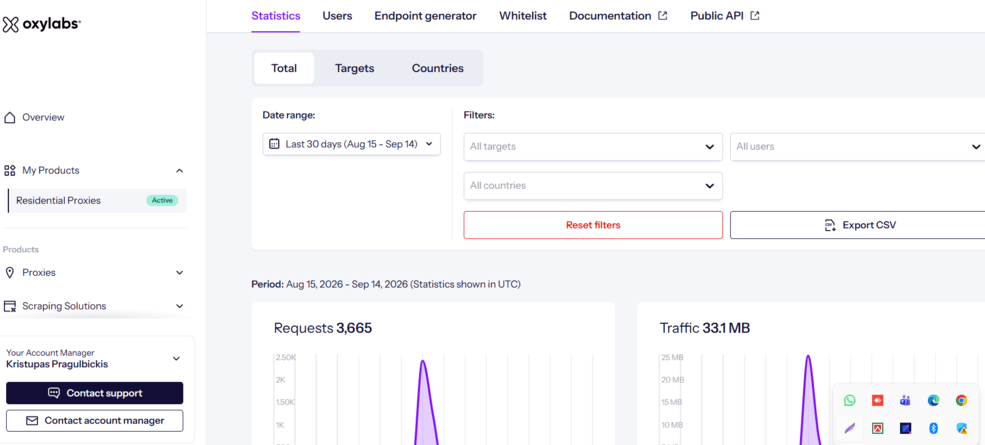
Oxylabs Dashboard

Success Rate: 99.20%
Advertised Pool: 175M+ IPs
Countries Coverage: 195+
Average Response Time: 2.68 sec
Rotation: Per-request rotation or sticky sessions up to 24 hours
Geo-targeting: Country, state, city, continent, ZIP code, coordinates, and ASN
Pros:
Cons:
Pricing Plans | From $6/GB |
Minimum Purchase | 5GB |
Protocols | HTTP, HTTPS, SOCKS5 |
Traffic Validity | 30 days on standard plans |
Support | 24/7, livechat |
Payment Methods | Card payment, PayPal, Google Pay, Apple Pay, AliPay |
Oxylabs is one of the best residential proxy providers for users who need large-scale IP coverage, precise geo-targeting, and strong automation support. In our 1,000-request benchmark, Oxylabs achieved a 99.20% success rate with an average response time of 2.68 seconds.
Oxylabs advertises 175M+ residential IPs across 195 countries, with per-request rotation, sticky sessions up to 24 hours, ZIP code and ASN targeting, and unlimited concurrent sessions.
What makes Oxylabs stand out is its support for AI-assisted proxy workflows and third-party integrations. Its Agent Skills can help AI agents generate proxy-based scraping code from plain-language instructions, while Residential Proxies integrate with tools such as Selenium, Puppeteer, Playwright, Scrapy, AdsPower, Multilogin, Shadowrocket, and SwitchyOmega.
Based on our testing, Oxylabs is best suited to large-scale web scraping, AI agents, browser automation, SEO monitoring, ad verification, price tracking, and enterprise data collection where reliability, location precision, and integration flexibility matter more than finding the cheapest residential proxy.
4. Decodo: Best for Mid-level Web Scraping and Ad Verification
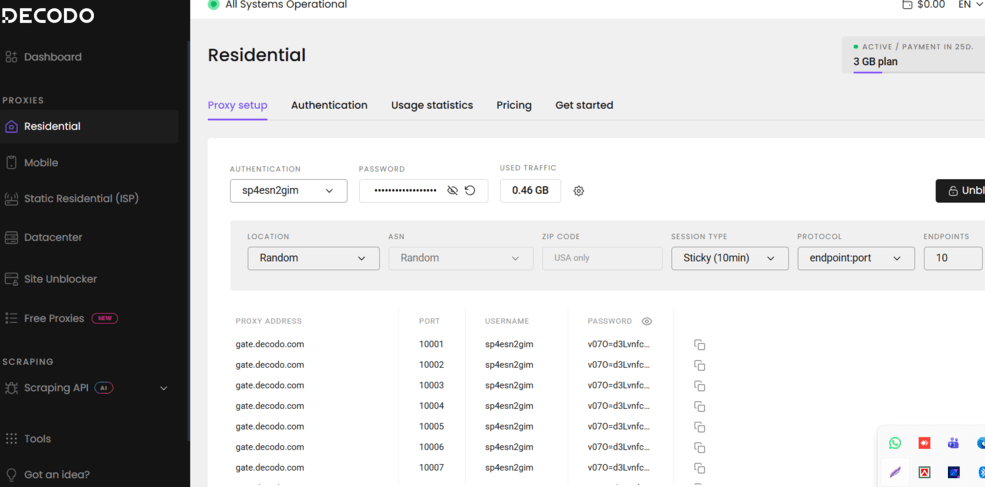
Decodo Dashboard

Success Rate: 99.90%
Advertised Pool: 115M+ IPs
Countries Coverage: 195+
Average Response Time: 2.12 seconds
Rotation: IP rotation sticky session 1min to up to 24 hours.
Geo-targeting: Continent, country, state, city, ZIP code, and ASN
Pros:
Cons:
Pricing Plans | From $3.75/GB |
Minimum Purchase | 3GB |
Protocols | HTTP, HTTPS, SOCKS5 |
Traffic Validity | 30 days |
Support | 24/7, AI assistant livechat |
Payment Methods | Card payment, PayPal, Google Pay, Apple Pay, Cryptocurrency, Bitcoin |
Decodo is easily the most popular enterprise proxy provider right now, and plenty of review websites rank it as the best.
I don't. Based on my own experience and thousands of requests we've tested, I think Decodo offers better value for mid-scale operations. In fact, Decodo delivers 99.90% success rates while costing roughly 60% less per GB than Oxylabs.
That doesn't mean Oxylabs isn't excellent. It has outstanding reliability, sub-1-second response times, and dedicated account management.
And depending on your budget, it can actually be the better choice. If you're running a large team with 500+ GB monthly usage and can't afford network downtime, for example, I'd absolutely recommend Oxylabs over Decodo.
While Oxylabs still edges it out on speed and enterprise support, Decodo gets almost everything else right. With 115M+ IPs across 195+ countries, 99.90% success rates, straightforward setup, and responsive support at fair pricing, Decodo is my top recommendation for growing teams that have outgrown budget proxies but aren't ready for enterprise prices.
5. Bright Data: Best for Enterprise-Level Web Data Scraping
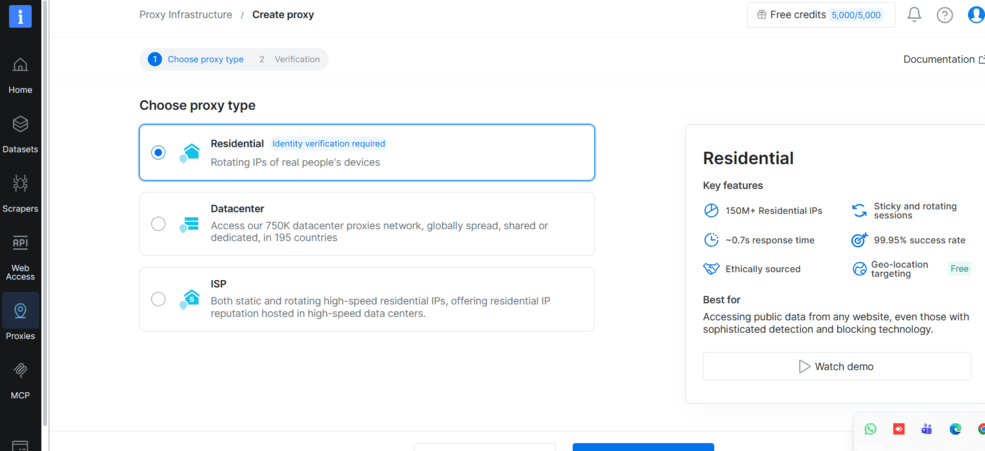
Bright data Dashboard

Success Rate: 99.80%
Advertised Pool: 400M+ IPs
Countries Coverage: 195+
Average Response Time: 3.19 sec
Rotation: IP rotation with sticky sessions up to 5 min.
Geo-targeting: Country, state, City, ZIP code, ASN/ISP level.
Pros:
Cons:
Pricing Plans | From $4/GB, $3/GB for 332 GB, $2.50/ GB for 798 GB |
Minimum Purchase | Any GB |
Protocols | HTTP, HTTPS, SOCKS5 |
Traffic Validity | Never expires on PAYG |
Support | 24/7, human livechat |
Payment Methods | Card payment, PayPal, Payoneer, Alipay, Google Pay, Apple Pay |
If you don’t have a budget problem but want a reliable residential proxy, then Bright Data is the number one choice. Bright Data has the largest IP pool; every month, you get up to 150M new, refreshed IPs. So, the chance of detection while web scraping is rare.
I have partially tested their residential proxy service using the Web Unblocker API and gained the success rate and average speed. However, we couldn’t overcome its KYC verification process. So, we couldn’t use it normally.
You can easily bypass Bright Data’s KYC verification if you have solid business information. Bright Data is best for businesses. Actually, it’s built more for serious scraping teams and enterprise users than beginners.
The platform is packed with advanced tools, including Proxy Manager, scraping APIs, Web Unlocker, and browser automation products. That makes Bright Data especially useful for large-scale web scraping, ad verification, market research, price monitoring, and AI data collection.
6. ProxyEmpire: Best for Unlimited Bandwidth Plans
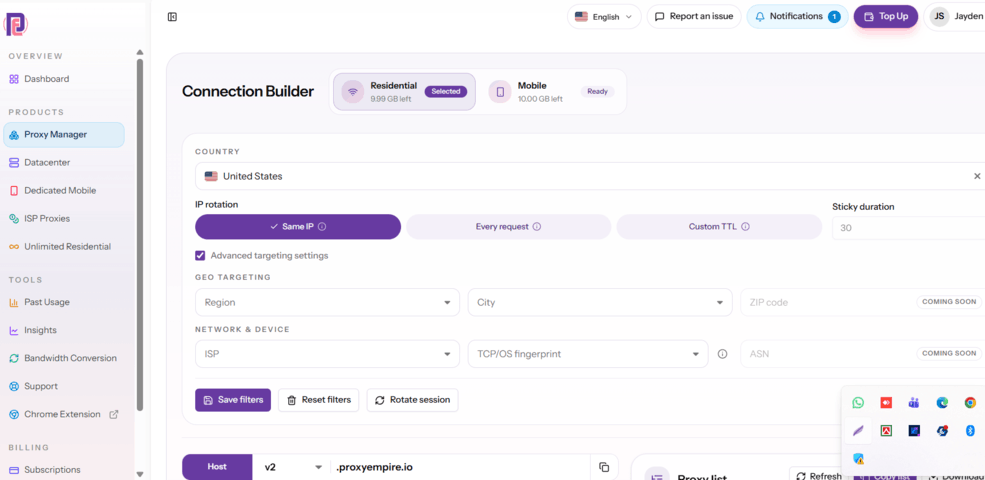
Proxyempire Dashboard

Success Rate: 99.90%
Advertised Pool: 30+ IPs
Countries Coverage: 170+
Average Response Time: 1.94 sec
Rotation: IP rotation, sticky sessions 90seconds up to 120 minutes
Geo-targeting: Country, state, City, ZIP code, or ASN level
Pros:
Cons:
Pricing Plans | $7/GB, $3.5/GB for 500 GB, $3/GB for 1TB |
Minimum Purchase | 1GB |
Protocols | HTTP, HTTPS, HTTP/2, and SOCKS5 |
Traffic Validity | Never expires |
Support | 24/7, real human live chat |
Payment Methods | PayPal, Card payment, Cryptocurrency. |
Proxyempire offers unlimited bandwidth plans. If you’re thinking about large-scale scraping but have a low budget for bandwidth, then it is a great option for you. They market less ip pool than big brands like Bright Data, but they provide clean IPs. Clean IPs are very important for strong online privacy and decreasing block rates.
ProxyEmpire also offers separate unlimited plans with no per-GB billing, although these plans use speed tiers and provide less precise country-level targeting.
The main drawback is price. Standard PAYG traffic costs $7/GB before discounts, and the unlimited plans are designed more for high-volume users than small projects.
Still, if you need fast residential proxies, flexible bandwidth options, or predictable costs for large-scale scraping and data collection, ProxyEmpire is one of the strongest options I’ve tested.
7. NodeMaven: Fast residential proxies with clean IPs
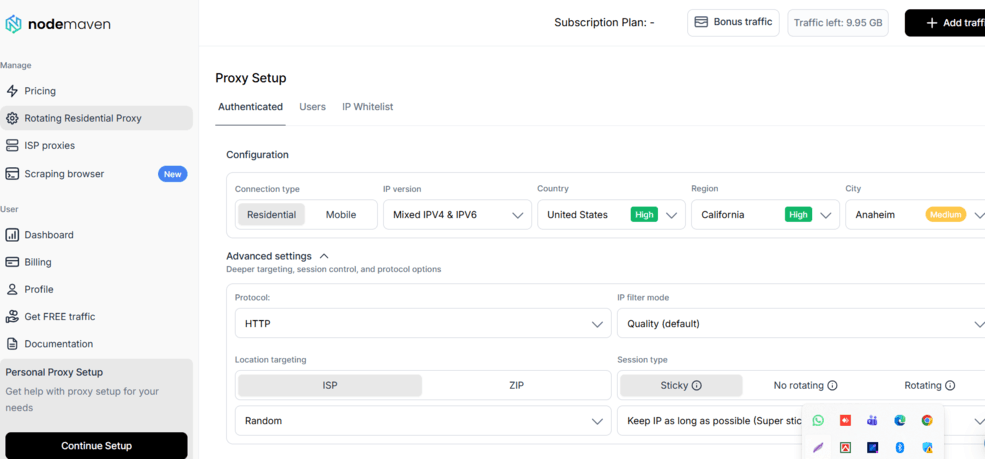
NodeMaven Dashboard
Success Rate: 99.90%
Advertised Pool: 30M+ IPs
Countries Coverage: 190+
Average Response Time: 1.92 sec
Rotation: IP rotation, super sticky sessions up to 24h
Geo-targeting: Continent, country, state, city, ZIP code, and ASN
Pros:
Cons:
Pricing Plans | From PAYG $5/GB, Monthly billing $4.25/GB |
Minimum Purchase | 2GB |
Protocols | HTTP & SOCKS5 |
Traffic Validity | Never expires |
Support | 24/7, AI assistant live chat, ticket-based support |
Payment Methods | Card payment, Cryptocurrency |
NodeMaven is one of the faster residential proxy providers I’ve tested, and its IP Quality Filter is the feature that stood out most to me.
In our 1,000-request benchmark, NodeMaven completed 999 requests successfully, giving it a 99.90% success rate with an average response time of 1.92 seconds. That made it both reliable and noticeably faster than several other residential proxy providers in our tests.
The dashboard is easy to use, and I like that NodeMaven supports Super Sticky sessions up to 24 hours, detailed targeting by country, state, city, ZIP code, and ISP, plus a built-in Scraping Browser for web automation and data collection.
The main drawback is price. Entry-level plans are relatively expensive, and the best per-GB rates only become attractive at higher volumes.
Still, if you need fast residential proxies, long sticky sessions, cleaner IP selection, and built-in scraping tools, NodeMaven is one of the stronger options I’ve tested for web scraping, SEO monitoring, account management, and location-sensitive data collection.
8. ProxyLane: Best for Browser Automation
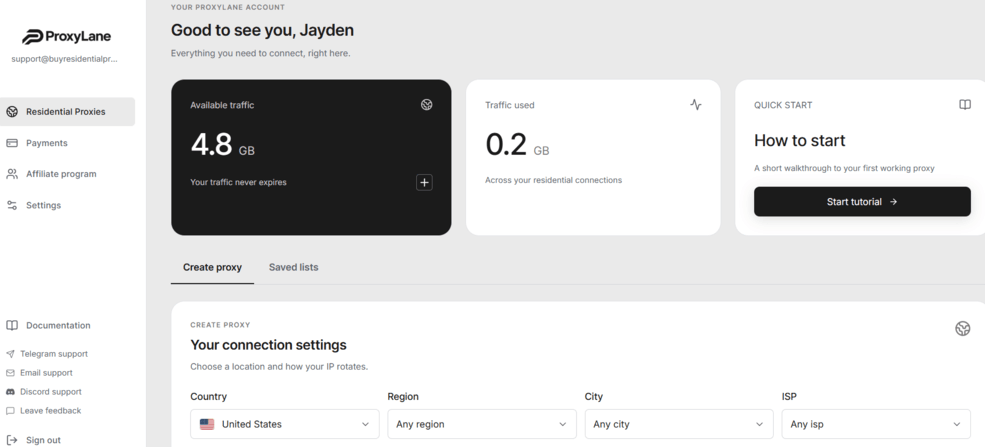
Proxylane Dashboard

Success Rate: 99.80%
Advertised Pool: 28M+IPs
Countries Coverage: 195+
Average Response Time: 2.10 seconds
Rotation: Per-request, sticky, or timed sessions up to 72 hours
Geo-targeting: Country, region, city, ZIP code, ISP, and ASN
Pros:
Cons:
Pricing Plans | $6.5/GB,$3.90/ GB for 100 GB, $2.5/GB for 500 GB, $2.50/GB for 1TB |
Minimum Purchase | 1GB |
Protocols | HTTP, HTTPS, and SOCKS5 |
Traffic Validity | Never expires |
Support | Telegram and email support. |
Payment Methods | Cards, PayPal, Cryptocurrency |
ProxyLane is one of my first recommendations for browser automation, especially if you need long, stable sessions and detailed location targeting.
In our testing, it achieved a 99.80% success rate with a 2.10-second average response time. I also found the dashboard simple to use, while features like ZIP, ISP, and ASN targeting make it practical for tools such as Selenium, Playwright, Puppeteer, AdsPower, and Multilogin.
The main downside is price, but if you need stable sessions, non-expiring traffic, and precise geo-targeting for long-running browser workflows, ProxyLane is a solid choice.
9. IPRoyal: Best for: Long sticky sessions and non-expiring traffic
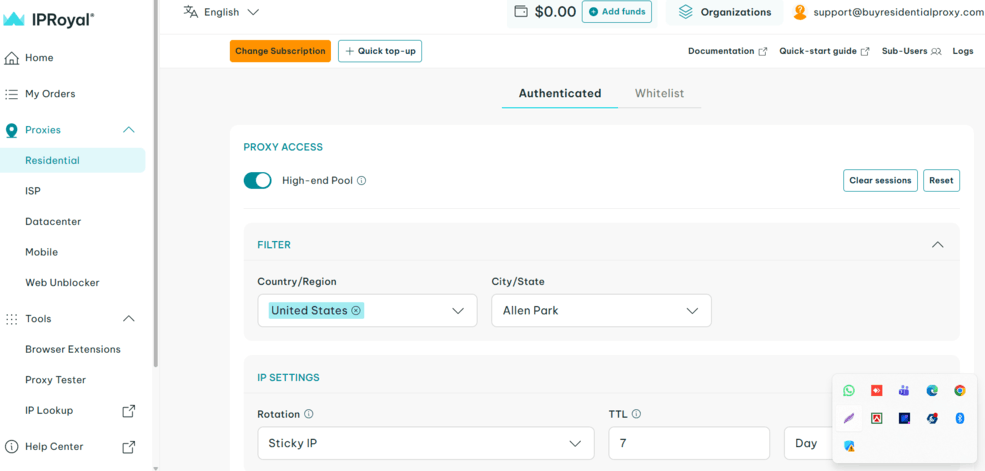
IPRoyal Dashboard

Success Rate: 99.90%
Advertised Pool: 64M+ IPs
Countries Coverage: 195+
Average Response Time: 2.33 seconds
Rotation: IP rotation, sticky sessions up to 7days
Geo-targeting: Country, state, City level
Pros:
Cons:
Pricing Plans | From PAYG $7.35/GB, Monthly billing $7/GB, $4.90/GB for 50GB,$3.71/GB for 500GB, $1.75/GB for 10kGB |
Minimum Purchase | 1GB |
Protocols | HTTP, HTTPS, and SOCKS5 |
Traffic Validity | Never expires |
Support | 24/7, Customer support |
Payment Methods | Card payment, PayPal, Google Pay, Alipay, Cryptocurrency |
IPRoyal performed well in our testing for users needing stable residential IPs. If you need sticky sessions up to 7 days for web scraping, ad verification, or market research, IPRoyal delivers solid performance.
Access to 64M residential IPs across 195+ countries with city-level geo-targeting. The 99.90% success rate and 2.33s average response time are reliable, and purchased traffic never expires. Pricing starts at $7.35/GB on PAYG or drops to $1.75/GB on annual plans.
However, there's no free trial, PAYG pricing is steep per GB, and sticky sessions depend on peer availability. The high-end IP pool also requires an active subscription, limiting flexibility for testing. I think it will best alternative to Decodo if you need long sticky sessions and fresh IPs. And if your budget is lower, then you should not use it.
10. Gsocks: Best for Budget Scraping Without KYC Verification
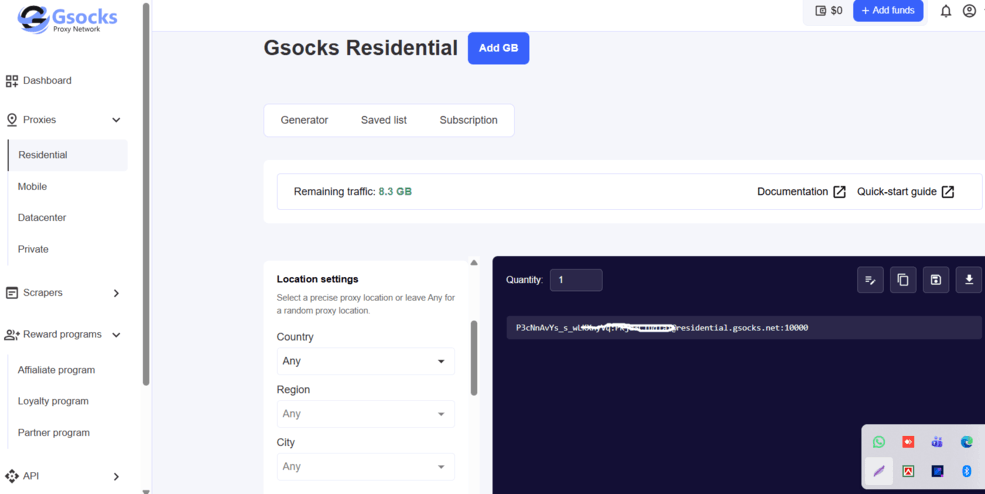
Gsocks Dashboard

Success Rate: 99.80%
Advertised Pool: 30M+ IPs
Countries Coverage: 190+
Average Response Time: 3.29 sec
Rotation: IP rotation with sticky sessions up to 24 hours
Geo-targeting: Country, state, and city
Pros:
Cons:
Pricing Plans | $4/GB |
Minimum Purchase | 1GB |
Protocols | HTTP & SOCKS5 |
Traffic Validity | Never expires |
Support | 24/7,AI assistant livechat |
Payment Methods | Card payment, PayPal, Cryptocurrency |
GSocks surprised me because it felt more reliable than fast.
In our 1,000-request test, 998 requests succeeded, giving it a 99.80% success rate, while the average response time came in at 3.29 seconds. That made it slower than some of the other residential proxy providers we tested, but the connection stability was consistently good.
The dashboard is simple, the proxy generator is easy to understand, and I like that you can start with a small PAYG purchase instead of committing to a large plan. GSocks also gives you access to 30M+ IPs across 190+ countries, with country, region, city, ISP, and rotation controls.
What stood out most to me was the non-expiring traffic. If your proxy usage is irregular, that is genuinely useful because you don’t feel pressured to use your bandwidth before a deadline.
The main downside is speed. At 3.29 seconds on average, GSocks was noticeably slower than several competitors in our testing. But if you care more about reliable connections, simple setup, and flexible PAYG usage than raw speed, GSocks is still a solid residential proxy option.
Residential Proxy Testing Methodology
To identify the best residential proxy providers, my team and I put each service through the same hands-on testing process.
We run our benchmarks in a consistent environment so success rates, response times, and reliability are fair and directly comparable.
We also keep provider-advertised claims separate from our own test results, and we never accept payment to influence a provider’s rating or position on this page.
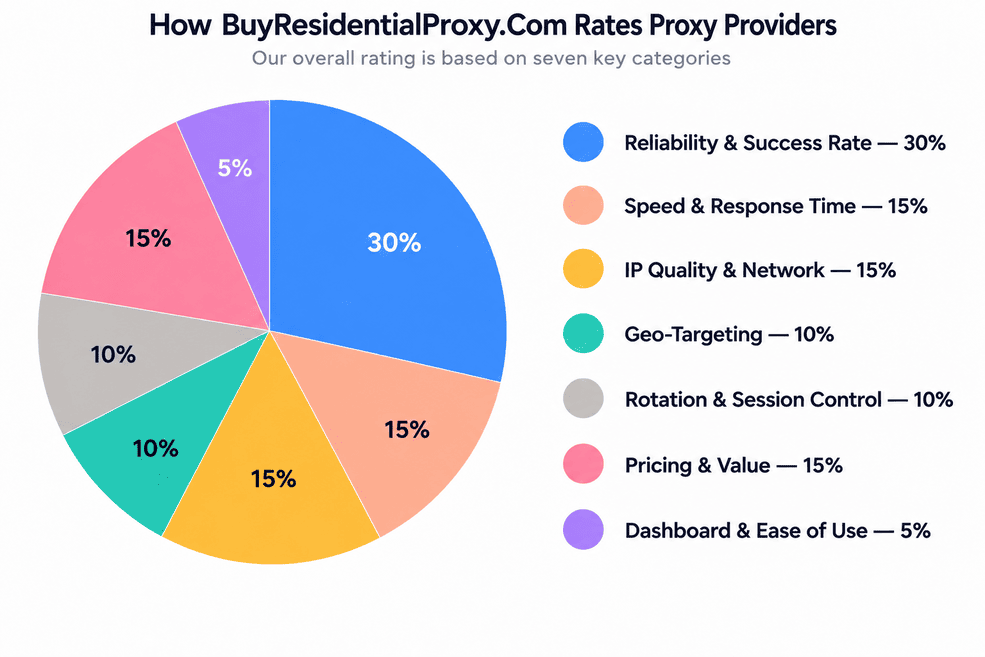
Our overall rating is based on seven key categories:
We measure how many requests are completed during our benchmark. Providers with consistently high success rates score better.
We measure average response time and consider connection consistency, not just the fastest individual request.
We evaluate residential IP quality, network size, connection stability, and how effectively the proxy network performs across different tasks.
We compare targeting options such as country, state, city, ZIP code, ISP, ASN, and coordinates.
We test rotating proxies, per-request rotation, timed rotation, and sticky session duration.
We compare PAYG pricing, subscription rates, volume discounts, traffic expiration, trials, and the overall price-to-performance ratio.
We evaluate account setup, proxy generation, authentication, documentation, browser extensions, integrations, and general usability.
How Much Do the Best Residential Proxies Cost?
Residential Proxy Cost Calculator
 Residential Proxy Cost Calculator
Residential proxy pricing is usually based on how much data/traffic you use. Most providers bill per GB. Some have monthly subscription plans or custom enterprise deals.
For smaller plans, expect about $3-$4 per GB; buying large volumes can bring that down to roughly $1.50-$3 per GB depending on the provider and amount purchased.
Monthly costs vary widely with usage: small monitoring projects might need $100-$300 per month, while large scraping or automation setups can easily exceed $1,000/month.
Pricing is affected by factors such as the size and quality of the IP pool, available geographic targeting, rotation controls, and infrastructure reliability. Higher-end providers charge more but usually deliver cleaner IPs and higher success rates.
FAQs: Residential Proxies
Residential proxies are expensive because they use real household IP addresses, which are harder to get and maintain. Their legitimacy also makes them more reliable for tasks where datacenter proxies are frequently blocked. Read more here.
Residential proxies are widely used for web scraping, price monitoring, SEO tracking, ad verification, market research, and testing how websites appear in different geographic regions.
Most residential proxy providers charge based on bandwidth, usually per gigabyte of traffic. Some services also offer monthly subscriptions, pay-as-you-go plans, or custom enterprise packages.
Large residential proxy providers often operate networks ranging from millions to over 100 million residential IPs, distributed across many countries and regions.
Yes. Most residential proxy services support automatic rotation, allowing requests to switch IP addresses periodically or on every request to reduce detection and blocking.
Look for residential proxy providers with a large and clean IP pool, flexible geo-targeting, strong uptime, transparent pricing, and good documentation or support for integration.
Final Thoughts: Choosing the Right Residential Proxy
Residential proxies can make a big difference when you're collecting data, running automation, or testing location-based content. But the “best” provider isn’t the same for everyone. What works well for large-scale scraping might not be the best choice for smaller research or monitoring tasks.
Instead of focusing only on brand names, think about how the proxy service fits your workflow. A reliable provider should give you stable connections, flexible targeting, and pricing that matches your expected usage.
The good news is that most residential proxy providers offer trials or small starter plans. Testing a service with your actual workload is often the fastest way to see whether it meets your needs before committing to a larger plan.