


- Best overall for price monitoring → Proxy Cheap
- Best price-to-performance for daily checks → Decodo
- Best for enterprise-scale intelligence → Oxylabs
- Best budget option with non-expiring traffic → DataImpulse
- Best for JS-heavy & protected retail sites → Bright Data
E-commerce sites now block datacenter proxies almost instantly. Residential proxies — IPs assigned to real devices by genuine ISPs — are the only reliable way to collect competitor pricing data at scale in 2026. This guide covers the top 8 providers ranked specifically for price monitoring workloads: rotating sessions, geo-precision, success rates, and true cost per GB.
| Provider | IP Pool | Starting Price | Best For | Session Type | Trial / Entry |
|---|---|---|---|---|---|
|
Cheap Our #1 Pick |
7M+ | Pay-as-you-go | Overall price monitoring | Rotating + sticky | Limited trial |
|
DataImpulse
Best Budget |
Large | $1/GB$0.70/GB bulk | Budget-to-scale | Rotating | $5 / 5 GB trial |
|
IPRoyal Flexible |
34M+ | $1.75/GB | Mid-scale, flexible | Rotating + static | Pay-as-you-go |
|
Oxylabs Enterprise |
175M+ | ~$6/GB | Enterprise scale | Rotating + sticky | 7-day free trial |
| NetNut ISP-direct |
40M+ | ~$99/Mo | ISP-stable sessions | Rotating + stickyup to 2 hours | Paid only28 GB minimum |
| Bright Data Full Ecosystem |
150M+ | ~$4/GB~$3.30/GB at 10TB | Data ecosystem + scrapers | Rotating + sticky | KYC required |
|
Decodo
Fastest Speed |
115M+ | ~$4/GB | Speed / price ratio | Rotating + stickyup to 30 min | 14-day refundCode: DECODO5 |
|
Webshare Free Tier |
80M+ | $1.40/GB1 GB/month free | Developers / testing | Rotating + static | 1 GB free foreverNo credit card needed |
Why residential proxies?
Anti-ban performance
Real ISP-assigned IPs blend with genuine shoppers — block rates drop dramatically vs datacenter IPs
Location-accurate pricing
Retailers show different prices by city or ZIP — residential geo-targeting surfaces the real local price
Rotating sessions
Each request arrives from a fresh IP — no session fingerprinting, no rate-limit accumulation
Top 8 residential proxies for Price Monitoring— 2026 providers reviewed
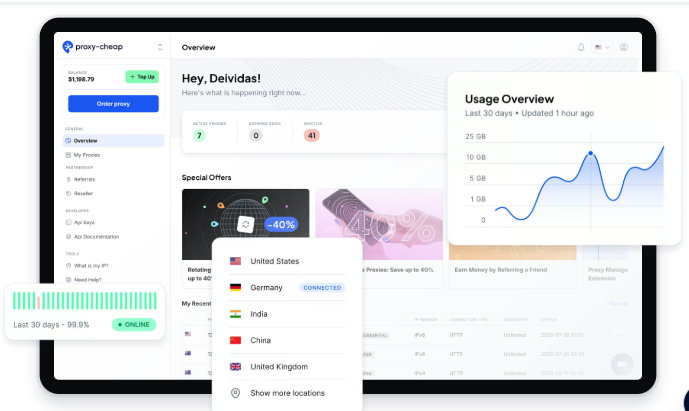
Proxy Cheap has become the most trusted and demanded residential proxy provider for price monitoring. Its pay-as-you-go model is a natural fit for price tracking — demand spikes before Black Friday, quiets in Q1 — so you never pay for bandwidth you don't use.
City-level geo-targeting surfaces real, local pricing across 195+ countries. Strong success rates on protected retail targets, rotating IPs per request, and 24/7 support round out a package built for production price intelligence. For more information, read our Proxy‑Cheap Review.
Pros:
Cons:
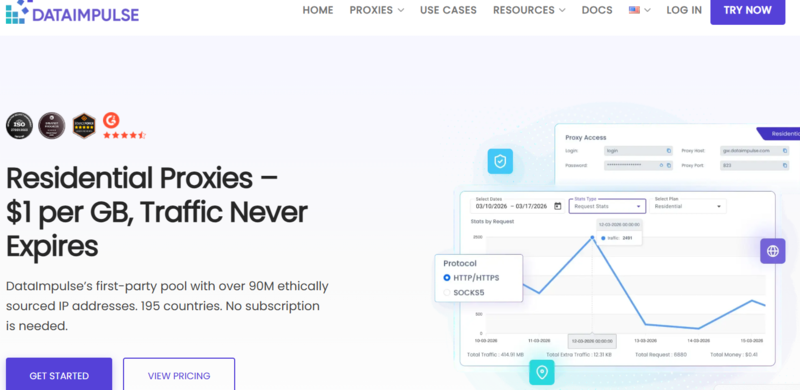
DataImpulse offers the most disruptive per-GB pricing in the market — $1/GB base, dropping to $0.70/GB at volume — and the traffic never expires. For operations that run in seasonal bursts (heavy pre-Black Friday, lighter otherwise), this means zero wasted spend.
Country-level targeting is included in the base price; advanced geo-options cost extra. Infrastructure is optimized for data collection workloads: product tracking, SERP monitoring, price checks at scale. For more information, read our DataImpulse Review.
Pros:
Cons:
IPRoyal hits the middle ground between budget and mid-market exceptionally well. The $1.75/GB residential price is one of the lowest among reliable providers, and the ZIP-code and ASN-level targeting is a standout feature — critical when a retailer delivers ZIP-specific pricing.
Static residential proxies are well-suited for platforms requiring session continuity. Unlimited bandwidth on datacenter proxies removes per-GB unpredictability for high-volume, lower-risk monitoring runs. For more information, read our IPRoyal Review.
Pros:
Cons:
Oxylabs controls the world's largest residential proxy pool at 175M+ IPs and explicitly positions its infrastructure for price monitoring use cases. Targeting precision reaches ZIP code and geographic coordinates — essential when retailers price dynamically by hyperlocal location.
At 99.95% success rate and 0.6-second average response times, Oxylabs is the benchmark for enterprise price intelligence. Unlimited concurrent sessions and dedicated account management complete the enterprise picture. For more information, read our Oxylabs Review.
Pros:
Cons:
NetNut sources IPs directly from ISPs rather than consumer devices — a structural advantage for scheduled price monitoring programs. Connection stability is higher because you're not dependent on a device staying online.
For monitoring runs that execute on fixed schedules (hourly, daily) across extended periods, fewer mid-session drops means cleaner price histories. The analytics dashboard is notably robust, simplifying operational management for ongoing monitoring programs. For more information, read our NetNut Review.
Pros:
Cons:
Bright Data is more than a proxy provider — it's a complete data collection ecosystem. The Web Unlocker handles CAPTCHAs and JavaScript challenges automatically; the Scraping Browser enables monitoring of JS-rendered price pages. 120+ pre-built scrapers for major retail sites give enterprise teams a head start.
Rated #1 on G2 in the Proxy Network category with 20,000+ business customers. The premium entry price drops substantially at scale — ~$3.30/GB at 10TB makes it competitive for very large operations. For more information, read our BrightData Review.
Pros:
Cons:

Decodo (the Smartproxy rebrand) earned the fastest response times in independent testing at 0.54 seconds and a 99.68% success rate — at pricing roughly 80% lower than Bright Data's residential rates. At 10TB scale, Decodo comes in 33% cheaper than Bright Data.
Sticky sessions up to 30 minutes handle personalization-sensitive monitoring. The 14-day money-back guarantee and 100MB free trial make it genuinely low-risk to test on your actual target sites before committing. For more information, read our Decodo Review.
Pros:
Cons:
Webshare is the only provider on this list with a genuine ongoing free tier — 10 proxies and 1GB per month at zero cost, no credit card required. For developers building price monitoring pipelines, this means real testing at zero risk.
Paid plans start at $1.40/GB, the lowest entry point among established providers. The combination of rotating and static residential proxies gives tactical flexibility, and 80M+ IPs ensures adequate diversity for most e-commerce targets. For more information, read our Webshare Review.
Pros:
Cons:
Final Verdict
For most price monitoring operations, Proxy Cheap is the most trusted and well-rounded choice — pay-as-you-go flexibility, strong residential IP quality, and city-level geo-targeting without enterprise pricing.
Choose DataImpulse to keep costs below $1/GB with non-expiring traffic. Pick Decodo for the best speed-to-price ratio with enterprise-caliber success rates. Go with Oxylabs or Bright Data when ZIP-level geo-precision and enterprise compliance are non-negotiable.
Start with Webshare's free tier to build and test your monitoring pipeline at zero cost — then scale to the provider that fits your operation.
Frequently asked questions
Yes. Collecting publicly available pricing data through residential proxies is a widely practiced, legitimate business activity. Review your target site's Terms of Service and choose providers with transparent acceptable use policies. Using proxies to collect public data is generally fine; using them for fraud or harassment is not.
Rotating IPs assign a fresh address per request — ideal for bulk price collection across many SKUs, preventing session-based fingerprinting. Sticky sessions hold the same IP for a period (15 minutes to hours) — necessary for platforms requiring login, cart simulation, or session continuity to surface real pricing. Most serious operations need both capabilities.
A baseline: monitoring 10,000 product prices once daily on standard e-commerce pages uses roughly 2–5 GB/month. Monitoring 100,000 SKUs with JS-heavy pages multiple times daily can reach 50–200+ GB/month. Start with pay-as-you-go to measure actual usage before committing to a subscription.
DataImpulse offers the lowest base rate at $1/GB with non-expiring traffic. Webshare provides the only ongoing free tier at 1GB/month. IPRoyal's paid residential plans start at $1.75/GB. The cheapest option shifts with volume — at 10TB scale, Decodo and Bright Data offer competitive bulk rates.
Yes. Amazon is one of the most aggressively protected targets and blocks datacenter IPs almost instantly. Residential proxies from providers like Proxy Cheap, Oxylabs, Bright Data, and Decodo achieve high success rates on Amazon by routing requests through genuine residential addresses. Use rotating sessions with randomized intervals for best results.
Residential proxies use IPs from real consumer devices enrolled in a proxy network. ISP proxies (static residential) are assigned directly by ISPs to proxy providers — they look residential to websites but offer more connection stability since they're not dependent on a consumer device staying online.
NetNut specializes in this model. For scheduled monitoring programs, ISP proxies offer a reliability advantage; for large-scale rotating price collection, standard residential IPs offer more diversity.