

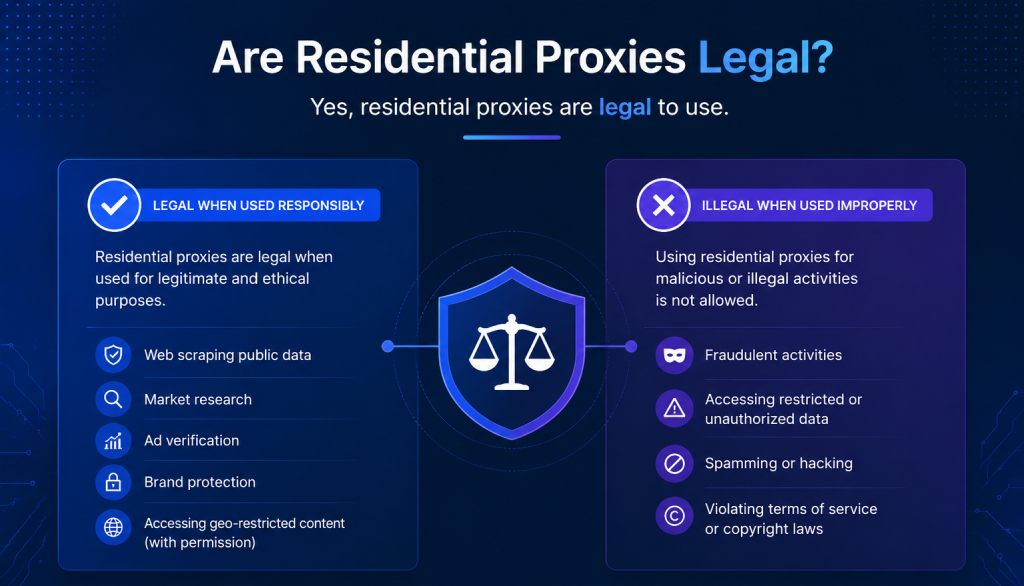
Yes — residential proxies are legal in most countries. Using a proxy to route your internet traffic through a different IP address is not inherently illegal anywhere in the world. What determines legality is not the proxy itself, but how you use it and what laws apply in your jurisdiction.
The legal line is crossed when proxies are used to commit fraud, violate computer access laws, breach platform Terms of Service in ways that constitute unlawful access, or infringe on data protection regulations.
Data Protection Laws That Apply to Proxy Use
| Regulation | Jurisdiction | Applies To |
|---|---|---|
| GDPR (Regulation 2016/679) | European Union | Personal data of EU residents, anywhere in the world |
| UK GDPR / Data Protection Act 2018 | United Kingdom | Personal data of UK residents |
| CCPA (Cal. Civ. Code § 1798.100) | California, USA | Personal data of California residents |
| PDPA 2012 | Singapore | Personal data of Singapore residents |
| Privacy Act 1988 (APPs) | Australia | Personal data of Australian residents |
| PIPL (2021) | China | Personal data of Chinese residents |
 You can be compliant with proxy laws in your country and still violate GDPR if you collect personal data about EU residents without a lawful basis — regardless of where you operate from.
What Makes a Proxy Legal or Illegal
The proxy is a tool. A hammer is not illegal — using it to break into a house is. The same logic applies to residential proxies.
Legal uses:
- Web scraping publicly accessible data for research or business intelligence
- Ad verification and brand protection monitoring
- Price comparison and market research
- Bypassing geo-restrictions for personal privacy
- Testing websites and applications across different regions
- Academic and journalistic research
- Protecting personal identity online
Illegal or legally risky uses:
- Accessing computer systems without authorization
- Scraping data protected by login walls or access controls
- Committing fraud, identity theft, or account takeover
- Circumventing security measures in violation of computer fraud laws
- Violating data protection regulations (GDPR, CCPA) by collecting personal data unlawfully
- Using proxies to conduct DDoS attacks or other cybercrimes
International Law: Jurisdiction by Jurisdiction
Proxy legality is determined at the national level. Here is how the major jurisdictions handle it.
Residential Proxy Laws by Country (2026)
| Country | Key Law | Code Reference | Proxy Legal Status |
|---|---|---|---|
 United States United States |
Computer Fraud and Abuse Act (CFAA) | 18 U.S.C. § 1030(a)(2), § 1030(a)(5) |  Legal for lawful use Legal for lawful use |
 United Kingdom United Kingdom |
Computer Misuse Act 1990 | CMA 1990, Section 1(1) | Legal for lawful use |
 European Union European Union |
Directive 2013/40/EU + GDPR | Article 3 (access); GDPR Article 6(1) | Legal — GDPR applies to data |
 China China |
Cybersecurity Law PRC 2017 | Article 12 — unauthorized access |  Restricted without approval Restricted without approval |
 Singapore Singapore |
Computer Misuse Act (Cap. 50A) + PDPA | CMA Section 3(1); PDPA 2012 | Legal for lawful use |
 Australia Australia |
Criminal Code Act 1995 + Privacy Act | Section 478.1; Privacy Act 1988 (APPs) | Legal for lawful use |
 Canada Canada |
Criminal Code (Part VI) + PIPEDA | R.S.C. 1985, c. C-46, s. 342.1 | Legal for lawful use |
 Germany Germany |
Strafgesetzbuch (StGB) + GDPR | StGB § 202a — Data Espionage | Legal — GDPR applies to data |
 India India |
Information Technology Act 2000 | IT Act, Section 66 — computer offences | Legal — evolving regulation |
 Brazil Brazil |
Marco Civil da Internet + LGPD | Law 12.965/2014; LGPD Law 13.709/2018 | Legal — LGPD applies to data |
 Important: "Legal for lawful use" means proxy use itself is not prohibited. What you do with the proxy — unauthorized access, fraud, unlawful data collection — determines criminal or regulatory liability in every jurisdiction.
United States
Key Law: Computer Fraud and Abuse Act (CFAA), 18 U.S.C. § 1030
The CFAA is the primary federal law governing computer access in the US. It criminalizes accessing a computer system "without authorization" or in a manner that "exceeds authorized access."
Using a residential proxy to browse the web, collect publicly available data, or verify ads is not a CFAA violation — there is no unauthorized access involved.
The legal risk arises when proxies are used to:
- Bypass authentication systems or access controls
- Scrape data from systems that have explicitly denied access (e.g., via robots.txt enforcement or cease-and-desist)
- Conduct fraud or identity theft
Key Case: hiQ Labs v. LinkedIn (9th Cir. 2022)The Ninth Circuit Court of Appeals ruled that scraping publicly available data does not violate the CFAA. LinkedIn's attempt to block hiQ from scraping public profile data was found to not constitute "unauthorized access" under the CFAA because the data was publicly accessible.
Additional relevant law: The Electronic Communications Privacy Act (ECPA), 18 U.S.C. § 2510, governs interception of communications. Proxy use for lawful routing does not implicate ECPA.
Code reference:
18 U.S.C. § 1030(a)(2): Prohibits intentional access to a computer without authorization
or exceeding authorized access to obtain information.
18 U.S.C. § 1030(a)(5): Prohibits knowingly causing damage to a protected computer
without authorization.
United Kingdom
Key Law: Computer Misuse Act 1990 (CMA)
The CMA has three main offences relevant to proxy use:
- Section 1: Unauthorized access to computer material
- Section 2: Unauthorized access with intent to commit further offences
- Section 3: Unauthorized acts with intent to impair computer operation
Using a residential proxy to access publicly available websites, collect open data, or protect personal privacy does not violate the CMA. The Act targets unauthorized access — not the use of IP-masking tools for lawful purposes.
Additional relevant law: The Data Protection Act 2018 and UK GDPR govern the collection and processing of personal data. Scraping personal data about UK residents without a lawful basis may violate these laws regardless of how the proxy is used.
Code reference:
Computer Misuse Act 1990, Section 1(1):
A person is guilty of an offence if he causes a computer to perform any function
with intent to secure access to any program or data held in any computer,
the access he intends to secure is unauthorized, and he knows at the time
when he causes the computer to perform the function that that is the case.
European Union
Key Laws: Directive on Attacks Against Information Systems (2013/40/EU), General Data Protection Regulation (GDPR — Regulation 2016/679)
The EU's cybercrime directive criminalizes illegal access to information systems, illegal system interference, and illegal data interference. Using a proxy for lawful purposes — including privacy, research, or business intelligence — does not fall under these provisions.
GDPR is the more significant legal consideration for proxy users in the EU. If your proxy-based data collection involves personal data of EU residents, GDPR applies regardless of where you are located.
Key GDPR obligations for proxy-based data collection:
- Must have a lawful basis for processing personal data (Article 6)
- Data minimization — collect only what is necessary (Article 5(1)(c))
- Purpose limitation — use data only for the stated purpose (Article 5(1)(b))
- Cannot collect special category data (health, race, religion) without explicit consent (Article 9)
Code reference:
Directive 2013/40/EU, Article 3 — Illegal access:
Member States shall take the necessary measures to ensure that,
when committed intentionally, access without right to the whole
or any part of an information system is punishable as a criminal offence.
GDPR Article 6(1) — Lawfulness of processing:
Processing shall be lawful only if and to the extent that at least
one of the following applies: (a) the data subject has given consent...
(f) processing is necessary for the purposes of the legitimate interests
pursued by the controller or by a third party...
China
Key Law: Cybersecurity Law of the People's Republic of China (2017), Network Security Law
China's legal framework is significantly more restrictive. The Cybersecurity Law requires internet users to use government-approved channels and service providers. Using unauthorized proxy services — especially to bypass the Great Firewall — is illegal for individuals and organizations operating in China.
Foreign businesses operating in China may face regulatory scrutiny for using unapproved proxy services, even for legitimate business purposes.
Code reference:
Cybersecurity Law of the PRC, Article 12:
No individual or organization shall use the internet to engage in activities
that endanger national security, national honor and national interests,
or use the internet to... engage in illegal and criminal activities.
Singapore
Key Law: Computer Misuse Act (Cap. 50A), Personal Data Protection Act 2012 (PDPA)
Singapore's Computer Misuse Act mirrors the UK model — it targets unauthorized access, not proxy use itself. Using residential proxies for lawful business operations, research, or privacy protection is not prohibited.
The PDPA governs the collection, use, and disclosure of personal data. Organizations using proxies to collect data about Singapore residents must comply with PDPA requirements including purpose limitation and consent obligations.
Code reference:
Computer Misuse Act (Cap. 50A), Section 3(1):
Subject to subsection (2), a person who knowingly causes a computer
to perform any function for the purpose of securing access without
authority to any program or data held in any computer shall be guilty of an offence.
Australia
Key Law: Criminal Code Act 1995 (Part 10.7 — Computer offences), Privacy Act 1988
Australia's computer offence laws target unauthorized access to computer data and systems. Using proxies for lawful purposes — data collection, privacy, research — does not constitute an offence under Part 10.7.
The Privacy Act 1988 and the Australian Privacy Principles (APPs) govern the handling of personal information. Organizations collecting personal data about Australians via proxy-based tools must comply with APP requirements.
Code reference:
Criminal Code Act 1995, Section 478.1:
A person commits an offence if the person causes any unauthorised access
to, or modification of, restricted data held in a computer.
Penalty: Imprisonment for 2 years.
The Terms of Service Question
Most platforms (Google, Instagram, LinkedIn, Amazon) prohibit the use of automated bots, scrapers, or proxy services in their Terms of Service (ToS). Violating a ToS is not automatically illegal — but it can become illegal in certain circumstances.
ToS violation alone: Civil matter. The platform can terminate your account, ban your IP range, or pursue civil damages for breach of contract.
ToS violation + unauthorized access: May become a criminal matter under computer fraud laws. If a platform has explicitly revoked access (via a cease-and-desist, IP block, or written notice) and you continue to access it through proxies, this may constitute unauthorized access under the CFAA (US), CMA (UK), or equivalent laws.
The key legal test: Did the platform explicitly deny you access? If yes and you circumvented that denial, the legal risk increases significantly. If no explicit denial exists and the data is publicly accessible, you are generally on solid legal ground.
Data Protection: The Layer Most Proxy Users Ignore
Using a residential proxy does not exempt you from data protection law. If your proxy-based activity involves collecting, processing, or storing personal data, data protection regulations apply based on where your data subjects are located — not where you are.
Practical implication: You can be compliant with proxy laws in your country and still violate GDPR if you are collecting personal data about EU residents without a lawful basis.
Ethical Considerations Beyond the Law
Legal and ethical are not always the same. Even where proxy use is lawful, consider:
Respecting robots.txt: The robots.txt file signals a website owner's preferences for automated access. Courts in some jurisdictions (notably the US, post-hiQ) have found that robots.txt alone does not legally bar access to public data — but ignoring it is considered poor practice and may affect legal standing.
Rate limiting: Sending excessive requests through proxies can degrade server performance. Even when data collection is lawful, causing measurable harm to a target system increases legal and civil liability.
Data minimization: Collect only what you need. Collecting personal data beyond your stated purpose increases regulatory risk under GDPR, CCPA, and equivalent laws.
Consent in P2P networks: Reputable residential proxy providers source IPs from device owners who have explicitly opted in. Using providers that source IPs without proper consent raises ethical concerns independent of legality.