

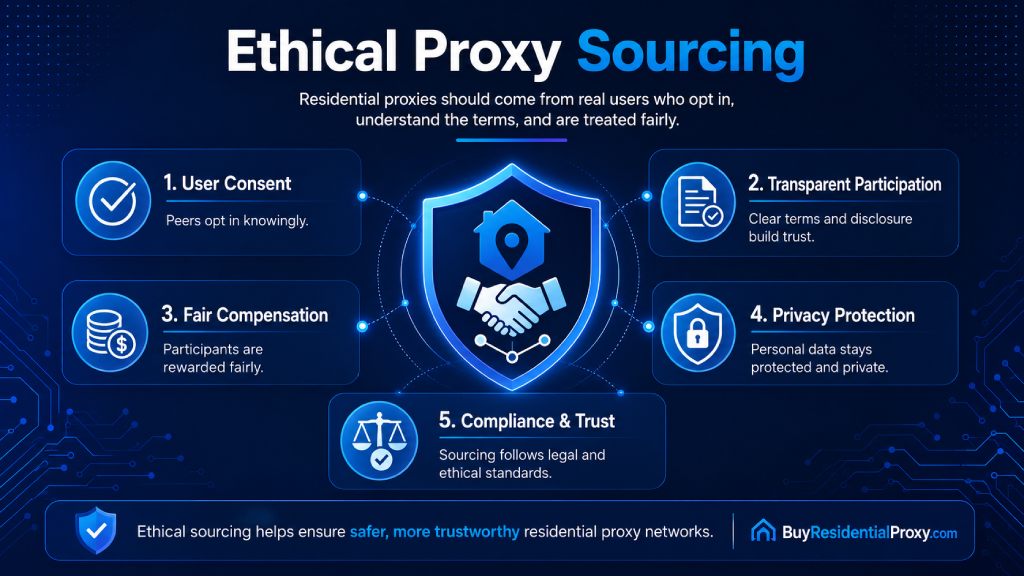
Ethical residential proxy sourcing means building proxy networks only from device owners who have given explicit, informed consent to share their bandwidth — with fair compensation, clear disclosure, and an easy opt-out. Unethical providers source IPs through malware, bundled software with buried consent, or opt-in-by-default installations that do not meet GDPR Article 7's standard for valid consent.
The ePrivacy Directive 2002/58/EC additionally requires consent before accessing terminal equipment — directly covering residential proxy device enrollment. For proxy buyers, using an ethically sourced network reduces the risk of using flagged or compromised IPs, avoids legal exposure under GDPR and CCPA, and delivers better long-term performance because ethically maintained IP pools are cleaner and more reliable.
Ethical vs Unethical Residential Proxy Sourcing: At a Glance
| Practice | Ethical Provider | Unethical Provider |
|---|---|---|
| Device Owner Consent | Explicit, informed opt-in | No consent or hidden in fine print |
| Disclosure | Clear terms explaining IP sharing | Buried or absent disclosure |
| Compensation | Device owners compensated fairly | No compensation to device owners |
| Data Collection | Minimal — traffic routing only | May log or inspect user traffic |
| Opt-Out |  Easy, immediate opt-out Easy, immediate opt-out |
✘ No opt-out mechanism |
| Legal Compliance | GDPR, CCPA, PDPA compliant | Ignores data protection law |
| Network Transparency | Published IP sourcing policy | No published policy |
| Third-Party Audits | Regular independent audits |
✘ No auditing |
| IP Harvesting Method | Legitimate opt-in programs only | Malware or bundled installs |
| Acceptable Use Policy | Published and enforced |
✘ No AUP |
 Choose a provider that publishes its IP sourcing policy, operates an explicit opt-in program, and maintains a publicly available Acceptable Use Policy.
Choose a provider that publishes its IP sourcing policy, operates an explicit opt-in program, and maintains a publicly available acceptable use policy.
What Is Ethical Residential Proxy Sourcing?
Ethical residential proxy sourcing means obtaining IP addresses only from real device owners who have given explicit, informed consent to share their internet connection — with fair compensation, transparent disclosure, and an immediate opt-out available at any time.
It is the single most important factor separating a legitimate residential proxy network from an exploitative one.
Most providers claim ethical sourcing. Few can prove it. The difference comes down to three questions:
- Does the device owner know their connection is being used as a proxy node?
- Did they agree to it — explicitly, not buried in a 40-page terms document?
- Do they benefit from it — through payment, credits, or equivalent value?
For reputable providers, the answer to all three is yes. For unethical providers, the answer is often no on all three counts.
Why Ethical Residential Proxy Sourcing Matters
Every IP in a residential proxy pool belongs to a real person's home internet connection — their laptop, phone, or router. That person's bandwidth is being used every time a request passes through their IP.
How that bandwidth is obtained determines whether the network is ethical or exploitative.
The consequences of using an unethical provider go beyond reputation:
- Legal liability under GDPR, CCPA, and computer misuse laws in the US and UK
- Compromised IPs — devices harvested without consent are flagged by security vendors, increasing your detection and ban rate
- Reputational exposure if your business is associated with a network built on unauthorized device access
- Account bans from platforms that have blocked IP ranges tied to known bad actors
Ethical sourcing is not a marketing checkbox. It is the foundation of a proxy network you can actually rely on.
The 5 Pillars of Ethical Residential Proxy Sourcing
1. Informed Consent — The Non-Negotiable Foundation
Ethical providers obtain IPs only from users who have explicitly opted in to a peer-to-peer bandwidth sharing program. This means:
- The user is told clearly what they are agreeing to — sharing their internet connection as a proxy node
- Consent is obtained before any bandwidth sharing begins — not buried in a later update
- The consent language is plain and specific — not hidden inside a 40-page general terms document
- Users can withdraw consent at any time, immediately removing their device from the pool
Under GDPR Article 7, consent must be specific, informed, unambiguous, and given by a clear affirmative action. Pre-ticked boxes and default-on settings are not valid.
GDPR Article 7(2):
If the data subject's consent is given in the context of a written declaration
which also concerns other matters, the request for consent shall be presented
in a manner which is clearly distinguishable from the other matters,
in an intelligible and easily accessible form, using clear and plain language.
GDPR Recital 32:
Consent should not be regarded as freely given if the data subject has
no genuine or free choice or is unable to refuse or withdraw consent
without detriment.
2. Fair Compensation
Device owners in ethical netw
orks receive something of genuine value in return for sharing their bandwidth — direct payment, service credits, free app features, or equivalent compensation.
This creates a transparent exchange: the device owner gives bandwidth, the provider gives value, and the proxy buyer gets a legitimate IP. Everyone in the chain has agreed and benefits.
Unethical networks extract bandwidth with no return to the device owner — or provide such minimal compensation that consent is effectively coerced by tying the IP-sharing agreement to a necessary app feature.
3. Traffic Transparency — No Inspection or Logging
Ethical proxy providers route traffic without inspecting its content. The provider's network sees the destination IP and the volume of data — not what is inside the requests or responses.
Providers that inspect, log, or monetize traffic content are violating the privacy of both the device owner (whose connection is being used) and the end user (whose traffic is being inspected).
GDPR Article 5(1)(c) — Data Minimisation:
Personal data shall be adequate, relevant and limited to what is necessary
in relation to the purposes for which they are processed.
GDPR Article 5(1)(f) — Integrity and Confidentiality:
Personal data shall be processed in a manner that ensures appropriate
security of the personal data, including protection against unauthorised
or unlawful processing.
4. Easy, Immediate Opt-Out
Device owners must be able to exit the network at any time. Ethical providers make this frictionless — a single toggle in an app, one account setting, or an uninstall that immediately removes the device from the proxy pool.
Providers that make opt-out difficult, delayed, or buried are operating exploitatively — regardless of whether the original consent was technically obtained.
Regulatory basis:
GDPR Article 17 — Right to Erasure:
The data subject shall have the right to obtain from the controller
the erasure of personal data concerning him or her without undue delay.
5. Published and Enforced Acceptable Use Policy
Ethical providers publish an Acceptable Use Policy (AUP) that prohibits illegal use of their network and actively enforce it. A legitimate AUP prohibits:
- Unauthorized access to computer systems
- Fraud and identity theft
- DDoS attacks and network abuse
- Spam and phishing campaigns
- Data collection in violation of GDPR, CCPA, or PDPA
- Any activity prohibited under CFAA (US), CMA (UK), or Directive 2013/40/EU (EU)
A provider without a published, enforced AUP is operating a network that enables harm — regardless of how the IPs were sourced.
How Unethical Providers Source Residential IPs
Understanding bad sourcing practices is the fastest way to identify providers to avoid:
Malware-based harvesting: Malicious software installed on devices without the owner's knowledge turns them into proxy nodes. The device owner has no idea their bandwidth is being used or sold.
Bundled software consent: A free app or browser extension buries IP-sharing in multi-page terms. The user agrees to the app — not specifically to becoming a proxy node. This is technically consent but does not meet GDPR's requirement for specific, informed, distinguishable consent.
Opt-in by default: The IP-sharing program is enabled by default during installation, with opt-out available but not clearly communicated. Under GDPR Article 7, consent requires a clear affirmative action — default-on settings are not valid.
No compensation model: The device owner gets nothing. The provider sells the IP. The device owner's bandwidth is the product, without their meaningful knowledge or benefit.
Regulatory Framework for Ethical Residential Proxy Sourcing
| Regulation | Requirement for Proxy Networks |
|---|---|
| GDPR Article 6 | Lawful basis required for processing personal data via proxy networks |
| GDPR Article 7 | Consent must be specific, informed, unambiguous, and freely given |
| GDPR Article 7(2) | Consent must be clearly distinguishable — not buried in general terms |
| GDPR Article 17 | Right to erasure — device owners can demand removal from the network |
| GDPR Recital 32 | Default-on and pre-ticked consent not valid — affirmative action required |
| GDPR Article 5(1)(c) | Data minimisation — routing only, no content inspection permitted |
| GDPR Article 5(1)(f) | Traffic must be processed with integrity and confidentiality |
| ePrivacy Directive 2002/58/EC | Consent required before accessing information stored on terminal equipment |
| CCPA § 1798.120 | California residents have right to opt out of sale of personal data |
| PDPA 2012 (Singapore) | Consent required before collecting, using or disclosing personal data |
| Computer Misuse Act 1990 (UK) | Accessing a device without authorization is a criminal offence |
| CFAA 18 U.S.C. § 1030 (US) | Unauthorized access to devices to harvest IPs may be a federal crime |
 Providers sourcing IPs without proper consent may violate GDPR, CCPA, ePrivacy Directive, UK CMA, and US CFAA simultaneously — across multiple jurisdictions at once.
Ethical Proxy Sourcing — FAQ
Straight answers on consent, compliance, and what separates legitimate providers from exploitative ones.
Ethical proxy sourcing means obtaining IP addresses only from device owners who have given explicit, informed consent to share their internet connection — with fair compensation, clear disclosure, and an easy opt-out. The device owner knows their bandwidth is being used, agrees to it, and receives something in return. Every step of that exchange is transparent and compliant with data protection law.
Ethical providers run opt-in programs — typically through apps or browser extensions — where users explicitly agree to share their bandwidth in exchange for compensation, free features, or service credits. The consent is obtained before any bandwidth sharing begins, clearly explained in plain language, and can be withdrawn at any time. The provider publishes a sourcing policy describing this process publicly.
Ethical sourcing requires explicit consent, fair compensation, and an easy opt-out for every device owner in the network. Unethical sourcing harvests IPs without the device owner's knowledge — through malware, bundled software with buried consent, or opt-in-by-default installations. The device owner's bandwidth is used and sold with no benefit to them and often without their awareness.
Yes — in most jurisdictions. Accessing a device to harvest its IP without authorization may violate the Computer Fraud and Abuse Act (18 U.S.C. § 1030) in the US, the Computer Misuse Act 1990 in the UK, and equivalent computer access laws across the EU, Singapore, and Australia. Additionally, processing personal data without proper consent violates GDPR Article 7, CCPA, and the ePrivacy Directive 2002/58/EC, which specifically requires consent before accessing terminal equipment.
Yes. GDPR applies to residential proxy networks in two ways. First, if the network includes device owners who are EU residents, the provider must have a valid lawful basis for processing their data under GDPR Article 6, and that consent must meet the standard of GDPR Article 7 — specific, informed, unambiguous, and freely given. Second, the ePrivacy Directive 2002/58/EC requires consent before accessing information stored on terminal equipment, which includes using someone's device as a proxy node.
The ePrivacy Directive (2002/58/EC) is an EU law that requires explicit consent before storing information on — or accessing information from — a user's terminal equipment (phone, laptop, router). Using someone's device as a proxy node falls squarely under this definition. This means proxy providers sourcing IPs from EU-based devices must obtain ePrivacy-compliant consent, separate from and in addition to any GDPR consent. Most existing proxy consent frameworks do not meet this standard.
No — not under GDPR. GDPR Article 7(2) requires that consent be clearly distinguishable from other matters when included in a broader declaration. GDPR Recital 32 states that consent must be given by a clear affirmative action — silence, pre-ticked boxes, and inactivity do not constitute valid consent. Burying IP-sharing terms in a general app ToS without specific, prominent disclosure does not meet this standard and exposes the provider to regulatory enforcement.
Using an unethical provider has practical consequences beyond the ethical concern. IPs sourced through malware or without consent are more likely to appear on security blacklists — because compromised devices are often flagged by security vendors. Your operations run through these IPs carry higher detection risk. Additionally, knowingly using a network built on unauthorized device access may create legal exposure for buyers under computer misuse and data protection laws in some jurisdictions.
Ask six questions: How do you source your residential IPs? Do device owners know their connection is being used? What do device owners receive in exchange? Do you have a published Acceptable Use Policy? Have you been independently audited for consent and data handling practices? How does a device owner opt out? A legitimate provider can answer all six clearly and quickly. Vague or unavailable answers to any of these are a significant red flag.
An Acceptable Use Policy (AUP) is a published document that defines what the proxy network may and may not be used for. An ethical provider's AUP prohibits illegal activities — unauthorized access, fraud, DDoS attacks, spam, personal data collection without consent — and actively enforces these terms by terminating accounts that violate them. Without a published and enforced AUP, the provider has no mechanism to prevent their network from being used for harmful purposes, making ethical claims hollow.
Leading providers undergo independent third-party audits of their consent practices, data handling, and network operations. These audits verify that the provider's stated policies match their actual operations — that device owners are genuinely consenting, that traffic is not being inspected, and that the AUP is being enforced. Audit results or certifications should be available on request. A provider that has never been audited and cannot provide any independent verification of their sourcing claims is a higher-risk choice.
Final Verdict
Ethical proxy sourcing is not a marketing checkbox — it is the foundation of a legitimate residential proxy network.
For proxy providers, it means building a device owner program based on informed consent, fair compensation, traffic transparency, and enforceable acceptable use policies.
For proxy buyers, it means choosing providers that can demonstrate how their IPs are sourced — not just claiming legitimacy but providing verifiable evidence through published policies, audit results, and clear consent documentation.
The proxy industry has a consent problem. The providers solving it openly are the ones worth working with.