

 Quick Answer
A backconnect proxy is a gateway server that automatically routes each of your requests through a different IP address from a large pool of proxies. You connect to one endpoint — for example gate.smartproxy.com:7000 — and the backconnect server handles all IP rotation behind the scenes. Instead of managing thousands of individual proxy IPs yourself, you use one connection string, and the provider does the rest. Every major residential proxy provider in 2026 — including Bright Data, Oxylabs, Decodo, and IPRoyal — runs on a backconnect architecture.
What Is a Backconnect Proxy?
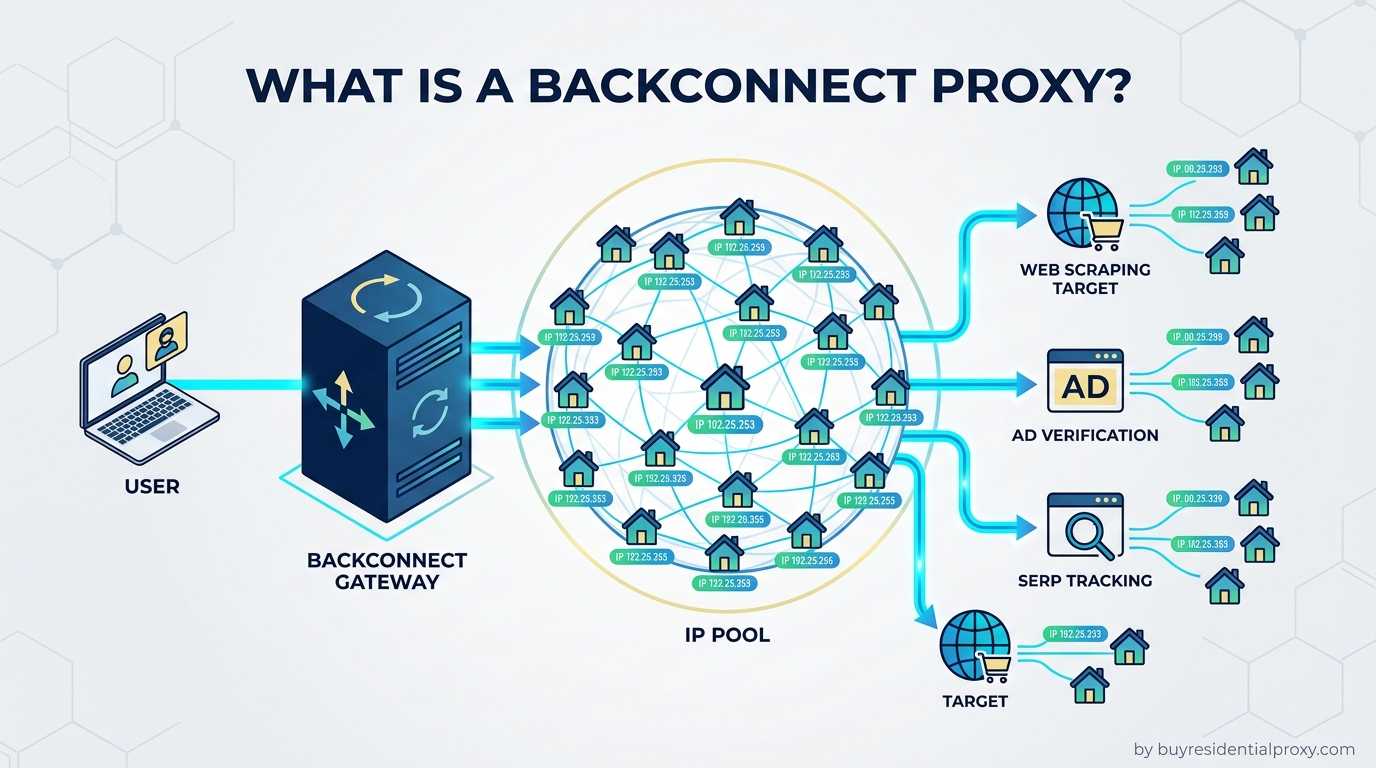
A backconnect proxy is a gateway-based proxy architecture where you connect to a single server, and that server routes each request through a different IP address from a large backend pool. The user-facing connection is a single, stable endpoint. The actual outbound IPs change automatically, request by request — controlled entirely by the provider's infrastructure.
The name "backconnect" comes from the back-end connections being managed by the proxy infrastructure rather than the user. You send traffic forward to the gateway; the gateway sends traffic back through a rotating set of exit nodes. Hence: backconnect.
This architecture is now the default for every major residential and mobile proxy provider in 2026. According to public provider documentation, the backconnect pools at the largest networks now exceed 175 million IPs (Oxylabs) and 150 million IPs (Bright Data) — orders of magnitude bigger than what any user could manage manually.
How a Backconnect Proxy Works
The backconnect architecture sits between your application and the destination website. Here's the exact flow:
 The Backconnect Gateway Flow
 Your Script
curl, python, scraper
Your Script
curl, python, scraper
 Backconnect Gateway
gate.provider.com:7000
Backconnect Gateway
gate.provider.com:7000
 Target Website
amazon.com
Target Website
amazon.com
The full lifecycle of a single request:
- Your application sends a request to the gateway address (e.g.
gate.decodo.com:7000). - The gateway authenticates you using your username and password.
- The gateway selects a backend IP from the pool based on your rotation rules (rotating per request or sticky for a session).
- The request is forwarded through that backend IP to the target website.
- The target site responds to the backend IP, which relays the response back to you through the gateway.
- On your next request, the gateway repeats the process — with a different backend IP if you're in rotating mode, or the same one if you're in sticky session mode.
 The Gateway Principle
The gateway IP itself is never used as your exit. It's the entry point for your traffic and the exit point for the response. Target sites only ever see the rotating backend IPs — never the gateway. That separation is what makes backconnect proxies invisible at scale.
Backconnect vs Regular Proxy: What's the Difference?
A regular (static) proxy gives you one IP address that you connect through every time. A backconnect proxy gives you one gateway address that automatically swaps a different IP for each request. The user experience and the infrastructure are completely different:
| Feature | Regular Proxy | Backconnect Proxy |
|---|---|---|
| Endpoint | One IP : Port (e.g. 198.51.100.7:8080) |
One gateway hostname (e.g. gate.provider.com:7000) |
| Outbound IP | Same IP every time | Different IP per request (or per session) |
| Rotation Logic | You implement it in code | Provider handles it server-side |
| Configuration | One config per IP | One config, infinite IPs |
| Pool Size | 1 IP | Thousands to 175M+ |
| Best For | Account whitelisting, stable sessions | Scraping, rotation at scale |
Is a Backconnect Proxy the Same as a Rotating Proxy?
The terms are used interchangeably, but they describe two different aspects of the same system:
- "Backconnect" refers to the architecture — the gateway server managing connections to a backend pool.
- "Rotating" refers to the behavior — IPs changing automatically per request or per session.
A rotating proxy is delivered through a backconnect gateway. You can't have one without the other in modern infrastructure. When a provider markets a "rotating residential proxy " what they're actually selling is access to a backconnect gateway operating in rotating mode. The same gateway also supports sticky session mode, which holds an IP for 1–30 minutes before rotating again.
 The simple way to remember
Backconnect = the system. Rotating = the behavior. The same gateway can run in rotating mode or sticky session mode — your choice, via a parameter in your connection string.
When to Use a Backconnect Proxy
Backconnect proxies are the right choice for any workflow involving IP rotation at scale. Six common scenarios:

Web Scraping
Send thousands of requests across thousands of IPs from a single gateway connection. No manual rotation needed.

SEO Rank Tracking
Check Google rankings from different cities and countries without managing a list of proxies for each location.

Price Intelligence
Collect competitor pricing across regions on travel, e-commerce, and fintech sites — rotating IPs avoid rate limits.

Ad Verification
Verify global ad campaigns by routing through residential IPs in target markets, with automatic rotation between markets.

Sneaker & Ticket Bots
Drop-day automation that needs fresh IPs per attempt — backconnect gateways deliver thousands of attempts per minute.

Brand Protection
Monitor counterfeit listings and unauthorized resellers across regional marketplaces without revealing your true IP.
 Backconnect's core promise
You write code once. You point it at one gateway. The provider's infrastructure handles rotation, geolocation filtering, pool management, and IP health — automatically — at any scale your plan allows.
Backconnect Proxy Providers by Pool Size (2026)
Pool size matters because it determines how rare each IP is and how well it can avoid detection. The largest backconnect pools in the industry as of 2026:
Larger pools generally mean lower abuse-per-IP rates, better detection avoidance, and broader geographic coverage. However, pool quality — real consumer ISPs versus flagged datacenter ASNs — matters more than raw count. A 30M pool of clean ISP IPs outperforms a 200M pool of recycled flagged IPs.
Related Reading
Frequently Asked Questions
What is a backconnect proxy in simple terms?
A backconnect proxy is a gateway server that automatically routes each of your requests through a different IP address from a large pool of proxies. You connect to one endpoint, and the backconnect server handles all the IP rotation behind the scenes. Instead of managing a list of thousands of proxy IPs yourself, you use one connection string and the provider does the rest.
How is a backconnect proxy different from a regular proxy?
A regular proxy gives you one fixed IP address that you connect through every time. A backconnect proxy gives you one gateway address that automatically swaps in a different backend IP for each request. Regular proxies require manual rotation logic in your code; backconnect proxies do all rotation server-side. Every major residential proxy provider in 2026 — including Bright Data, Oxylabs, Decodo, and IPRoyal — uses a backconnect architecture.
Is a backconnect proxy the same as a rotating proxy?
The terms are used interchangeably, but they describe two sides of the same system. Backconnect refers to the architecture (the gateway server managing connections to a pool). Rotating refers to the behavior (IPs changing per request or per session). A rotating proxy is delivered via a backconnect gateway. In practice, when someone says "rotating proxy" in 2026, they mean a backconnect proxy in rotating mode.
What is the gateway IP in a backconnect proxy?
The gateway IP is the single, stable endpoint your application connects to (for example gate.decodo.com:7000 or pr.oxylabs.io:7777). All your requests go to the gateway first. The gateway then assigns a different backend IP from its pool to each outgoing request. Target websites only see the backend IPs, never the gateway. You point your script at the gateway once and the provider handles the rest.
When should I use a backconnect proxy?
Use a backconnect proxy for any workload that needs IP rotation at scale: web scraping, SEO rank tracking, price intelligence, ad verification, sneaker copping, social media management, and any task where sending too many requests from one IP would trigger rate limits or blocks. Backconnect proxies replace the need to maintain and rotate a static list of individual proxy IPs.
Can a backconnect proxy keep the same IP for multiple requests?
Yes. Most backconnect gateways support sticky sessions — a mode that holds the same backend IP for a configurable window, typically 1 to 30 minutes. This is essential for workflows like logins and checkouts where the website expects the user to stay on the same IP. You toggle the mode by adding a session ID parameter to your username string.
How big is a typical backconnect proxy pool?
Major providers in 2026 maintain backconnect pools ranging from 30 million to 175 million residential IPs. Oxylabs operates 175M+, Bright Data 150M+, Decodo 125M+, Webshare 80M+, IPRoyal 32M+. Larger pools generally mean lower per-IP request rates and better detection avoidance, but pool quality (real consumer ISPs vs flagged ASNs) matters more than raw size.
Are backconnect proxies legal?
Yes. Backconnect proxies are completely legal in most jurisdictions. They're a network infrastructure tool used by ad verification companies, SEO platforms, cybersecurity researchers, and Fortune 500 brand protection teams. Legality depends on how you use them — scraping publicly available data is generally lawful, but using proxies to violate a site's terms of service, commit fraud, or attack accounts is not. Always check local laws and the target site's terms.
Key Takeaways
- A backconnect proxy is a gateway server that automatically routes your requests through a large pool of rotating IP addresses.
- You connect to one stable gateway endpoint (like
gate.provider.com:7000), and the provider's infrastructure handles all IP rotation server-side. - Backconnect = architecture. Rotating = behavior. The terms are used interchangeably but describe different aspects of the same system.
- Every major residential proxy provider in 2026 — Bright Data (150M+), Oxylabs (175M+), Decodo (125M+), Webshare (80M+), IPRoyal (32M+) — operates on backconnect.
- Best for web scraping, SEO tracking, price intelligence, ad verification, sneaker bots, and brand protection — any workflow needing rotation at scale.
- Backconnect gateways also support sticky sessions — same IP held for 1–30 minutes — for logins, checkouts, and multi-step flows.
This page contains affiliate links — we may earn a commission if you buy through them, at no extra cost to you.