


What is a Static Residential Proxy?
A static residential proxy is an IP address that:
- Is assigned by a real Internet Service Provider (Comcast, AT&T, Spectrum, BT, Lumen, etc.) — so websites see it as a normal home connection.
- Does not rotate. You keep the same IP for hours, days, weeks, or for the duration of your subscription.
- Is hosted on datacenter infrastructure, which means it's much faster than a peer-to-peer residential IP (sub-second response times instead of 3–5 seconds).
This is why most providers use “static residential proxy” and “ISP proxy” interchangeably — they're the same technology.
static residential = the trust of a residential IP + the speed and stability of a datacenter. That's why they're the go-to choice for account management, sneaker bots, ad verification, and any task that needs a stable identity.
When Should You Use a Static Residential Proxy?
You should use a static residential proxy instead of a rotating one when consistency matters more than scale.
Best situations:
- One account, one IP. This is the gold-standard setup for managing Reddit, Facebook, Instagram, eBay, Amazon Seller, or any platform that links accounts to IPs.
- Long logged-in sessions where you don't want the IP “jumping” mid-session and triggering security checks.
- Sneaker bots and drop monitoring (Nike SNKRS, Footlocker, Shopify drops).
- Ad verification — you want the same IP to keep visiting a campaign URL and reporting consistently.
- eCommerce account management and competitor monitoring where logins must be stable.
- SEO rank-tracking from a fixed location where you want results that match what a real user in that city would see.
Why it's safer: Sites trust consistent behavior. A stable IP + stable device fingerprint usually triggers fewer checks than constant IP switching.
When NOT to Use a Static Residential Proxy
Don't reach for static residential if your job needs scale or IP diversity. In those cases, rotating residential is better:
- High-volume public data scraping (millions of requests)
- Multi-account farms where you actually want each request to come from a different IP
- Price aggregation across hundreds of geos
- SERP scraping at scale
For those use cases, see our best residential proxies list.
7 Best Static Residential Proxy Providers in 2026 (In-Depth)
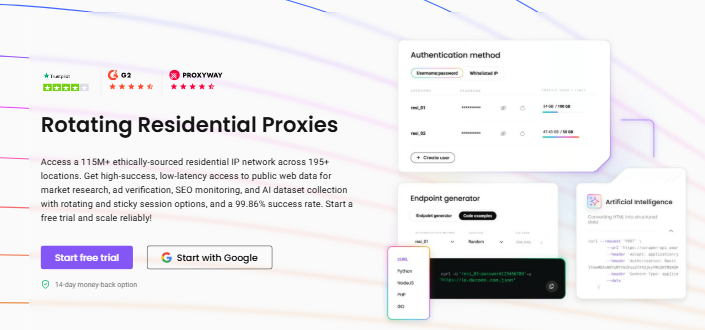
Decodo (formerly Smartproxy) is, in my testing, the most well-rounded static residential provider in 2026. Their static residential (ISP) product is priced from $0.27/IP at bulk volume (down from $3.33/IP at entry) — a structure that scales cleanly whether you're buying 5 IPs or 500.
What separates Decodo from cheaper options is infrastructure quality: sub-0.2s average response time, 99.99% uptime, 99.86% success rate, and ISPs sourced from premium tier-1 networks. They're also one of the few providers offering both pay-per-IP and pay-per-GB billing on static residential, so you can pick the model that matches your workload.
The dashboard is clean, integration with Python/Selenium/Puppeteer/Playwright takes minutes, and they offer a 14-day money-back guarantee (plus a 3-day free trial on residential). For a more detailed look at the rotating product, see our Decodo residential proxy review.
- Static residential (ISP): from $0.27/IP at bulk, $3.33/IP at entry
- 15 countries available for ISP proxies
- Pay-per-IP or pay-per-GB
- 14-day money-back guarantee
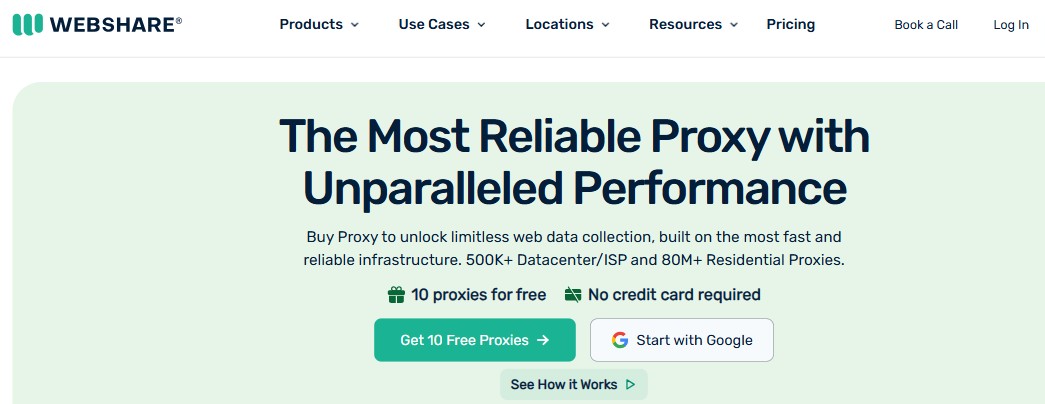
If you're testing the waters or running a small project, Webshare has the lowest entry price in the entire industry. Shared static residential IPs start at $0.23/IP, private static at $0.53/IP, and dedicated static at $1.47/IP — a three-tier structure that's unusual and useful.
Webshare was awarded Best Entry Choice in the Proxyway Proxy Service Awards and named best budget proxy server by CNET in 2026. They also offer a permanent free tier of 10 proxies, no credit card required, which is genuinely unique. The ISP pool supports both HTTP and SOCKS5, and the dashboard is one of the cleanest in the industry.
The trade-off: shared static residential IPs are used by other Webshare customers too, so if your target is heavily anti-bot protected, upgrade to private or dedicated. For most account-management and price-monitoring tasks, the shared tier is more than enough.
- Shared static residential: from $0.23/IP
- Private static residential: from $0.53/IP
- Dedicated static residential: from $1.47/IP
- Free tier: 10 proxies forever, no credit card
- Annual billing saves ~30%
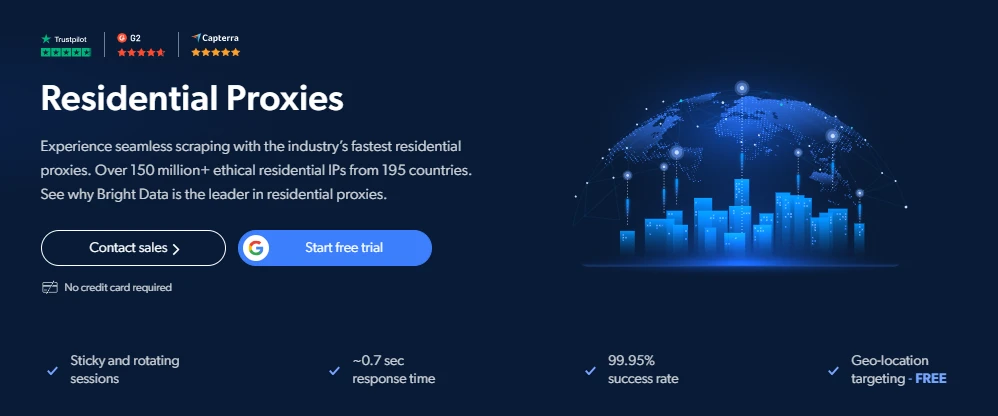
Bright Data runs the largest ISP proxy network in the world — approximately 1.5M static residential IPs after their 2026 expansion. For enterprises that need compliance documentation, audit trails, and SLAs, Bright Data is hard to beat. They're ISO/IEC 27001:2022 certified, GDPR-compliant, and their proxies are covered by Technology Errors & Omissions plus Cyber Insurance.
Their ISP product gives you country, city, ZIP code, carrier, and ASN-level targeting, with both shared (pay-per-usage or pay-per-IP) and dedicated options. Unlimited bandwidth is available on per-IP plans, with 99.99% uptime as standard.
The downside is the entry cost — Bright Data is the most expensive option here, and the platform itself has a learning curve. But if your team is already using their Web Scraper API, Scraping Browser, or pre-collected datasets, having ISP proxies on the same platform genuinely simplifies operations.
- ISP proxies: from $1.30/IP (shared) / from $3.20/IP (dedicated)
- Pay-as-you-go available — no minimum commitment
- 7-day trial for businesses
- Enterprise plans available on request
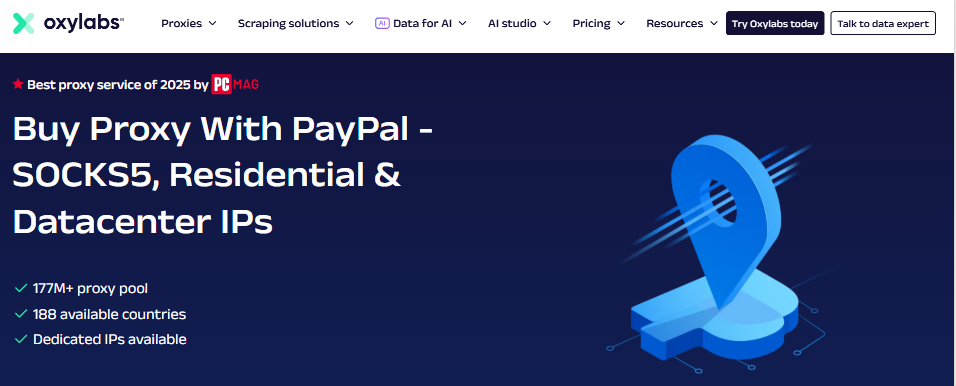
Oxylabs is the enterprise benchmark for scraping teams — and in January 2026 they launched Dedicated ISP Proxies with full ASN selection (you choose whether your IP is registered under Lumen, Comcast, BT Group, Orange, Cox, AT&T, or others). No other provider at this scale offers that level of granular control.
Their ISP proxies hit a 99.9% success rate on tough targets and support HTTP, HTTPS, and SOCKS5 out of the box. Coverage spans 195+ countries with the broadest static residential footprint of any provider in 2026. CNET named Oxylabs the best proxy server for larger businesses.
Pricing starts at $1.60/IP on the Starter plan (10 IPs) and drops to $1.30/IP at the Advanced tier. Free trials are available on request via support — Oxylabs prefers a brief KYC step over self-serve trials, which is the trade-off for using a more regulated, compliance-heavy provider.
- ISP Proxies: from $1.60/IP
- Dedicated ISP (with ASN selection): from $2.10/IP
- Unlimited bandwidth (subject to fair use policy)
- Pay-per-IP billing, no extra traffic charges
- Free trial available on request
IPRoyal's pitch is simple and unusual: truly unlimited bandwidth on every static residential IP. You pay per IP per month, and you can pump as much traffic through it as you like — no fair-use caps to worry about.
Their static residential pool covers 31+ countries (heavily weighted toward US and EU), with state- and city-level targeting included. Each IP is 100% dedicated (only you use it), and they support HTTP, HTTPS, and SOCKS5. Speeds are strong — direct ISP connectivity gives you the kind of low latency you'd expect from a datacenter proxy.
What I particularly like is the no-contract model: you can buy a single IP for a week, test it on your actual workflow, and scale up only if it works. They also run regular promotions (a 50% off code circulates most months). For a deeper look at the rotating product, see our IPRoyal review.
- Private static residential: from $2.00/IP with unlimited bandwidth
- 31+ countries available
- 100% dedicated IPs (no sharing)
- HTTP/HTTPS/SOCKS5 supported
- No monthly minimum
NetNut is built on a one-hop, direct-to-ISP architecture — meaning your requests don't bounce through end-user devices like a peer-to-peer pool. They have a direct partnership with ISPs (via DiviNetworks), giving you 1M+ static residential IPs sourced directly at the network level.
The practical result: faster response times, lower latency, and a 99.99% uptime SLA. Sessions don't drop unexpectedly because there's no end-user device to disconnect. For long-running sessions (account management, persistent logins, multi-hour scraping jobs), this is genuinely the most stable network I've tested.
NetNut isn't the cheapest — their pricing is structured for enterprise and serious commercial use, with monthly bandwidth commitments rather than pay-as-you-go. Starter plans begin around $1.59/GB on residential, and static residential ISP is priced as a separate enterprise product. Read our full NetNut residential proxy review.
- Static Residential (ISP): custom enterprise pricing, contact for quote
- Rotating residential from $1.59/GB at enterprise tier
- 7-day free trial available
- Dedicated account manager on higher tiers
Rayobyte (formerly Blazing SEO) is a US-based, US-focused provider that's built a strong reputation on three things: unlimited bandwidth, ethical sourcing, and strong US ASN diversity (9+ ASNs). If your primary target is the US market — Amazon, US sneaker drops, US-based social platforms, US SEO — Rayobyte is competitive with anyone here.
Their static ISP proxies come with unlimited bandwidth (200GB fair-use cap per IP), 1Gbps speeds, and they don't charge extra for that traffic the way premium providers do. They're also one of the few proxy providers certified by the Ethical Web Data Collection Initiative, meaning their residential IPs are independently verified as opt-in sourced.
The limitations: city-level targeting is currently only available for US locations (international city-targeting is weaker than competitors), and their network is smaller than the giants on this list. But for US-focused use cases, the value-to-quality ratio is hard to beat.
- Static ISP proxies: from $5/IP/month with unlimited bandwidth
- 9+ US ASNs and subnets
- HTTP/HTTPS/SOCKS5 supported
- Free residential trial on signup
- Custom plans for 5,000+ IPs
Explore: Best residential proxy company
Static Residential vs Rotating Residential: Which One Do You Actually Need?
| Rank | Provider | Rating | Best For | Starting Price | Free Trial | Coupon | Action |
|---|---|---|---|---|---|---|---|
| 1 | Decodo |  4.3 / 5 4.3 / 5 |
Best Overall | From $0.27/IP | 3-Day Trial | RESI50 | Try Decodo |
| 2 | Webshare | 4.5 / 5 |
Best Cheap Option | From $0.23/IP | 10 Free Proxies | 50% OFF | Try Webshare |
| 3 | Bright Data | 4.3 / 5 |
Best Enterprise Option | From $1.30/IP | 7-Day Trial | RESIGB50 | Try Bright Data |
| 4 | Oxylabs | 4.1 / 5 |
Best for Scraping | From $1.60/IP | 7-Day Trial | OXYLABS50 | Try Oxylabs |
| 5 | IPRoyal | 4.7 / 5 |
Best for Unlimited Bandwidth | From $2.00/IP | PAYG | IPR50 | Try IPRoyal |
| 6 | NetNut | 4.6 / 5 |
Best Stable ISP Connectivity | Custom Quote | 7-Day Trial | — | Try NetNut |
| 7 | Rayobyte | 4.1 / 5 |
Best US-Focused ISP | From $5.00/IP | 2-Day Risk-Free | NY50 | Try Rayobyte |
Final Verdict: Which Static Residential Proxy Should You Buy?
For most users in 2026, Decodo is the best static residential proxy thanks to its mix of price, performance, and platform quality. If your budget is tight, start with Webshare's free 10-proxy tier. If you need enterprise compliance, go with Bright Data or Oxylabs. For unlimited bandwidth with no surprises, IPRoyal and Rayobyte are the strongest picks.
Whichever you pick, start small, test on your actual target sites, and scale up only when you've confirmed the IPs work for your workflow. That's the cheapest and safest way to choose.
FAQs: About Reddit Residential Proxies
A static residential proxy is an IP address assigned to you by a real ISP (Comcast, AT&T, BT, Lumen, etc.) but hosted on datacenter hardware. It doesn't rotate — you keep the same IP for the full duration of your plan. Websites see it as a normal home internet connection, which means it's much harder to detect than a datacenter proxy.
Yes. Almost all major providers (Decodo, Bright Data, Oxylabs, IPRoyal, Webshare, NetNut, Rayobyte) use the two terms interchangeably. The underlying technology is identical: an IP from a real ISP, hosted in a datacenter, that doesn't rotate.
It depends on the use case. Static residential is better for account safety: you stay logged in, the IP doesn't change mid-session, and platforms see consistent behavior. Rotating residential is better for scale: scraping public data, running many parallel requests, or testing from many geos. For mixed workflows, providers like Decodo and Oxylabs offer both on the same dashboard.
They're the safest proxy type for these platforms. Because the IP is sourced from a real ISP and stays stable, it looks indistinguishable from a normal home connection. However: no proxy can prevent bans caused by behavior (spammy posting, fast repeated actions, breaking platform rules). The proxy hides your real IP — it doesn't fix bad automation.
You'll see static residential prices from $0.23/IP (Webshare shared) at the cheap end to $5+/IP (Rayobyte, Bright Data dedicated) at the premium end. For most users, the sweet spot is $1–$3 per IP per month with unlimited or high-volume bandwidth. Pay-per-GB models exist (Decodo, NetNut) but per-IP pricing is more common because the IP itself is the product.
Not recommended. The whole point of static residential is the 1 account = 1 IP model. If you share an IP across multiple accounts on the same platform, the platform can link those accounts and trigger checks. Buy one IP per account if you're serious about account safety.
Most do. Webshare, Oxylabs, IPRoyal, Rayobyte, and NetNut all support HTTP, HTTPS, and SOCKS5 on their static residential plans. Bright Data supports SOCKS5 for ISP proxies on ports above 1024. Always double-check protocol support on the provider's pricing page before buying if SOCKS5 is critical for your tool.
No proxy can guarantee that. A static residential proxy makes you look like a normal home user, which dramatically reduces IP-related blocks. But bans for bad behavior (spam, automation patterns, terms-of-service violations) happen regardless of which IP you use. The proxy is one part of a safe setup — the other parts are realistic timing, clean fingerprints, and following platform rules.
- Shared = the same static IP is assigned to multiple customers at the same time. Cheaper, but if another user gets the IP blocked, you're affected too.
- Dedicated (or private) = the IP is yours alone. Costs more, but the reputation is entirely under your control.
For account management, always go dedicated. For light browsing or price monitoring, shared is fine.
Most providers offer one, but the format varies. Webshare gives 10 free proxies forever (no card required). Decodo offers a 3-day trial with 100MB. Oxylabs, NetNut, and Bright Data offer free trials on request via support. Rayobyte activates a residential trial automatically on signup. IPRoyal is pay-as-you-go with no monthly commitment, so you can buy a single IP for a week as a low-risk test.