


- SOAX — Best mobile + residential proxy accuracy for Android automation
- Decodo — Best balance of speed, price, and SOCKS5 compatibility
- IPRoyal — Strong budget-friendly residential + mobile proxy option
- Webshare — Cheapest rotating residential proxies for starter Android setups
- ProxyRack — Unlimited bandwidth plans for scaling automation
- AnyIP — Flexible residential + mobile proxy mix
- iProxy.online — Real SIM-based Android mobile proxy creation (advanced users)
Why Web Scraping Requires Residential Proxies
Android handles proxy traffic differently from any desktop environment. Native Wi-Fi proxy settings don't support username/password authentication. Mobile data connections ignore system proxy settings entirely on most devices. Running a proxy on Android in 2026 means understanding two distinct components:
the proxy service (the IP pool you connect to) and the proxy tool (the app that routes your Android traffic through it). This guide covers both — ranked and reviewed for real Android use cases.


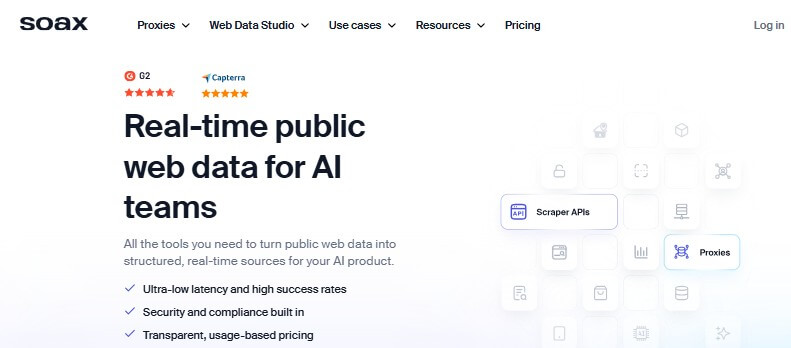
SOAX is the standout choice for Android proxy use in 2026. Its curated residential pool aggressively removes flagged or overused IPs — resulting in higher trust scores on platforms that perform IP reputation checks, which directly reduces ban rates for Android-based social media management and automation workflows.
The 33M+ mobile IPs cover 3G, 4G, 5G, and LTE carrier networks globally, making SOAX one of the few providers that genuinely bridges residential and mobile proxy infrastructure in a single subscription. City, region, ISP, and ASN-level targeting lets you place your Android traffic in exactly the right location.
Sticky sessions up to 60 minutes suit persistent login-based workflows; per-request rotation suits high-volume scraping or account verification. The $1.99 trial (400MB, 3 days) removes the risk of testing on your specific Android targets before committing. For more information, read our Soax Review.
 Pros
Pros
- Largest mobile IP pool at 33M+ (3G/4G/5G/LTE)
- Aggressively curated — fewer banned or flagged IPs
- City, ISP, ASN, carrier-level targeting
- 99.95% success rate, 0.55s response time
- Low-cost $1.99 trial before committing
✘ Cons
- $3.60/GB — not the cheapest entry point
- Learning curve for advanced rotation config
- Less geo-coverage in niche regions (parts of Africa, SE Asia)
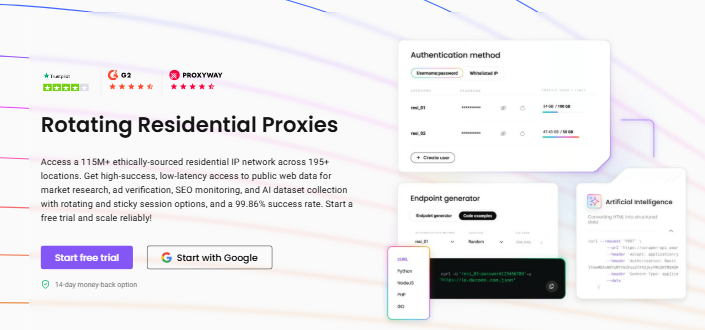
Decodo is the most Android-friendly premium proxy provider in 2026. It earned the fastest response times in independent testing at 0.54 seconds — directly valuable for Android workflows where latency affects user experience and automation reliability.
The provider publishes step-by-step Android configuration guides covering both Wi-Fi and mobile data setup, which removes one of the biggest pain points Android proxy users face.
The X Browser and built-in proxy checker streamline session management on Android. With 10M+ mobile IPs and OS-level targeting (filter by iOS or Android-originated IPs), Decodo's mobile pool is well-suited for app testing, geo-restricted content access, and multi-account social media management from Android devices. For more information, read our Decodo Review.
Pros
- Fastest response times tested (0.54s)
- Dedicated Android setup documentation
- iOS/Android OS-level IP filtering
- Free X Browser + proxy checker included
- 14-day money-back + 100MB free trial
✘ Cons
- Sticky sessions capped at 30 minutes
- Mobile pool (10M) smaller than SOAX (33M)
IPRoyal is the go-to budget option for Android proxy users. Its proxies are designed to work on Android without requiring additional proxy apps — a genuine convenience advantage. At $1.75/GB for residential proxies, IPRoyal is among the most affordable established providers for Android geo-testing, casual scraping, and social media access. The mobile proxy offering is unique:
instead of a shared pool, IPRoyal rents dedicated mobile devices with real SIM cards and unlimited bandwidth — ideal for social media managers who need dedicated IP continuity.
Coverage is available across 15 countries for the dedicated device model. For teams that need basic proxy access on Android without complex configuration, IPRoyal is the cleanest starting point. For more information, read our IPRoyal Review.
Pros
- Works on Android without extra apps
- Affordable at $1.75/GB residential
- Dedicated device mobile proxies (unlimited BW)
- Simple setup — good for beginners
✘ Cons
- Higher latency variance outside US/Western Europe
- Dedicated mobile coverage limited to 15 countries
- Smaller pool than top-tier providers
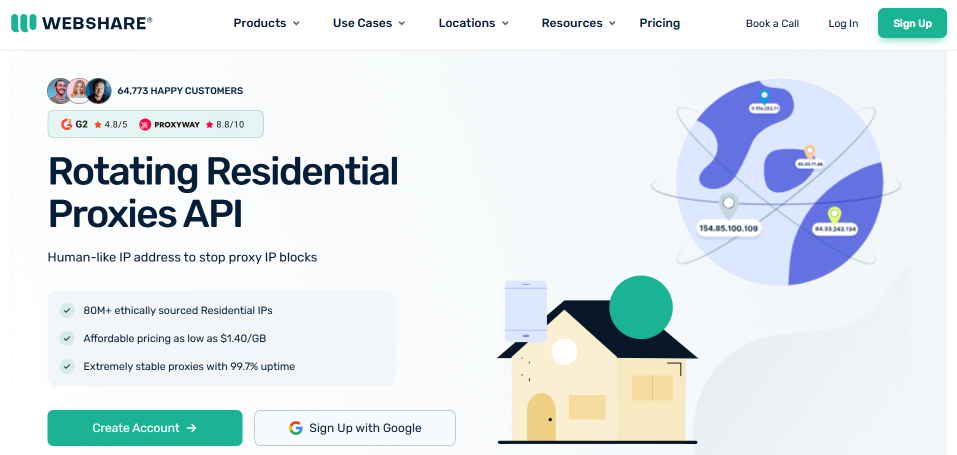
Webshare is the only provider on this list with a permanent free tier — 10 proxies and 1GB per month at zero cost, no credit card required. For developers testing Android proxy integrations or individuals exploring geo-unblocking, the free tier lets you validate the setup end-to-end before spending anything.
Webshare provides a SocksDroid tutorial specifically for Android configuration, covering SOCKS5 setup on both Wi-Fi and mobile data.
Paid plans at $1.40/GB are among the lowest of any established provider. Rotating and static residential proxies give Android users flexibility between anonymous browsing and session-consistent workflows. For more information, read our Webshare Review.
Pros
- Only provider with permanent free tier
- Android-specific SocksDroid tutorial
- Lowest paid entry at $1.40/GB
- No credit card to start
✘ Cons
- Residential IPs show mediocre success rates in testing
- Limited targeting — primarily country-level
- Monthly bandwidth expires — no rollover
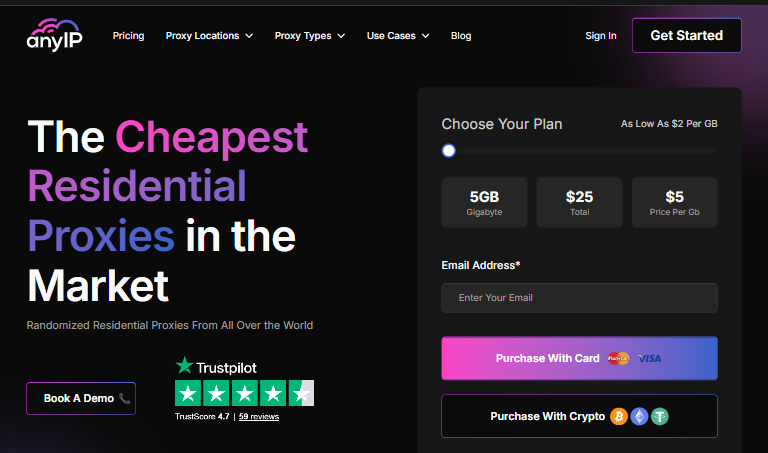
AnyIP stands out for its unified pricing model — $2/GB covers both mobile and residential proxies in a single plan, with no extra fees to switch between types. For Android users who need mobile IPs for social media work and residential IPs for general scraping, this removes the usual cost complexity.
The unused data rollover policy means bandwidth doesn't vanish at month end — useful for Android workflows that run in bursts.
At a 98.6% request success rate and with AI-powered IP selection (automatically picks the best-performing IPs for your target), AnyIP delivers solid performance for Android-based automation and account management without the enterprise price tag.
Pros
- One plan covers mobile + residential IPs
- Unused traffic rolls over — no waste
- AI IP selection for best success rates
- 98.6% success rate, coordinate-level targeting
✘ Cons
- Only 38+ countries — narrower geo coverage
- Newer provider, smaller community reputation
- No SOCKS5 in earlier versions (check current support)
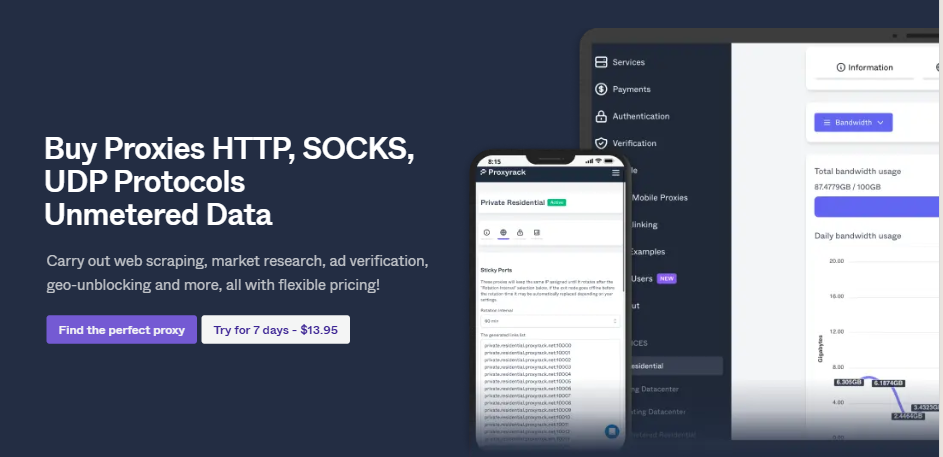
ProxyRack is the most protocol-flexible provider on this list — supporting HTTP, HTTPS, SOCKS4, SOCKS5, and UDP. For Android developers who need to route specific types of traffic (including UDP-based apps, games, or VoIP), this breadth is rare and genuinely useful.
The unlimited bandwidth datacenter plans starting at $150/month are well-suited for high-volume Android automation workflows that need consistent throughput without tracking every gigabyte.
Residential IPs refresh hourly, which maintains pool freshness for long-running Android sessions. Sub-user management and unlimited threads make ProxyRack practical for teams managing multiple Android devices or proxy farms.
Pros
- HTTP, HTTPS, SOCKS4/5, and UDP support
- Unlimited bandwidth datacenter plans
- Residential IPs refresh every hour
- Sub-user management for team/farm use
✘ Cons
- Residential pricing (~$5/GB) not the cheapest
- Less known than major providers; fewer reviews
- Trial costs $13.95 — not free
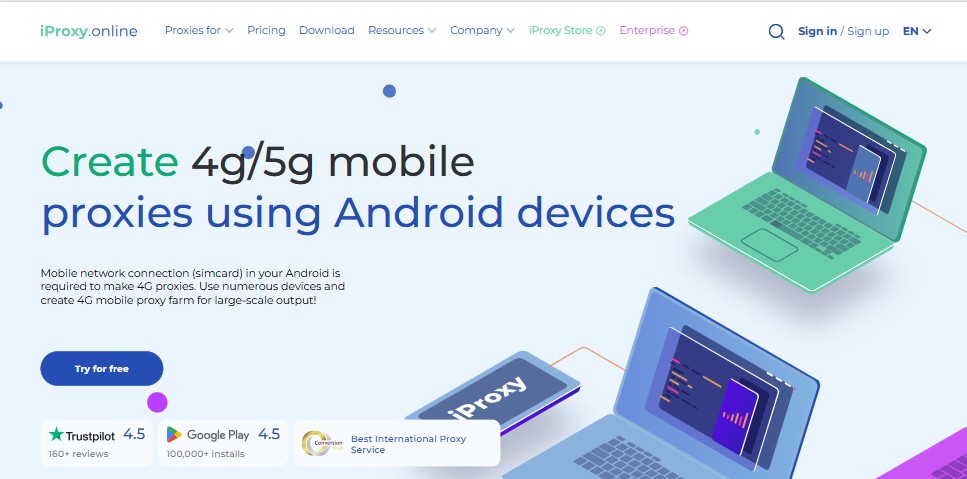
iProxy.online is a fundamentally different product from the other entries on this list — instead of connecting your Android to a remote proxy pool, it turns your Android device itself into a mobile proxy server.
Install the app, insert a SIM card, subscribe for $6/month, and you have a fully private 3G/4G/5G proxy that you control 100%. This is the model used by professional "proxy farm" operators — racks of Android phones with SIM cards, each running iProxy, selling or using the mobile IPs generated. For individuals and agencies who need guaranteed-private, carrier-grade mobile IPs, iProxy delivers something no shared pool provider can match: an IP that nobody else has ever used.
IP rotation is handled via dashboard, a direct link, or even a Telegram bot command. With a 48-hour free trial (no credit card) and 100K+ downloads, it's the most proven Android-native proxy creation tool available.
Pros
- 100% private — your device, your IP, no sharing
- True carrier-grade mobile proxy (real SIM)
- $6/month — extremely affordable per device
- Telegram bot IP rotation for automation
- 48hr free trial, no credit card required
- Scalable — run farms of 100s of devices
✘ Cons
- Requires physical Android device + SIM card
- Geo-coverage limited to where your devices are
- Not suitable without hardware investment
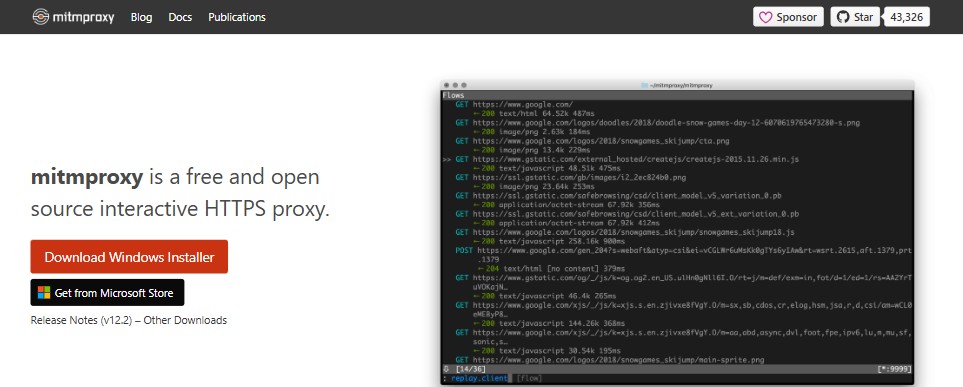
mitmproxy is not a proxy provider — it is an open-source interactive proxy tool used by developers, QA engineers, and security researchers to intercept, inspect, and modify HTTP/HTTPS traffic from Android devices.
It runs on your desktop and routes Android traffic through itself, allowing you to see exactly what an app is sending and receiving. For Android developers testing proxy-dependent applications, debugging API calls, or verifying how apps behave behind a proxy, mitmproxy is the industry-standard tool.
Its Python scripting API allows automated traffic manipulation — useful for testing how Android apps respond to different proxy configurations or geo-spoofing. It does not provide proxy IPs — pair it with a provider like SOAX or Decodo for full functionality.
Pros
- 100% free and open source
- SSL decryption for HTTPS traffic inspection
- Python scriptable — fully automatable
- Industry standard for Android app traffic debugging
✘ Cons
- Not a proxy service — provides no IPs
- Requires desktop + certificate installation on Android
- Developer/technical tool — not for general users
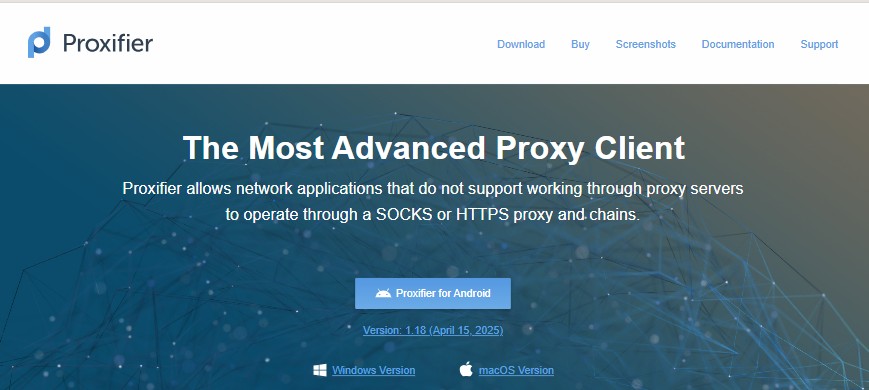
Proxifier solves one of Android's most persistent proxy problems: getting specific apps (not your whole device) to route through a proxy server, including over mobile data. It supports per-app routing rules — you decide which apps use the proxy and which connect directly.
This is essential for multi-account social media management on Android, where you want each app (Instagram, TikTok, Twitter) routing through a different IP.
Proxifier supports SOCKS5 and HTTP, bridging the Android authentication gap — it handles the credential exchange your chosen proxy service requires. Pair it with SOAX, Decodo, or any provider on this list to get a complete, app-specific Android proxy setup without rooting your device.
Pros
- Per-app proxy routing without root
- Works over mobile data (not just Wi-Fi)
- Bridges Android's credential auth gap
- Compatible with any proxy service provider
✘ Cons
- Paid — no free tier
- Provides no IP pool — needs a service to pair with
- Some Android versions have setup complexity
| Provider / Tool | Type | IP Pool | Starting Price | Best Android Use Case | Trial / Entry |
|---|---|---|---|---|---|
| SOAX Our #1 Pick |
Service | 155M+ res33M+ mobile | $3.60/GB | Social media, multi-account, mobile automation | $1.99 / 400MB |
| Decodo | Service | 115M+ res10M+ mobile | ~$4/GB | Fastest Android sessions, app testing | 14-day refund |
| IPRoyal | Service | 34M+ residential | $1.75/GB | Budget setup, no extra app needed | Pay-as-you-go |
| Webshare | Service | 80M+ | $1.40/GB1GB/month free | Developer testing, geo-unblocking | 1GB free forever |
| AnyIP | Service | 100M+mobile + res | $2/GB unified | Mobile + residential in one plan | 14-day refund |
| ProxyRack | Service | 85M+ residential | $49.95/mo10GB plan | UDP traffic, team / farm management | 7-day ($13.95) |
| iProxy.online | App | Your own device | $6/mo per device | Private mobile proxy farm from Android | 48hr free trial |
| mitmproxy | Tool | None — inspect only | Free | Android app traffic debugging | Fully free |
| Proxifier | Tool | None — needs a service | Paid (one-time) | Per-app routing over mobile data | Trial available |
Frequently asked questions
A proxy service (like SOAX, Decodo, IPRoyal) provides the remote IP addresses your Android traffic routes through. A proxy tool (like iProxy.online, mitmproxy, or Proxifier) is an app that manages how traffic is routed on your Android device.
For most use cases, you need both: a service to provide IPs and a tool to handle authentication and routing.
Stock Android's Wi-Fi proxy settings only support IP-address allowlisting — there is no credential field. This is Android's authentication gap.
If your proxy provider uses username/password authentication (which most do), you need a proxy app like Proxifier, Drony, or Postern that handles the credential exchange before passing traffic through.
For most Android-specific tasks — social media management, multi-account work, app testing — mobile proxies (carrier IPs from 3G/4G/5G networks) deliver higher trust scores because they originate from the same infrastructure Android devices use natively.
Residential proxies are better for general scraping, geo-unblocking, and price monitoring where carrier-level trust isn't required. SOAX and Decodo offer both types, which covers the full range of Android use cases.
For Wi-Fi: go to Settings → Wi-Fi → long press your network → Modify Network → Advanced → Proxy: Manual → enter host and port. For credential-based proxies or mobile data, install a proxy app (Proxifier or Drony), enter your provider credentials, and configure per-app routing rules. Decodo publishes the most thorough Android setup guides of any provider on this list.
Yes — fundamentally different. Most providers sell access to their shared IP pool. iProxy.online lets you use your own Android phone as a proxy server — your traffic routes out through your SIM card's carrier IP, giving you a 100% private mobile proxy that no one else can use.
At $6/month per device, it is the most affordable way to get a genuine, dedicated carrier-grade mobile proxy, and it scales to farms of hundreds of devices.
Final verdict
For the best Android proxy service overall, start with SOAX — it has the largest mobile IP pool, the most precise carrier and city targeting, and the lowest ban rates for social media and multi-account work. The $1.99 trial removes any risk.
For the fastest Android sessions with the best documentation, choose Decodo. For budget access without extra apps, IPRoyal is the cleanest starting point. To test at zero cost, Webshare's free tier is the only real option on the market.
If you need 100% private mobile IPs — not a shared pool — build with iProxy.online. For per-app routing over mobile data, add Proxifier to whatever service you choose. For traffic inspection and debugging, mitmproxy is free and irreplaceable.