
How to Use Residential Proxies for Price Tracking and Monitoring?

by Jayden Sprent // March 5, 2026
Residential proxies allow businesses to run large-scale price analysis and monitor pricing differences across markets.
What are Residential Proxies For Price Tracking & Monitoring Used for?
Residential proxies are commonly used to collect pricing data, monitor competitors, and analyze market behavior across regions. They allow businesses to track prices at scale with fewer access issues, supporting data-driven pricing, market research, and competitive analysis
Price Analysis
Analyze competitor prices across websites and regions using residential proxies.
Dynamic Pricing Strategy
Monitor market prices in real time to support dynamic pricing decisions.
Price Discrimination Research
Analyze how prices vary by location, region, or market conditions
Market Trend Identification
Identify pricing and demand trends by analyzing market data across multiple websites.
E-commerce Optimization
Optimize e-commerce pricing and strategy using competitor and market data. Learn More
Supply Chain Analysis
Analyze supply chain pricing and availability using market data from multiple sources.
Benefits of Residential Proxies
How Residential Proxies Improve Price Tracking Accuracy
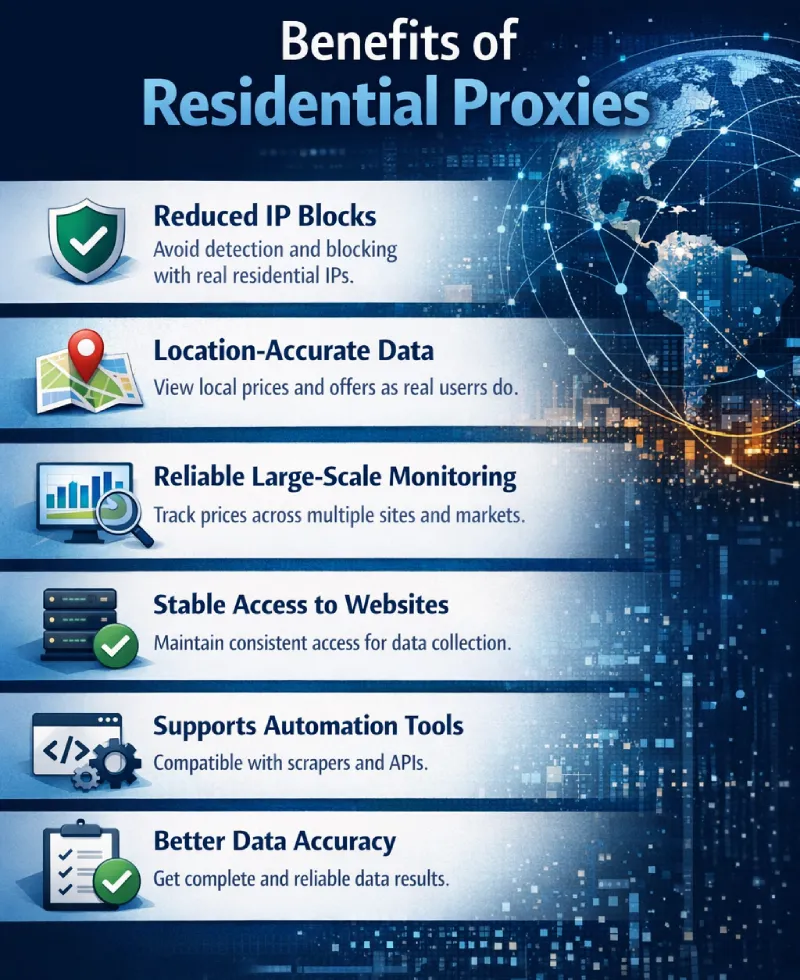
Price tracking often fails when websites block repeated requests, show different prices by location, or limit access based on IP behavior. Residential proxies help reduce these issues by routing requests through real residential IP addresses instead of a single server location.
By using residential IPs from different regions, businesses can view prices as real users see them, including location-based variations and regional offers. This improves data accuracy when monitoring competitors, comparing markets, or analyzing pricing trends over time.
Residential proxies also help maintain consistent access during large-scale tracking, reducing interruptions caused by rate limits or automated detection systems.
Frequently Asked Questions (FAQs)
Yes. Residential proxies are commonly used for price tracking because they provide access through real residential IPs, reducing blocks when collecting pricing data from eCommerce and retail websites.
Rotating proxies automatically change IP addresses at set intervals or per request, helping businesses collect pricing data at scale without repeatedly using the same IP.
This depends on the provider. Some residential proxy networks use shared IP pools, while others offer dedicated or semi-dedicated options for more consistent access.
With rotating residential proxies, IPs typically change automatically. Static or dedicated residential proxies may remain the same unless replaced or upgraded.
Yes. Most providers allow access to fresh IPs through rotation settings or by refreshing the proxy pool, depending on the plan.
Most residential proxy services offer geo-targeting, allowing you to collect pricing data from different countries, regions, or cities.
Blocked ports vary by provider. Standard HTTP and HTTPS ports are usually supported, while non-standard ports may be restricted.
Some providers offer free trials or limited testing options, while others require a paid plan to access residential proxy networks.
Payment methods usually include credit cards, PayPal, and sometimes cryptocurrency, depending on the provider.
Yes. Most providers allow plan upgrades to support higher data usage, more locations, or additional features.
Cancellation and refund policies vary by provider. It’s recommended to review terms related to billing cycles, usage limits, and refund eligibility before purchasing.
Author
Jayden Sprent (Proxy Specialist)
Hi, I'm Jayden Sprent. Dive into the world of proxy servers with my expert evaluations and insightful analyses based on thorough research. I'll share my experiences and comprehensive guides to help you make informed decisions about proxy services.
Learn More About Jayden Sprent