

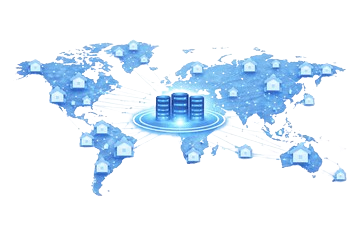
Why Web Scraping Requires Residential Proxies
Most modern websites block automated scraping using CAPTCHAs, rate limits, fingerprint tracking, geo-filters, and IP reputation checks. Residential proxies solve this by routing requests through real household IP addresses, making your traffic look like normal users instead of bots.
They help you:
- scrape Google results safely
- collect e-commerce pricing data
- monitor competitors
- extract marketplace listings
- build AI training datasets
Large rotating IP pools also reduce detection risk during high-volume scraping. Learn use cases of residential proxy for web scraping.
Top 7 Residential Proxies for Web Scraping in 2026
IP Pool: 100M+ IPs
Coverage: 195 countries
Price: ~$8.00 / GB
No Expiry: ✘ Monthly billing
Best For: Cloudflare sites, SERP APIs
Oxylabs is built for scrapers who keep hitting walls. Their Web Unblocker automatically handles JS rendering, TLS fingerprinting, and Cloudflare bot scores — so your scraper gets clean HTML without fighting each protection layer manually. Particularly strong for SERP scraping (dedicated Search API) and e-commerce targets that block datacenter IPs on sight. Unlimited concurrent sessions — no throttling. Read more Oxylabs Review.
 Pros for Web Scraping
- Web Unblocker handles Cloudflare & JS automatically
- Dedicated SERP API for search result scraping
- Unlimited concurrent sessions — no throttling
- Strong success rate on protected e-commerce sites
✘ Cons for Web Scraping
- High cost — ~$8/GB makes bulk scraping expensive
- More than needed for simple/unprotected targets
IP Pool: 175M+ IPs
Coverage: 195 countries
Price: ~$8.40 / GB
No Expiry: ✘ Monthly billing
Best For: Large orgs, compliance ops
When your scraping targets are Amazon, Google Shopping, or any site with enterprise-grade anti-bot, Bright Data's 175M+ IP pool gives you the volume and diversity to keep success rates high. Built-in CAPTCHA solving, a dedicated Scraping Browser, and structured data APIs mean you can collect and parse in one place. GDPR-compliant and audit-ready — important for commercial data products. Read more Bright Review.
Pros for Web Scraping
- Largest IP pool — best diversity for block avoidance
- Built-in CAPTCHA solving & Scraping Browser
- Structured data APIs — no custom parser needed
- Best success rates on Amazon, Google, and LinkedIn
✘ Cons for Web Scraping
- High cost — ~$8/GB makes bulk scraping expensive
- More than needed for simple/unprotected targets
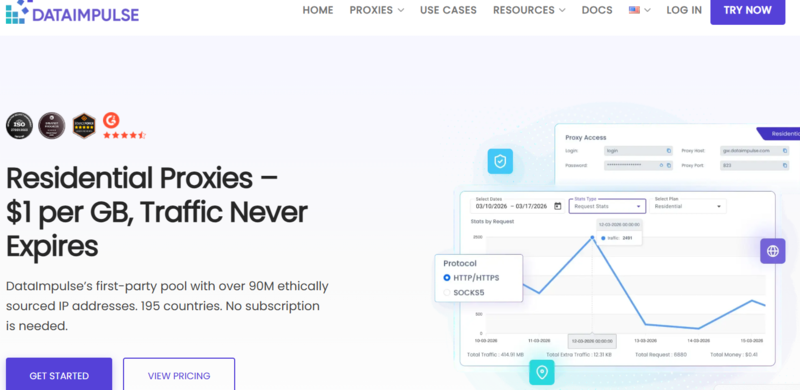
IP Pool: 90M+ ethically-sourced
Coverage: 195 countries
Price: $1.00 / GB
No Expiry: Credits never expire
Best For: Budget scraping, SERP, AI data
For web scraping, DataImpulse hits the sweet spot most scrapers need: a large, clean IP pool that rotates per request, keeping your scraper invisible across long sessions. At $1/GB with non-expiring traffic, you can run price monitoring, SERP tracking, or e-commerce crawls without watching the clock on your credits. Works out of the box with Scrapy, Puppeteer, and Playwright. City and ASN targeting let you pull geo-specific data accurately. Start for $5 — no commitment. Read more DataImpluse Review.
Pros for Web Scraping
- $1/GB — lowest price for real residential IPs
- Traffic never expires — zero wasted credits
- Rotating & sticky sessions up to 120 min
- City & ASN targeting for geo-accurate data
- Works with Scrapy, Puppeteer, Playwright, Selenium
✘ Cons for Web Scraping
- Premium pool needed for the hardest anti-bot targets
- Smaller pool vs. Bright Data for enterprise scale
IP Pool: 100M+ IPs
Coverage: 195 countries
Price: ~$3.50 / GB
No Expiry: ✘ Monthly billing
Best For: Developers, quick integration
If you're setting up a scraper for the first time, Decodo will save you hours. Their integration guides for Scrapy, Playwright, Puppeteer, and Selenium are genuinely well-written. The backconnect gateway handles IP rotation automatically per request — no proxy list management needed. Strong for mid-volume scraping: product listings, review data, lead gen. Real-time dashboard lets you spot block rate spikes fast. Read more Decodo Review.
Pros for Web Scraping
- Best integration docs for Scrapy, Playwright, Puppeteer
- Auto IP rotation via backconnect — no list management
- Real-time dashboard to monitor block rates
- Good success rate on mid-difficulty targets
✘ Cons for Web Scraping
- Traffic expires monthly — unused bandwidth is lost
- Less suited for very high-volume enterprise scraping
IP Pool: 52M+ ISP-direct IPs
Coverage: 190+ countries
Price: ~$15.00 / GB
No Expiry: ✘ Monthly billing
Best For: Finance, flights, real-time data
Most residential proxies route through peer-to-peer networks — adding latency you can't control. NetNut cuts that out by connecting directly to ISPs. For scraping where timing matters — live stock prices, airfare fluctuations, limited-drop product pages — that speed advantage is the difference between fresh and stale data. Not the pick for bulk static scraping at this price, but for latency-sensitive collection, it earns its premium. Read more NetNut Review.
Pros for Web Scraping
- ISP-direct — lowest latency of any provider here
- Stable sessions for time-sensitive data pulls
- 99.9% uptime SLA for consistent scraping pipelines
✘ Cons for Web Scraping
- ~$15/GB — poor value for bulk or static scraping
- Smaller pool — less IP diversity for large crawls
IP Pool: 34M+ ethically-sourced
Coverage: 195+ countries
Price: ~$3.00 / GB
No Expiry: Traffic never expires
Best For: Small projects, burst scrapers
IPRoyal is a solid pick for scraping projects that don't need millions of IPs but do need clean, reliable ones. At ~$3/GB with traffic that never expires, it works well for recurring scrapers that run in bursts — weekly competitive analysis, periodic price checks, or small-scale lead scraping. Ethically sourced IPs mean fewer dirty addresses and lower block rates. Not built for high-concurrency workloads, but for lightweight consistent scraping it delivers. Read more IPRoyal Review.
Pros for Web Scraping
- No-expiry traffic — credits roll over indefinitely
- Ethically sourced IPs — cleaner pool, lower block rates
- ~$3/GB competitive for this reliability level
- Great for burst scrapers with unpredictable schedules
✘ Cons for Web Scraping
- Smaller pool (34M) — higher IP reuse on large crawls
- Not suited for high-concurrency enterprise scraping
IP Pool: 22M+ ethically-sourced
Coverage: Global, country & city level
Price: From $4.00 / GB
No Expiry: Traffic never expires
Best For: SERP, OSINT, mid-scale scraping
Gsocks is built around clean, stable residential IPs on a 1000+ Mbps network — and the no-expiry traffic model means you're never racing a billing cycle. For scraping tasks like SERP monitoring, OSINT, price comparison, and brand protection, it delivers reliable rotation and consistent connection quality. Supports HTTP, HTTPS, and SOCKS5 out of the box. Country and city-level targeting covers most geo-specific data collection needs. A practical, no-fuss option for mid-scale scrapers who value stability over enterprise feature bloat. For more information, read our Gsocks Review.
Pros for Web Scraping
- Traffic never expires — buy and use at your own pace
- 1000+ Mbps network — fast, stable connections
- DNS leak & TCP fingerprint protection built-in
- HTTP, HTTPS & SOCKS5 — works with all scraping tools
- Clean IPs with low abuse rates — lower block rates
✘ Cons for Web Scraping
- Smaller pool (22M) — less diversity for very large crawls
- Less established than Bright Data or Oxylabs at the enterprise scale
Side-by-side comparison
7 providers ranked for web scraping in 2026.
| # | Provider | IP Pool | Countries | Price / GB | No Expiry | Best Scraping Use Case |
|---|---|---|---|---|---|---|
| 1 | Oxylabs | 100M+ | 195 | ~$8.00 | No | Cloudflare bypass, SERP APIs, e-commerce |
| 2 | Bright Data | 175M+ | 195 | ~$8.40 | No | Enterprise, Amazon, Google, compliance |
| 3 | DataImpulse ★ Best Value | 90M+ | 195 | $1.00 | Yes | Budget crawls, SERP, e-commerce, AI data |
| 4 | Decodo | 100M+ | 195+ | ~$3.50 | No | Developer setup, mid-volume crawls |
| 5 | Gsocks | 22M+ | Global | From $4.00 | Yes | SERP, OSINT, mid-scale scraping |
| 6 | NetNut | 52M+ | 190+ | ~$15.00 | No | Real-time latency-critical data |
| 7 | IPRoyal | 34M+ | 195+ | ~$3.00 | Yes | Burst scraping, small/recurring projects |
Which One Should you pick?
Match your use case to the right provider.
Tight budget or variable scraping traffic?
$1/GB, traffic never expires, works with every major scraping framework.
Scraping Amazon, Google, or LinkedIn?
Enterprise-scale IP pools and built-in CAPTCHA solving keep success rates high.
Cloudflare keeps blocking your scraper?
Web Unblocker handles JS challenges and bot scores automatically.
Setting up your first serious scraper?
Best integration docs, easiest setup, solid free trial.
Need stable, clean IPs for SERP, OSINT, or brand protection?
No-expiry traffic, 1000+ Mbps network, and built-in DNS leak protection for reliable mid-scale scraping.
Speed is the priority — finance, flights, live drops?
ISP-direct sourcing cuts the peer-to-peer routing lag that slows other providers.
Small project with irregular burst usage?
No-expiry credits at ~$3/GB — buy once, use at your own pace.
What Makes a Residential Proxy Good for Web Scraping?
For scraping workloads, these factors matter most:
IP Pool Size
Larger pools reduce repeated-IP detection during high-volume crawling.
Rotation Control
Automatic rotation prevents rate limits across target websites.
Geo Targeting
City-level filtering improves accuracy when collecting localized datasets.
Success Rate Against Anti-Bot Systems
Clean residential IP reputation helps bypass CAPTCHA and blocking systems.
Pricing Model
Bandwidth-based pricing allows scalable experimentation before automation expands.
When Should You Use Residential Proxies for Web Scraping?
Residential proxies are especially useful if you:
- scrape ecommerce prices
- monitor search rankings
- collect competitor intelligence
- extract marketplace listings
- build machine-learning datasets
Because they use real device IP addresses, they significantly reduce block rates compared to datacenter proxies.
Frequently asked questions
What's the cheapest residential proxy for web scraping in 2026?
Are residential proxies legal for web scraping?
What's the difference between rotating and sticky sessions?
Do residential proxies bypass Cloudflare in 2026?
How much does residential proxy traffic cost on average?
Final verdict
For most people scraping in 2026, DataImpulse is the smartest starting point — real residential IPs at $1/GB, traffic that never expires, and 500,000+ users backing it up. Scale up to Oxylabs or Bright Data when your targets get harder and your budget allows.
Whatever you choose, the proxy is only one piece of the puzzle. Smart rotation, human-like delays, and proper geo-matching will always make a bigger difference than chasing the provider with the biggest IP count in their marketing copy.