

Quick pick by use case
- Enterprise Spotify scraping or account management at scale → Bright Data or Oxylabs
- Best price-to-performance for most Spotify tasks → Decodo
- Occasional geo-testing or personal use without monthly commitment → IPRoyal
- Absolute lowest budget, light tasks only → Proxy-Cheap
Who needs them and for what
Your use case determines which provider and which session type you actually need. Here are the six scenarios where residential proxies add real value on Spotify in 2026:
Geo-restriction bypass
Access region-locked catalogs, exclusive artist releases, and country-specific pricing. Common for travelers, expats, and music researchers testing cross-market availability.
Multi-account management
Labels and agencies assign a unique sticky residential IP per Spotify account to prevent account-linking flags. Each account appears to Spotify as a separate household connection.
Data scraping & analytics
Collect playlist metadata, regional chart rankings, artist engagement stats, and listener trend data at scale — without hitting Spotify's rate limits or triggering scraping blocks.
Automation & stream tools
Run Spotify promotion bots, playlist pitching tools, and audience research automation with IPs that don't trigger mass-detection or account flags on shared infrastructure.
Privacy on restricted networks
Mask your real IP when streaming on public Wi-Fi, corporate networks, or school/office connections where Spotify is throttled, logged, or partially blocked.
Regional promotion research
Verify how your music appears to listeners in specific target markets. Check playlist placements, algorithmic recommendations, and Discover Weekly results from a local listener's perspective.
Top 8 residential proxies for Spotify — 2026 providers reviewed
Every provider below was evaluated against criteria that matter specifically for Spotify: geo-targeting accuracy, session flexibility, IP pool cleanliness, streaming performance, and scraping success rates. Pool sizes and pricing reflect what's verifiable from provider sites and third-party benchmarks as of April 2026.
1. PrivateProxy
High-volume data extraction
An ethically sourced residential proxy provider offering exclusive ISP-direct IPs designed for secure Spotify account management and geo-testing in 2026
PrivateProxy focuses on clean, private ISP-assigned IPs rather than large shared pools, reducing detection risk during Spotify account logins and regional testing. Since each IP is exclusively assigned, it provides stronger session stability than typical rotating residential networks. Ethical sourcing and consistently low fraud scores make it reliable for long-term account anchoring workflows.
Its smaller pool and lack of ZIP/ASN-level targeting make it less suitable for high-scale scraping compared to Decodo or Oxylabs
Pros:
Cons:
Best for: users managing Spotify accounts, running geo-tests, or needing stable ethically sourced IPs where reputation matters more than pool size

50M+ clean IPs across 180+ countries — pay-as-you-go with no expiry, 99.5% success rate, and a no-frills dashboard built for speed over complexity.
SimplyNode offers a straightforward proxy experience with ethically sourced IPs and reliable global coverage for Spotify geo-unblocking and light multi-account workflows. The non-expiring traffic model makes it flexible for occasional usage, while its simple dashboard allows quick setup without technical complexity. Multi-protocol support ensures compatibility with most Spotify tools and automation setups.
However, the lack of static IP options and slightly higher per-GB pricing makes it less suitable for persistent account anchoring or budget-heavy workloads.
Pros:
Cons:
Best for: Beginners and solo developers who want clean residential IPs for Spotify geo-unblocking or light multi-account work — with zero setup complexity and pay-as-you-go flexibility.
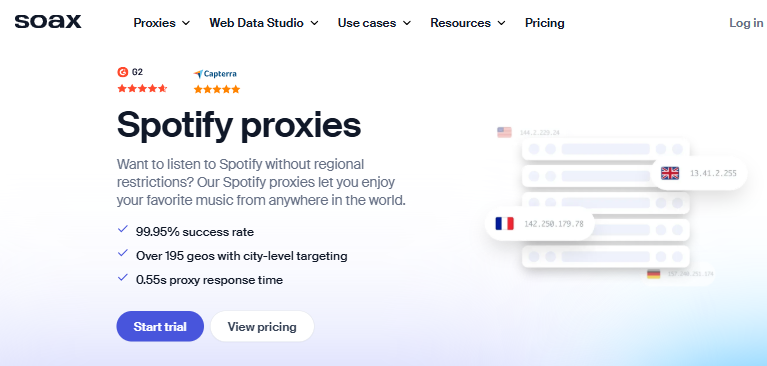
A premium residential proxy network with 155M+ whitelisted IPs, fast response times, and advanced geo-targeting built for large-scale Spotify automation.
SOAX provides a large clean IP pool with strong geo-targeting precision, making it ideal for Spotify catalog testing, automation workflows, and regional data collection. Its 99.95% success rate and sub-second response speed support stable performance across demanding scraping setups. The unified credit system allows flexible use across multiple proxy types, and the $1.99 trial (400MB) helps test performance before committing. For more information, read our Soax Review.
 Pros for Web Scraping
✘ Cons for Web Scraping
Best for: Agencies and automation teams needing high-volume, precise geo-targeted Spotify data collection — where 99.95% success rates and sub-second response times are non-negotiable.

Bright Data offers one of the largest residential proxy pools, reducing IP reuse risk on Spotify tasks where repeated requests trigger limits quickly. Its ZIP, ISP, and ASN-level targeting helps simulate real regional users for catalog checks and pricing tests. Sticky sessions stay stable across long workflows, and SOCKS5 ensures compatibility with most automation tools. Rated 4.7/5 on G2, reflecting strong enterprise trust.
Pricing is the main drawback. Plans range around $5.88–$10.50/GB, making it less suitable for beginners or small teams. Budget users may prefer Decodo or IPRoyal, while enterprises benefit most from Bright Data’s scale and stability. For more information, read our BrightData Review.
Pros for Web Scraping
✘ Cons for Web Scraping
Best for: agencies managing large Spotify artist portfolios, enterprise teams running multi-region Spotify data collection, and any operation where detection resistance is non-negotiable and budget is secondary.
Oxylabs operates the largest verified residential IP pool, making it ideal for geo-distributed Spotify catalog testing and analytics pipelines. Targeting includes country, city, ASN, and ZIP, and their API-first architecture integrates smoothly with Python scrapers and automation systems. The OxyCopilot AI assistant helps configure scraping workflows faster without manual setup. Benchmark testing reports 99.95% success rate with ~0.6s response time.
The main limitation is 30-minute sticky sessions, shorter than Bright Data’s 24-hour persistence. Pricing also starts around $75/month, which is better suited for professional teams rather than beginners. For more information, read our Oxylabs Review.
Pros for Web Scraping
✘ Cons for Web Scraping
Best for: developers building Spotify analytics platforms, teams running large-scale geo-localized catalog testing, and any API-first operation where the highest pool size and success rate matter most.
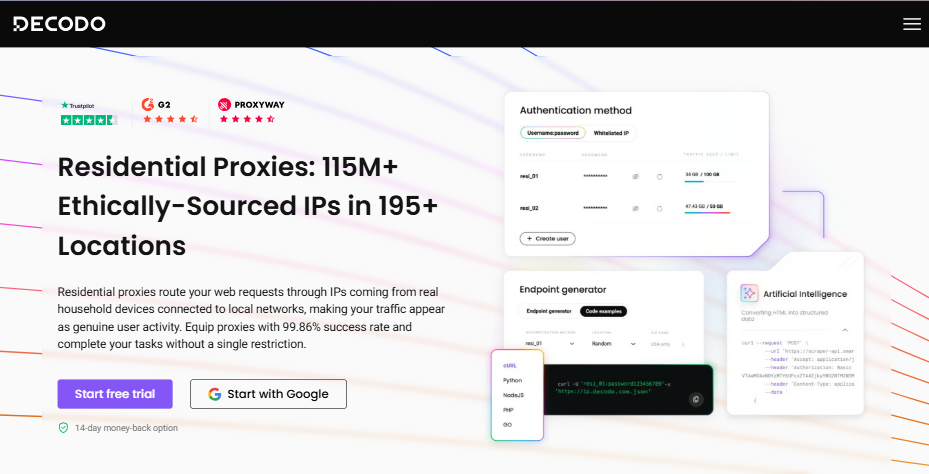
A high-value residential proxy network with 115M–125M+ IPs, fast response times, and flexible sessions starting at $2/GB in 2026
Decodo delivers one of the best price-to-performance ratios for Spotify automation and scraping. Geo-targeting matches Bright Data’s depth but at a lower cost, and flexible session control supports streaming, account management, and bot workflows. Independent benchmarks show 99.86% success rate with very fast responses and low fraud-score IP quality, making connections cleaner and more stable. For more information, read our Decodo Review.
Pros for Web Scraping
✘ Cons for Web Scraping
Best for: Best for: marketers, automation users, and teams managing Spotify accounts or scraping tasks who want strong performance without enterprise-level pricing
An affordable residential proxy network with 32M+ IPs and non-expiring bandwidth starting at $1.75/GB - ideal for occasional Spotify projects
IPRoyal stands out for its non-expiring traffic model, making it the most economical choice for users who don’t run Spotify automation daily. You can buy bandwidth once and use it anytime without monthly limits. It supports both rotating sessions for scraping and sticky sessions for account workflows or streaming, with quick setup even for beginners. Trustpilot rating: 4.6/5
The smaller IP pool and slower response speeds make it less suitable for large-scale scraping compared to Decodo or Oxylabs. For more information, read our IPRoyal Review.
Pros for Web Scraping
✘ Cons for Web Scraping
Best for: individuals, marketers, and small teams running occasional Spotify automation, geo-testing, or account access tasks without ongoing bandwidth commitments
A budget-friendly residential proxy provider with 50M+ IPs, suitable for light Spotify tasks and occasional regional testing
Proxy-Cheap is a practical entry-level choice for geo-unblocking tracks, checking regional playlists, or testing availability across markets. Rotating residential proxies start around $5/GB, while static ISP proxies with unlimited bandwidth help maintain a stable residential identity for a single Spotify account. SOCKS5 compatibility ensures support across most automation tools, and the Chrome extension simplifies manual location switching.
Performance is weaker than mid-tier providers like Decodo or IPRoyal, especially for large scraping workloads or multi-account automation. For more information, read our Proxy‑Cheap Review.
Pros for Web Scraping
✘ Cons for Web Scraping
Best for: budget-conscious users with simple, light Spotify geo-unblocking or research needs — not for anyone running scale operations, multi-account management, or sustained scraping tasks.
Quick Comparison — Best Residential Proxies for Spotify ⟳ 2026 Verified
Pool sizes, pricing, and success rates verified from provider sites and Proxyway benchmarks — April 2026.
| # | Provider | IP Pool (2026) | Price / GB | Success Rate | Geo-targeting | Sticky Sessions | Best Spotify Use | Review |
|---|---|---|---|---|---|---|---|---|
| 1 |
Bright Data
Best Overall
|
150M+ | $5.88–$10.50 | 99%+ | Up to 24h | Enterprise scale, account mgmt | Review  |
|
| 2 |
Oxylabs
Enterprise-grade
|
175M+ ★ | From $75/mo | 99.95% | Up to 30 min  |
API teams, large-scale scraping | Review |
|
| 3 |
Decodo
Best Value Mid-Tier
|
115M–125M+ | From $2/GB | 99.86% | Minutes → days | Best all-round value for Spotify | Review |
|
| 4 |
IPRoyal
Best Pay-As-You-Go
|
32M+ | From $1.75/GB ★ | 98.2% | Supported | Occasional use, non-expiring traffic | Review |
|
| 5 |
Proxy-Cheap
Most Affordable
|
50M+ | From ~$5/GB | Adequate | Supported | Budget users, light tasks only | Review |
Oxylabs sticky sessions cap at 30 min | Data verified April 2026
Rotating vs. Sticky Sessions for Spotify
Session type is the most important configuration decision for Spotify proxy work. Getting it wrong either breaks your audio stream or gets your scraping flagged. The rule is simple — streaming needs sticky, scraping needs rotating.

A new residential IP is assigned for each request or at set intervals. Distributes traffic across thousands of IPs — ideal for scraping and data collection where session continuity isn't needed.
✓ Best for: scraping & research
The same residential IP is held for a configurable window — from 30 minutes to 24 hours. Keeps your connection consistent for uninterrupted streaming, account management, and bot simulation.
✓ Best for: streaming & accounts| Spotify Task | Session Type | Duration | Why It Matters |
|---|---|---|---|
| Personal streaming | Sticky |
30 – 60 min | IP change mid-stream kills audio playback |
| Multi-account management | Sticky |
4 – 12 hours / account | Each account must always appear from the same IP |
| Chart & playlist scraping | Rotating |
New IP per request | Distributes requests to avoid single-IP rate limits |
| Artist metadata collection | Rotating |
1 – 5 min rotation | Moderate rotation prevents IP saturation |
| Stream automation bots | Sticky |
60 min minimum | Bot simulates a consistent single-listener session |
| Regional A/B testing | Sticky |
Per test session | Consistent IP isolates regional variables accurately |
Step-by-step: how to set up a residential proxy for Spotify
The process below applies to the Spotify desktop app with system-level proxy configuration — the most reliable method because it routes all app traffic through the proxy automatically, without app-specific settings that Spotify can sometimes override.
Choose your provider and plan Match provider to use case: Decodo for regular use, IPRoyal for occasional use, Bright Data or Oxylabs for enterprise. For streaming, confirm sticky session support. For scraping, confirm pool size and rotation options.
Retrieve your proxy credentials From your provider dashboard, collect: hostname, port, username, and password. SelectSOCKS5where available — it handles audio streaming more reliably than HTTP proxies and supports all Spotify traffic types.
Configure your OS proxy settings Windows: Settings → Network & Internet → Proxy → Manual proxy setup → enter host + port + credentials.
macOS: System Settings → Network → your active connection → Proxies → SOCKS Proxy → enter host + port → Authentication → enter credentials.Configure your sticky session duration In your provider dashboard, set session duration before opening Spotify. Streaming: 30–60 min. Account management: 4–12 hours. Automation: 60 min minimum. Do not use rotating sessions for streaming— the IP change interrupts audio playback every rotation.
Verify your IP and location Before opening Spotify, visit ipinfo.io in your browser. Confirm: (1) IP shows the correct target country, (2) org/ISP field shows a residential provider name — not a datacenter. A datacenter classification means your proxy isn't properly residential.
Open Spotify and test access Launch the Spotify desktop app. Search for an artist or track known to be exclusive to your target region. Verify playback works without buffering. If slow, try switching to a different residential IP in the same country via your provider dashboard.
Mobile note
The Spotify mobile app can bypass system-level proxy settings on some devices. For mobile use, configure your proxy directly in your phone's Wi-Fi settings: tap your connected network → configure proxy → Manual → enter your proxy host and port. This routes Spotify mobile traffic through the same residential IP.
Legal and Terms of Service notice
Using a residential proxy is legal in most countries — you're routing internet traffic through an intermediary, which is a standard networking practice. However, two layers of compliance matter before using proxies with Spotify:
Spotify's Terms of Service: Spotify prohibits location spoofing, automated account behavior, and artificial stream manipulation. Using a proxy to access a geo-restricted catalog or to run automation tools may result in account restriction or permanent suspension. Enforcement is not uniform, but accounts running automation at scale are at higher risk than individual listeners.
Data protection laws: If you're scraping Spotify data, verify compliance with GDPR (EU), CCPA (California), and any applicable local regulations. Collect only publicly accessible data, don't store personal identifiers, and follow your provider's acceptable use policy.
Disclaimer
This guide covers residential proxy use for research, analytics, geo-testing, and legitimate access scenarios. It is not legal advice. Always review Spotify's current Terms of Service and your local laws before deploying proxies on the platform.
Why residential proxies — not datacenter — for Spotify
Spotify now serves 751 million monthly active users across 184 markets (Q4 2025, official Spotify filing). That scale has pushed Spotify's backend detection systems into a different league. IP reputation checks, behavioral pattern analysis, ASN classification, and connection fingerprinting all run continuously.
Datacenter proxies fail on almost every one of these signals — they're hosted on commercial servers, not home connections, and Spotify's systems have long since catalogued their subnet ranges.
Residential proxies pass because they come from real ISP-assigned household IP addresses. To Spotify's servers, a connection from a residential IP is indistinguishable from any other listener's home router. That single difference determines whether geo-restricted tracks play, whether multi-account setups survive, and whether scraping requests go through at scale.
Key Insight
Spotify's detection evaluates IP type, ASN origin, request history, and behavioral consistency simultaneously. Residential IPs pass all four checks. Datacenter IPs consistently fail ASN origin checks — and once one IP in a subnet is flagged, the entire range often gets blocked.
The practical tradeoff is cost. In 2026, quality residential proxies run $1.75–$10/GB depending on provider and volume tier, versus $0.50–$2/GB for datacenter. For Spotify specifically, datacenter proxies waste money — they get blocked fast enough that the cost difference disappears in failed requests and account replacements. For any task where detection matters, residential is the professional choice.
Frequently Asked Questions
Everything you need to know about using residential proxies for Spotify in 2026.
Explore:
Best Residential Proxy with API
Residential Proxy with Crypto Payment
Residential Proxies for Facebook
Residential Proxies for Reddit
Check Residential proxy list