

Note: This page contains affiliate links — we may earn a commission if you buy through them, at no extra cost to you.
Swipe or scroll horizontally to compare all providers →
| Provider | Proxy Pool | Locations | Proxy Model | Unlimited Limit | Starting Price | Action |
|---|---|---|---|---|---|---|
| 1 ProxyScrape Best overall speed-based option | 4M+ rotating residential IPs | 96+ countries | Rotating residential | Limited by Mbps | 200 Mbps plan: $933 | View Plan |
| 2 ProxyEmpire Best for predictable enterprise usage | 500K+ daily residential IPs | 41+ countries | Rotating and sticky residential | 100–1,000 Mbps | From $200/day or $1,500/month | View Plan |
| 3 Storm Proxies Best low-cost monthly option | 20M+ rotating residential IPs | USA or EU selection | Backconnect residential | Limited by ports | From $19/month for 1 port | View Plan |
| 4 ProxyOmega Best budget port-based plan | 1.5M–10M+ listed IPs | 200+ countries | Rotating and sticky residential | Unlimited per port | From $51.99/month for 5 ports | View Plan |
| 5 Proxyrack Best thread-based unmetered plan | 35M+ monthly residential IPs | Country, city and ISP targeting | Rotating and sticky residential | Limited by threads | From $300/month | View Plan |
| 6 Geonode Best flat-rate starter plan | 2.5M online residential IPs | 195+ countries | Rotating residential | Speed-based / 5 ports | From $499/month | View Plan |
| 7 ScaleProxy Best for continuous workloads | 85M+ residential IPs | 195+ countries | Rotating residential | 25 Mbps–2.5 Gbps | From $279/month | View Plan |
| 8 711Proxy Best for short-duration projects | Unlimited IP access during plan | 190+ geolocations on port plans | Rotating residential | By duration or port | From $15/hour | View Plan |
| 9 Webshare Best static residential alternative | 100K+ static residential IPs | Worldwide ISP inventory | Static residential / ISP | Up to unlimited bandwidth | 100 IPs: $90/month | View Plan |
| 10 Decodo Best dedicated ISP alternative | Dedicated ISP allocation | Worldwide locations | Dedicated static ISP | Unlimited bandwidth per IP | From $2.50 per ISP IP | View Plan |
Prices and conditions may change. Confirm the current starting price, bandwidth limits, port limits, targeting options, and acceptable-use rules directly with the provider before purchasing.
Unlimited residential proxies sound simple: pay once, use as much traffic as you want. But in real life, “unlimited” can mean different things depending on the provider.
Some companies mean unlimited bandwidth. Some mean unlimited concurrent sessions. Others mean you get access to a large residential IP pool, but you still pay per GB. That difference matters because a plan that looks cheap can become expensive fast if your project uses a lot of bandwidth.
After reviewing current provider data, pricing pages, and plan structures, the best unlimited residential proxies are usually sold in one of three ways:
- By port — for example, 1 port, 5 ports, 10 ports, or 50 ports.
- By thread or connection — useful for scraping tools and automation.
- By speed/Mbps — for high-volume users who want predictable monthly costs.
If you need residential proxies for scraping, SEO monitoring, price tracking, ad verification, market research, or AI data collection, this guide breaks down the best unlimited and unmetered options available today.
What Are the Best Unlimited Residential Proxies?
The best unlimited residential proxy providers are Proxyrack, Storm Proxies, ProxyScrape, Geonode, ScaleProxy, ProxyEmpire, 711Proxy, ProxyOmega, Webshare, and Decodo.
For true rotating residential proxies with no GB billing, Proxyrack is the strongest overall option. For a cheaper port-based option, Storm Proxies is one of the easiest providers to understand. For speed-based unlimited plans, ProxyScrape, ScaleProxy, and ProxyEmpire are better fits.
For static residential or ISP proxies with unlimited bandwidth, Webshare and Decodo are better choices.
What Does “Unlimited Residential Proxy” Really Mean?
An unlimited residential proxy is a residential proxy plan where your usage is not billed strictly by gigabytes.
A normal residential proxy plan charges you by traffic. For example, you might pay $3 per GB, $5 per GB, or $8 per GB. Once your bandwidth runs out, you need to buy more.
An unlimited residential proxy plan works differently. Instead of paying per GB, you usually pay for:
- Number of ports
- Number of threads
- Maximum speed
- Plan duration
- Access IP limits
- Country or region access
This is why unlimited does not always mean unlimited in every way. You may get unlimited bandwidth, but your plan may still be limited by speed, location targeting, port count, session control, or fair-use rules.
10 Best Unlimited Residential Proxy Companies in 2026
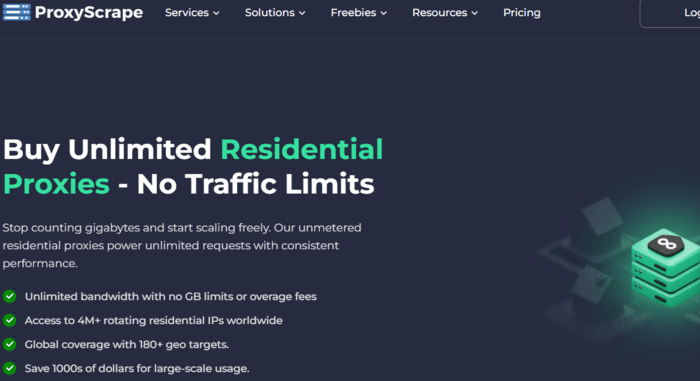
ProxyScrape offers unlimited residential proxies with no GB caps or overage fees. Instead of buying traffic, you buy a speed-based plan.
Its public pages show unlimited residential proxies with 4M+ rotating residential IPs, sticky sessions, and global targeting. A 200 Mbps unlimited residential plan is shown at $933.
Why ProxyScrape stands out
ProxyScrape is useful for high-volume users who want predictable pricing. If your monthly bandwidth changes a lot, a speed-based plan can be easier to control than a per-GB model.
Best for
ProxyScrape is best for continuous scraping, data collection, AI dataset gathering, and price monitoring.
Main drawback
Some public pages show different location counts, so you should confirm the exact location coverage before buying.
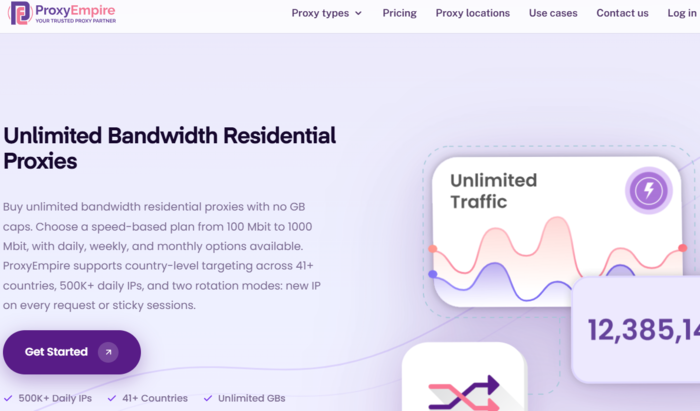
ProxyEmpire offers unlimited-bandwidth residential proxies on a port-speed model. Its unlimited plans are available at speeds of 100 Mbps, 200 Mbps, 500 Mbps, and 1 Gbps.
The important thing is that ProxyEmpire is clear about the trade-off. Its unlimited residential plans use a smaller pool and less granular targeting than its regular rotating residential proxies.
Why ProxyEmpire stands out
ProxyEmpire is honest about when unlimited residential proxies make sense. They are best when predictable pricing matters more than the largest IP pool or advanced targeting.
Best for
ProxyEmpire is best for price monitoring, competitor tracking, market research, SEO tools, and AI data collection workflows.
Main drawback
Public pricing is not as easy to find as some competitors. Also, country-level targeting may not be enough if you need city or ISP targeting.
Storm Proxies is one of the easiest unlimited residential proxy providers to understand. It sells residential backconnect rotating proxies by port.
The pricing is simple:
- 1 port: $19/month
- 5 ports: $50/month
- 10 ports: $90/month
- 20 ports: $160/month
- 50 ports: $300/month
- 100 ports: $550/month
Storm Proxies says its residential proxy pool includes 20M+ IPs and that residential IPs rotate every 5 minutes. For more information, read our Storm Proxies Review.
Why Storm Proxies stands out
Storm Proxies is not the most advanced provider, but it is affordable and simple. For users who want to test unlimited residential bandwidth without paying hundreds or thousands of dollars upfront, Storm is a practical starting point.
Best for
Storm Proxies is best for small scraping projects, SEO tools, basic market research, and users who want a fixed monthly price.
Main drawback
Storm Proxies has fewer advanced targeting options than premium providers. Location control is also limited compared with providers that offer city, ASN, ZIP code, or carrier targeting.
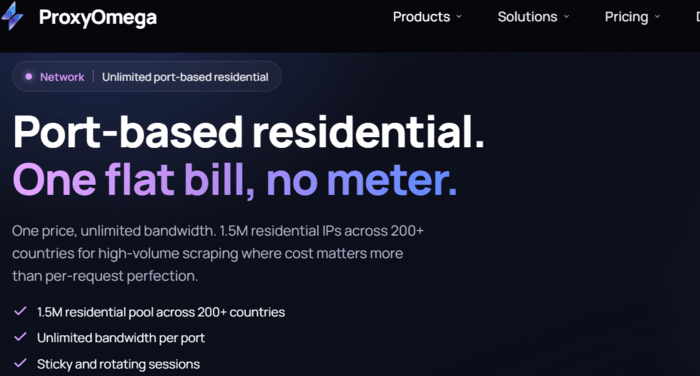
ProxyOmega offers budget and premium unlimited residential proxy plans. Its budget unlimited residential plan is shown from $51.99 per month, with 10M+ rotating IPs across 70+ countries. Its premium unlimited option is positioned for enterprise-grade usage.
Why ProxyOmega stands out
ProxyOmega is attractive because the entry price is much lower than many speed-based unlimited residential providers.
Best for
ProxyOmega is best for budget users who want to test unlimited residential proxies without starting at several hundred dollars per month.
Main drawback
Because pricing and plan details may depend on the dashboard, you should verify the bandwidth rules, speed limits, and refund policy before buying.
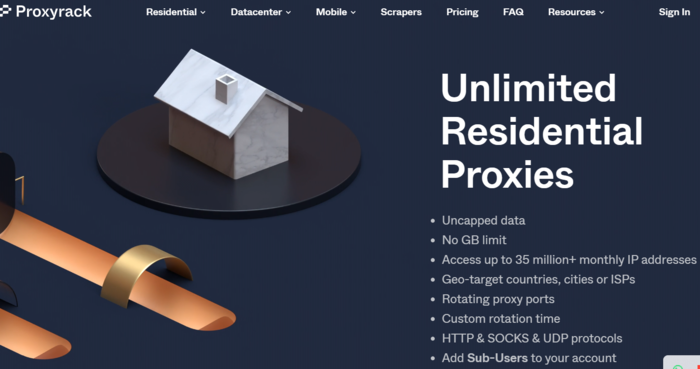
Proxyrack is one of the strongest options if you want real unmetered residential proxies. Its unmetered residential plans are not priced per GB. Instead, they are priced by thread.
The Build Your Own plan starts at around $300 per month, while larger plans can go from $1,250 per month to $4,500 per month depending on the number of threads.
What makes Proxyrack useful is that all unmetered residential plans include uncapped data, rotating and sticky IPs, country/city/ISP targeting, and support for HTTP, SOCKS, and UDP protocols.
Why Proxyrack stands out
Proxyrack is a good fit for teams that already know they need heavy bandwidth. If your scraping or monitoring project burns through hundreds or thousands of GBs per month, a thread-based plan can be easier to budget than per-GB residential proxy pricing.
Best for
Proxyrack is best for web scraping, SEO monitoring, price tracking, brand monitoring, and large-scale public data collection.
Main drawback
The entry cost is higher than many cheap residential proxy providers. If you only need a few GBs, Proxyrack is probably overkill.
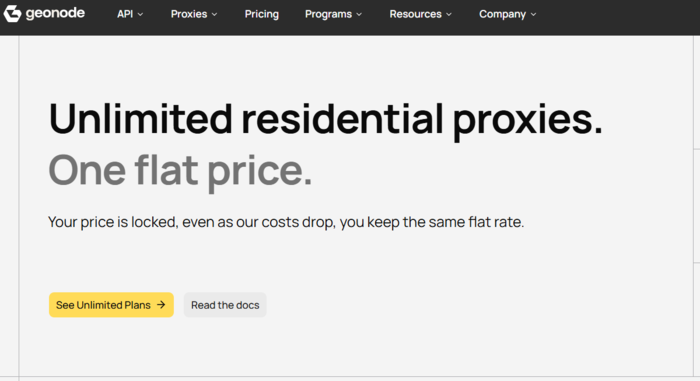
Geonode is another strong option for unlimited residential proxies. Its public page lists an unlimited residential plan at $499 per month with no GB cap and a 5-port starter setup.
Geonode also explains that its unlimited residential model is speed-based. That means you are not charged by data volume, but your throughput is limited by the plan speed. For more information, read our Geonode Review.
Why Geonode stands out
Geonode is more transparent than many proxy companies because it clearly explains that unlimited does not mean unlimited speed. It means no per-GB billing.
Best for
Geonode is best for users who want a flat monthly cost, residential IPs, and a simpler pricing model than traditional per-GB plans.
Main drawback
GeoNode’s owned residential pool is smaller than that of enterprise providers with 100M+ IP claims.
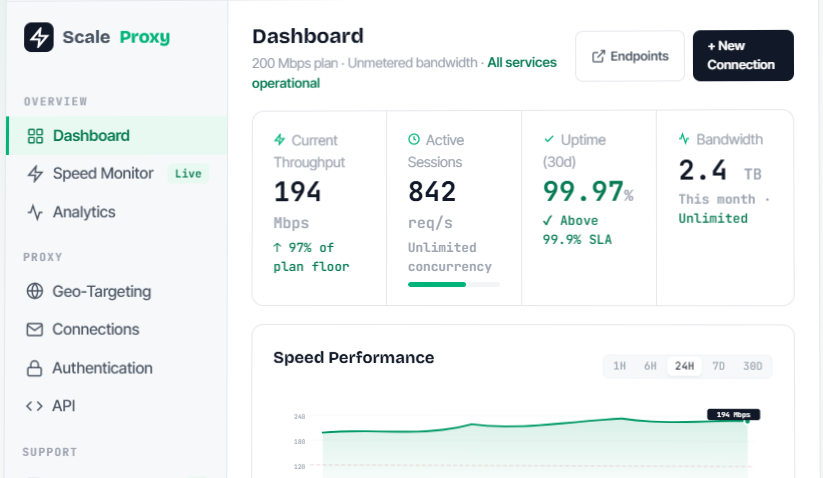
ScaleProxy sells unmetered residential proxies by speed tier. Its public page mentions speed tiers from 25 Mbps to 2 Gbps, unlimited concurrent connections, no per-GB fees, and 85M+ residential IPs across 195+ countries.
A visible example plan shows 200 Mbps at $1,145 per month.
Why ScaleProxy stands out
ScaleProxy is interesting because it focuses heavily on speed transparency. Instead of saying “fast proxies,” it talks about throughput floors, plan speed, and automatic credits if performance drops.
Best for
ScaleProxy is best for businesses that run large, continuous data workloads and want speed-based pricing.
Main drawback
ScaleProxy appears newer than legacy providers, so real-world testing is important before ranking it as a top enterprise choice.
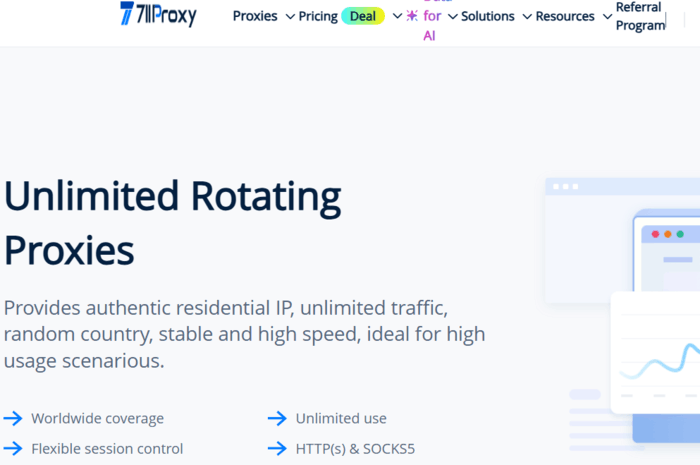
711Proxy offers unlimited rotating proxy plans by high-bandwidth duration and by port. Its public pricing includes hourly, daily, weekly, and longer-duration options.
One plan shows a $15 trial, while a 200 Mbps one-day plan is listed at $230 and a weekly plan at $740. The by-port plan shows 5 ports for $5, valid for 7 days, with 5 Mbps per port, unmetered traffic, unlimited threads, and HTTP(S)/SOCKS5 support.
Why 711Proxy stands out
711Proxy is useful if you do not want a full monthly commitment. The hourly and short-duration model can work well for one-off projects.
Best for
711Proxy is best for short-term scraping, temporary campaigns, and testing high-bandwidth residential proxy access.
Main drawback
The pricing structure is unusual, so you should test carefully before using it for production.
Webshare is not the best choice for unlimited rotating residential proxies, but it is a strong option for static residential or ISP proxies with unlimited bandwidth.
Its public pricing shows 100 static residential IPs with unlimited bandwidth at $90 per month. For more information, read our Webshare Review.
Why Webshare stands out
Webshare is simple, affordable, and beginner-friendly. Static residential IPs are useful when you need stable IPs rather than constant rotation.
Best for
Webshare is best for account access, testing, small automation workflows, and tasks where stable ISP IPs matter more than massive rotation.
Main drawback
Webshare’s rotating residential plan is not truly unlimited. It may have high bandwidth limits, but it is still not the same as no-GB billing.

Decodo is a strong proxy provider, but its unlimited proxy offer is better understood as dedicated ISP/static residential, not true unlimited rotating residential.
Its unlimited proxy page lists dedicated ISP proxies from $2.5 per IP with unlimited-duration sessions, premium ISP providers, and worldwide locations. For more information, read our Decodo Review.
Why Decodo stands out
Decodo is a better fit for users who need stable ISP proxies and a polished dashboard, rather than cheap unlimited rotating residential traffic.
Best for
Decodo is best for dedicated ISP use cases, long sessions, account stability, localized testing, and business users who want reliable infrastructure.
Main drawback
If your main goal is heavy rotating residential scraping with no GB limit, Decodo may not be the most direct fit.
Are Unlimited Residential Proxies Really Unlimited?
Not completely.
A good unlimited residential proxy plan usually means you do not pay per GB. But it does not mean you get unlimited speed, unlimited ports, unlimited targeting, unlimited success rate, or unlimited access to every IP in the provider’s network.
The real limits are usually hidden in:
- Mbps speed
- Thread count
- Port count
- Access IP count
- Fair-use policy
- Country availability
- Rotation rules
- Session duration
- Abuse policy
Final Verdict
The best unlimited residential proxy depends on your use case.
If you want the strongest overall unmetered residential option, Proxyrack is the best choice. If you want a cheaper, beginner-friendly unlimited port plan, Storm Proxies is easier to start with. If you want speed-based pricing for heavier workloads, ProxyScrape, Geonode, ScaleProxy, and ProxyEmpire are worth comparing.
If you do not need rotating residential IPs and only need stable ISP-style IPs with unlimited bandwidth, Webshare and Decodo are better fits.
For most buyers, the safest approach is simple:
Start with a small plan, test your real target websites, check speed and success rate, then scale only if the provider performs well for your specific workflow.
FAQs About Unlimited Residential Proxies
Unlimited residential proxies are residential proxy plans where traffic is not billed strictly by GB. Instead, the plan is usually limited by ports, threads, speed, duration, or fair-use rules.
Proxyrack is the best overall option for unmetered residential proxies. Storm Proxies is better for budget users, while ProxyScrape and Geonode are better for speed-based or flat-rate plans.
They can be cheaper for heavy users. If you use hundreds or thousands of GBs per month, unlimited residential proxies can reduce cost uncertainty. For small usage, pay-per-GB proxies are usually cheaper.
Some do not meter GB usage, but they may still limit speed, ports, threads, or locations. Always check the provider’s fair-use policy and plan details.
Yes, they can be useful for high-volume scraping, price monitoring, market research, and SEO tracking. However, success depends on proxy quality, rotation settings, request speed, and the target website.
Unlimited rotating residential proxies change IPs regularly and are better for large-scale data collection. Static residential or ISP proxies use stable IPs and are better for long sessions, account access, and testing.
Storm Proxies offers unlimited bandwidth on residential backconnect proxy plans, but the plans are limited by port count, access IP, and available locations.
Webshare offers static residential proxies with unlimited bandwidth. Its rotating residential plans are not the same as true unlimited rotating residential proxies.
Usually no. If your project uses only a few GBs per month, a pay-as-you-go residential proxy plan is often cheaper and more flexible.
Check bandwidth rules, speed limits, port count, location targeting, IP pool size, refund policy, and whether your use case is allowed.