
Buyresidentialproxy / Reviews /Bright Data

Bright Data Review
Bright Data Web Unlocker Review (2026): Our Hands-On Test
Rating 4.7 / 5
We purchased and tested Bright Data Web Unlocker ourselves instead of relying only on the provider’s advertised performance figures. In our 1,000-request benchmark, all 1,000 requests succeeded with no failures, producing a 100% success rate, with an average response time of 3.19 seconds.
Based on this test, Bright Data Web Unlocker delivered excellent request completion and dependable overall performance. The result suggests it is a strong option for users who need a managed service to access difficult public web pages without handling proxy rotation and blocking issues themselves.
These results apply to Bright Data Web Unlocker, a managed web-unblocking service. They should not be treated as a benchmark for Bright Data’s separate raw residential, ISP, datacenter, or mobile proxy networks.
Test #1: Bright Data Web Unlocker 1,000-Request Success Rate
We sent 1,000 requests through Bright Data Web Unlocker and recorded every successful and failed request.
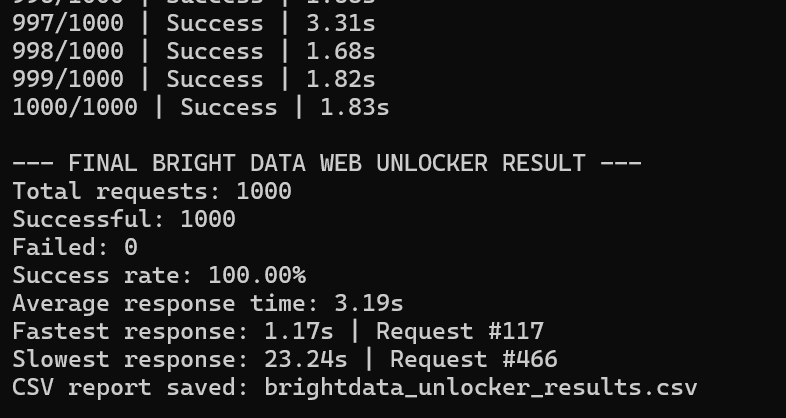
Successful: 1,000 / 1,000
Failed: 0 / 1,000
Success Rate: 100%
Failure Rate: 0%
Failure Reasons:
No failures were recorded in our Bright Data Web Unlocker benchmark.
BrightData Test Results at a Glance
Metric | Our Test Result |
|---|---|
Total Requests | 1,000 |
Successful Requests | 1,000 / 1,000 |
Failed Requests | 0 / 1,000 |
Success Rate | 100% |
Failure Rate | 0% |
Average Response Time | 3.19 sec |
For managed web-unblocking services, a high completion rate is an important reliability signal. Bright Data Web Unlocker completed all 1,000 requests successfully in our benchmark, producing a 100% success rate with no recorded failures.
This indicates highly reliable request completion in our test environment. These results apply to Bright Data Web Unlocker, not to its separate residential proxy network.
About BrightData Proxy
Bright Data Web Unlocker is a managed web-unblocking API for collecting public web data from sites that use bot detection, CAPTCHAs, JavaScript rendering, or other access restrictions.
According to Bright Data, Web Unlocker automatically manages browser fingerprinting, CAPTCHA solving, IP rotation, retries, cookies, and JavaScript rendering. This means users send a target URL through the API instead of manually configuring proxy rotation or maintaining browser automation.
Bright Data Web Unlocker Overview
Metric | Our Test Result |
|---|---|
Product Type | Managed web-unblocking API |
Proxy Infrastructure | 400M+ residential IPs advertised |
Geo-Targeting | Country-level targeting available |
IP Rotation | Automatic IP rotation and retries |
CAPTCHA Handling | Automatic CAPTCHA solving |
Browser Features | Browser fingerprinting, cookies, and JavaScript rendering |
Request Output | HTML, JSON, Markdown, or screenshot output |
Concurrency | Unlimited concurrency advertised |
Bright Data Web Unlocker Pros and Cons
Metric | Our Test Result |
|---|---|
100% success rate in our 1,000-request benchmark | Pricing is based on successful requests, which may be costly for high-volume use |
No failed requests recorded in our test | It is a managed API, not a raw proxy endpoint for users who need direct proxy control |
Automatically handles IP rotation, retries, CAPTCHAs, cookies, and JavaScript rendering | The 3.19-second average response time is reliable but not the fastest for simple requests |
Unlimited concurrency advertised | Advanced API-based setup may be less beginner-friendly than a basic proxy list |
Multiple output options, including HTML, JSON, Markdown, and screenshots | Results apply to Web Unlocker only, not Bright Data’s separate proxy products |
Bright Data Web Unlocker Dashboard & Setup Experience
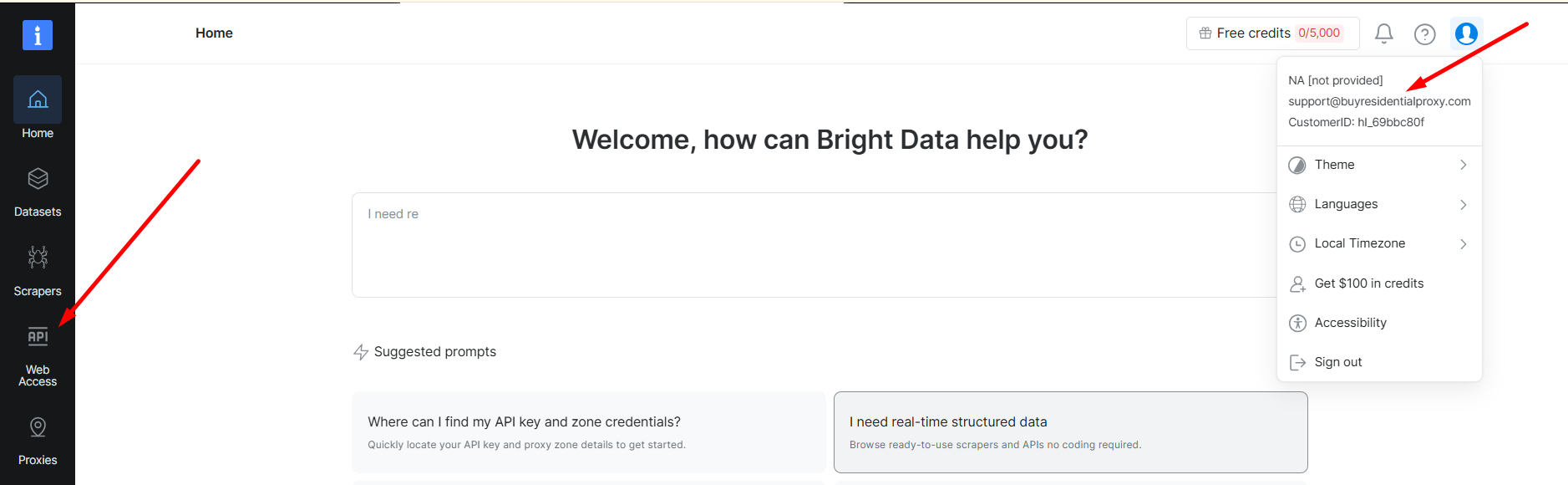
Bright Data manages Web Unlocker through its Web Access API dashboard. From the main navigation, users can access Web Access, Proxies, Datasets, and Scrapers. Each Web Unlocker zone includes three core areas:
Overview → Configuration → Playground
The Overview tab displays the zone’s access details, including API keys, IP allowlist controls, documentation, zone status, current plan, rate limit, free-credit balance, and account balance. Users can also choose between direct API access and native proxy-based access.
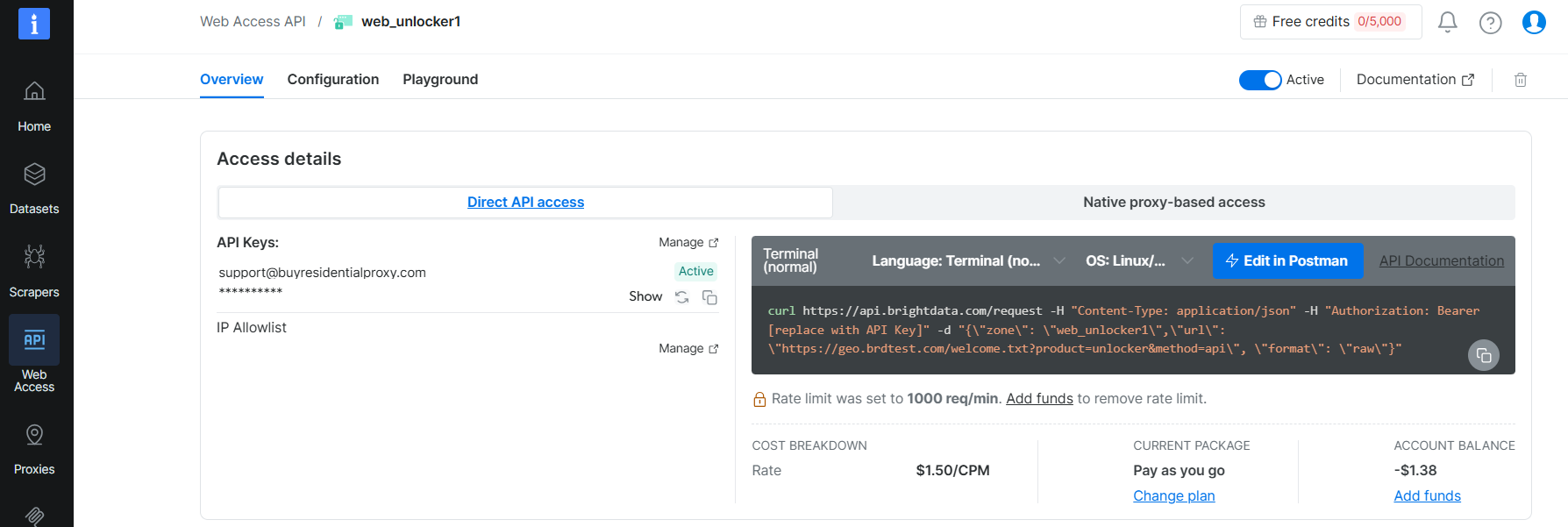
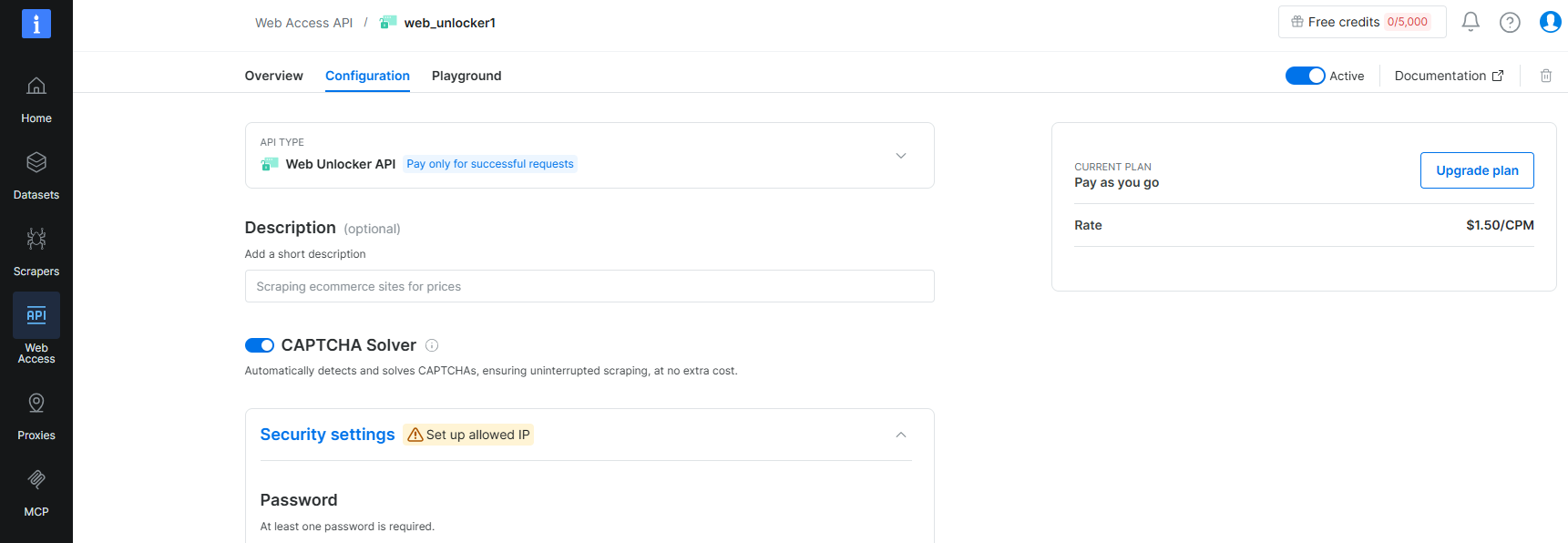
The Configuration tab lets users manage the Web Unlocker API type, add an optional zone description, enable or disable the CAPTCHA Solver, and configure security settings such as passwords and allowed IPs. In our account, the dashboard showed a pay-as-you-go plan at $1.50 CPM, with billing based on successful requests.
The Playground is useful for testing before deployment. Users can select API or native access, enter a target URL, choose a country and device type, add custom headers or cookies, and then click Run request to view the result. Bright Data also generates a ready-to-copy request example, which can help technical users move from testing to implementation.
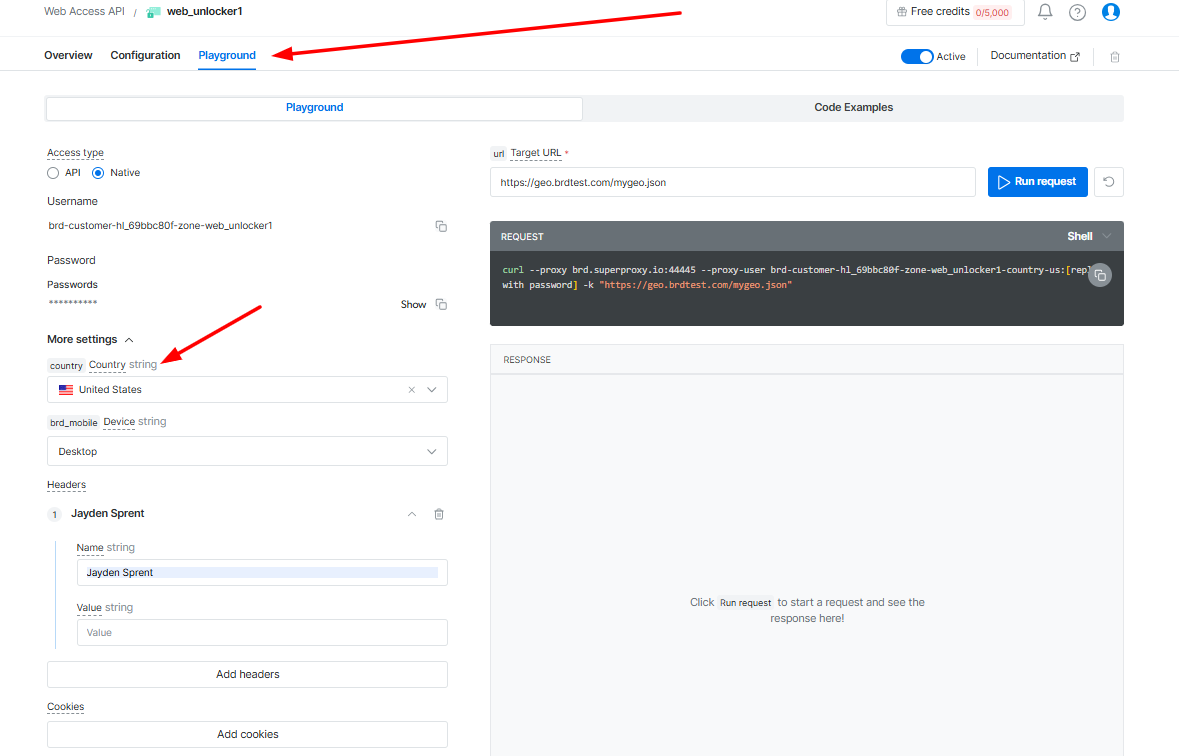
Overall, the dashboard is powerful and gives users detailed control over their Web Unlocker zone. However, it is designed around an API workflow, so it may take beginners longer to understand than a simple proxy-list dashboard.
Final Verdict & Scorecard
Category | Score | Why |
|---|---|---|
Success Rate | 5.0/5 | 1,000 / 1,000 requests succeeded (100%) |
Reliability | 5.0/5 | No failed requests were recorded in our benchmark |
Speed | 4.6/5 | 3.19-second average response time |
Pricing | 4.2/5 | Pay-as-you-go pricing |
Setup & Dashboard | 4.5/5 | API access, documentation, cURL example, Postman option, and testing tools |
Overall Rating: ⭐ 4.7/ 5 — Excellent
Bright Data Web Unlocker is a strong choice for teams that need reliable access to difficult public web pages without managing proxy rotation, CAPTCHA solving, browser fingerprints, or retries themselves.
Our 1,000-request benchmark achieved a 100% success rate with a 3.19-second average response time, showing excellent request completion and solid overall speed. It is especially suitable for web scraping, price monitoring, market research, SEO data collection, and other API-based public-data workflows.
This rating applies specifically to the Bright Data Web Unlocker configuration we tested. Bright Data’s residential, ISP, datacenter, and mobile proxy products are separate services.
Frequently Asked Questions (FAQs)
Bright Data Web Unlocker is a managed web-unblocking API that helps users collect public web data from sites protected by bot detection, CAPTCHAs, and JavaScript-based challenges.
No. Web Unlocker is a managed API service that uses Bright Data’s proxy infrastructure behind the scenes. It is different from buying and configuring Bright Data residential proxies directly.
In our 1,000-request benchmark, Bright Data Web Unlocker completed 1,000 of 1,000 requests successfully. It had a 100% success rate and an average response time of 3.19 seconds.
Yes. Bright Data states that Web Unlocker automatically manages IP rotation, retries, browser fingerprinting, cookies, CAPTCHAs, and JavaScript rendering.
It can be used by beginners, but it is API-based and best suited to users who are comfortable following API documentation or using provided cURL and Postman examples.
Bright Data advertises pricing from $1.50 per 1,000 successful requests and a free tier of 5,000 requests per month. Check Bright Data’s current pricing before purchasing because plans and rates can change.
No. Our results apply only to the Bright Data Web Unlocker configuration tested. Bright Data’s residential, ISP, datacenter, and mobile proxy products are separate services and may perform differently.

Author
Jayden Sprent (Proxy Specialist)
Hi, I'm Jayden Sprent. Dive into the world of proxy servers with my expert evaluations and insightful analyses based on thorough research. I'll share my experiences and comprehensive guides to help you make informed decisions about proxy services.
Learn More About Jayden Sprent