

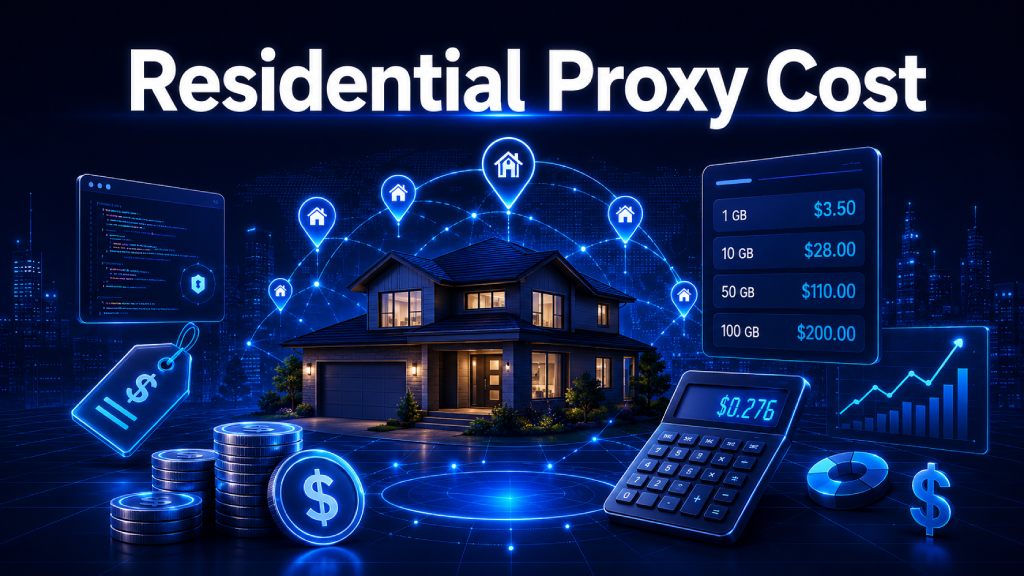
Residential proxies typically cost $3–$15 per GB depending on provider tier, pool size, and geo-targeting precision. Entry-level plans start at $5–$15 per GB. Mid-tier volume plans run $3–$8 per GB. Enterprise and dedicated pool plans drop to $1–$4 per GB. There are no unlimited bandwidth residential proxy plans — bandwidth is always metered.
Residential Proxy Pricing by Plan Tier (2026)
| Plan Tier | Price Range | Best For |
|---|---|---|
| Entry-Level | $8–$15 per GB | Testing, low-volume tasks |
| Starter | $5–$10 per GB | Small scraping, personal use |
| Mid-Tier | $3–$8 per GB | Regular business operations |
| High-Volume | $2–$5 per GB | Large-scale scraping, price monitoring |
| Enterprise | $1–$4 per GB | Dedicated pools, custom infrastructure |
| Pay-As-You-Go | $10–$15 per GB | Irregular usage, no commitment |
| Monthly Subscription | $3–$8 per GB | Consistent ongoing operations |
| Annual Subscription | $1–$5 per GB | Best value, long-term commitment |
 Best value rule: Always buy closer to your actual usage. The highest volume tier you can sustain gives you the lowest per-GB rate.
What Affects Residential Proxy Cost
Residential proxy pricing is not one flat number. Several factors push the price up or down — understanding them helps you avoid overpaying.
1. Bandwidth Volume
The single biggest cost driver. The more bandwidth you commit to, the lower your per-GB rate. A 1 GB plan may cost $15/GB. A 100 GB plan may cost $3/GB from the same provider. Always buy closer to your actual usage — unused bandwidth is wasted spend.
2. IP Pool Size and Quality
Larger, cleaner IP pools cost more. Providers that maintain millions of IPs across hundreds of countries, clean their pools regularly, and remove flagged IPs invest more in infrastructure — and charge accordingly. Cheap providers often have smaller, dirtier pools with higher ban rates.
3. Geo-Targeting Precision
Country-level targeting is standard and usually included in base pricing. City-level targeting often costs 10–20% more. ZIP or ASN-level targeting — where available — may be priced separately or available only on higher tiers.
4. Rotation Type
Rotating residential proxies (standard) are priced per GB. Static residential proxies (ISP proxies) are priced per IP per month — typically $2–$6 per IP — with unlimited bandwidth included.
5. Session Length
Sticky sessions — where the same IP is held for a defined period (1 minute, 10 minutes, 30 minutes) — may cost more than pure rotating sessions where the IP changes with every request.
6. Provider Reputation and Support
Established providers with large pools, verified consent programs, legal compliance documentation, and 24/7 support charge a premium. Budget providers cut costs somewhere — usually in pool quality, support, or ethical sourcing practices.
Residential Proxy Cost by Monthly Bandwidth
| Monthly Bandwidth | Price per GB | Estimated Monthly Cost |
|---|---|---|
| 1 GB | $10–$15 | $10–$15 |
| 5 GB | $8–$12 | $40–$60 |
| 10 GB | $6–$10 | $60–$100 |
| 25 GB | $5–$8 | $125–$200 |
| 50 GB | $4–$6 | $200–$300 |
| 100 GB | $3–$5 | $300–$500 |
| 250 GB | $2–$4 | $500–$1,000 |
| 500 GB+ | $1–$3 (best rate) | $500–$1,500+ |
 Always add a 15–20% buffer on top of your estimated bandwidth to account for retries, redirects, CAPTCHAs, and failed requests that still consume bandwidth.
Residential vs Other Proxy Types: Cost Comparison
| Proxy Type | Pricing Model | Typical Cost | Bandwidth |
|---|---|---|---|
| Residential (rotating) | Per GB | $3–$15 per GB | Always metered |
| Static Residential (ISP) | Per IP / month | $2–$6 per IP/month | Usually unlimited |
| Datacenter (shared) | Per GB or per IP | $0.50–$2 per GB | Often metered |
| Datacenter (dedicated) | Per IP / month | $1–$5 per IP/month | Usually unlimited |
| Mobile Proxy | Per GB | $15–$30+ per GB | Always metered |
Residential proxies sit in the middle of the pricing spectrum — more expensive than datacenter, less expensive than mobile. For most scraping and data collection, they offer the best balance of cost and detection resistance.
Residential proxies sit in the middle of the pricing spectrum — more expensive than datacenter, less expensive than mobile. For most scraping and data collection tasks, they offer the best balance of cost and detection resistance.
Hidden Costs to Watch For
Most proxy buyers focus on the per-GB headline price. These costs are less visible but add up quickly:
Overage fees: Some plans charge significantly higher rates for bandwidth used beyond your plan limit — sometimes 2–3x the standard rate. Always check the overage policy before committing.
Geo-targeting surcharges: City-level or ZIP-level targeting is often priced separately. A plan advertised at $5/GB may become $6–$7/GB for city-level targeting.
Sticky session premiums: Plans that offer session persistence (holding the same IP for 10–30 minutes) sometimes charge a premium over pure rotating plans.
Minimum commitments: Some enterprise plans require a minimum monthly spend or a minimum bandwidth commitment. Unused bandwidth typically does not roll over.
Setup fees: Less common but present with some providers — particularly for custom or dedicated pool arrangements.
Concurrent connection limits: Some plans cap the number of simultaneous connections. Exceeding the limit either blocks requests or triggers upgrade prompts. Factor this into your actual operational cost.
How to Calculate Your Real Residential Proxy Cost
Use this formula to estimate your actual monthly spend before purchasing:
Monthly Cost = (Expected Requests × Average Page Size in MB) ÷ 1,024 × Price per GB
Example:
- 50,000 requests per month
- Average page size: 1.5 MB
- Price: $5 per GB
= (50,000 × 1.5) ÷ 1,024 × $5
= 75,000 MB ÷ 1,024 × $5
= 73.2 GB × $5
= ~$366 per month
Add 20% buffer for retries, redirects, and failed requests:
= $366 × 1.2 = ~$439 per month
Always add a 15–20% buffer on top of your calculated estimate to account for retries, redirects, CAPTCHAs, and failed requests that still consume bandwidth.
Residential Proxy Cost by Use Case
| Use Case | Est. Monthly Bandwidth | Est. Monthly Cost |
|---|---|---|
| Light SEO rank tracking | 2–5 GB | $10–$50 |
| Small-scale price monitoring | 5–20 GB | $25–$160 |
| Ad verification (single market) | 3–10 GB | $15–$100 |
| Social media research | 5–25 GB | $25–$200 |
| Travel fare aggregation | 10–50 GB | $50–$400 |
| Mid-scale web scraping | 20–100 GB | $80–$500 |
| Large-scale data collection | 100–500 GB | $300–$2,000 |
| Enterprise scraping operation | 500 GB–2 TB | $1,000–$6,000+ |
 All estimates include a 20% buffer for retries and failed requests. Actual cost depends on page complexity, target site difficulty, and provider pricing tier.
Is Cheap Always Bad? What Budget Proxies Actually Cost You
A $1/GB residential proxy sounds like a bargain. Here is what cheap proxies typically compromise on:
Pool quality: Smaller pools with more shared IPs mean higher reuse rates — the same IP appears in more requests. Detection rates increase. You pay less per GB but complete fewer successful requests per GB.
Ban rate: Dirty pools with previously flagged IPs result in higher block rates. If 30% of your requests fail, your effective cost per successful request doubles even at half the per-GB price.
Ethical sourcing: Budget providers often source IPs with minimal consent practices. This creates legal exposure and means IPs may come from compromised devices — flagged by security vendors and more likely to be blocked.
Support and reliability: When your scraping job fails at 2am, support quality matters. Budget providers often have limited or slow support, increasing downtime costs.
The real cost formula:
Effective Cost per Successful Request =
(Price per GB × Bandwidth Used) ÷ (Total Requests × Success Rate)
Example — Cheap provider:
($1 × 100 GB) ÷ (50,000 requests × 0.60 success rate) = $0.0033 per success
Example — Quality provider:
($5 × 100 GB) ÷ (50,000 requests × 0.95 success rate) = $0.0105 per success
At scale (1 million successful requests):
Cheap: $3,300 | Quality: $10,500
If cheap proxy requires 70% more bandwidth due to failures:
Cheap: $3,300 × 1.7 = $5,610 — still cheaper, but gap narrows significantly.
At moderate scale, quality providers often deliver better ROI once retry overhead and operational costs are factored in.
Residential Proxy Cost — FAQ
Straight answers on pricing, bandwidth, hidden fees, and how to calculate your real monthly cost.
It depends entirely on how much bandwidth you use. Light users (2–5 GB) pay $10–$75 per month. Mid-scale operations (50–100 GB) pay $200–$500 per month. Enterprise operations (500 GB+) pay $1,000–$6,000+ per month. All residential proxy plans are metered per GB — there are no unlimited bandwidth options for rotating residential proxies.
Residential proxy networks are built on real home devices through peer-to-peer opt-in programs. Providers must compensate device owners, maintain consent infrastructure, clean IP pools regularly, and manage compliance with data protection laws. All of that costs significantly more than running commercial datacenter servers. The premium reflects genuine infrastructure complexity, not arbitrary markup.
No. All rotating residential proxy plans are metered per GB — there are no unlimited bandwidth options. Unlimited bandwidth is a feature of static residential (ISP) proxies and dedicated datacenter proxies, which are priced per IP per month rather than per GB. If unlimited bandwidth is your priority, static residential proxies at $2–$6 per IP per month are the closest residential equivalent.
Enterprise and annual subscription plans at high volume tiers can reach $1–$2 per GB — the lowest rate available for residential proxies. The cheapest option per-GB is always the highest volume commitment you can sustain without leaving bandwidth unused. Pay-as-you-go entry plans are the most expensive at $10–$15 per GB, but require no commitment. Never choose a plan based on headline price alone — pool quality and success rate affect your real cost per successful request.
Multiply your expected monthly requests by the average page size, then divide by 1,024 to convert MB to GB. For example: 50,000 requests × 1.5 MB average = 75,000 MB ÷ 1,024 = 73.2 GB per month. Always add a 15–20% buffer on top to account for retries, redirects, CAPTCHAs, and failed requests that still consume bandwidth. So 73.2 GB × 1.20 = approximately 88 GB — plan for a 100 GB tier.
Six hidden costs catch buyers off guard: overage fees (some providers charge 2–3x the standard rate for bandwidth beyond your plan limit); geo-targeting surcharges (city or ZIP-level targeting can add $1–$2 per GB); sticky session premiums (holding the same IP for 10–30 minutes sometimes costs more); minimum commitments with no bandwidth rollover; setup fees on custom or dedicated pool arrangements; and concurrent connection limits that block requests when exceeded. Always read the full plan terms before committing.
Yes. Country-level targeting is standard and usually included in the base per-GB price. City-level targeting often costs 10–20% more per GB. ZIP-level or ASN-level targeting — where available — may be priced separately or only available on higher tiers. If your use case requires city or ZIP-level precision, factor the surcharge into your cost estimate before choosing a plan.
Sometimes, but the headline price is not the real cost. Cheap providers typically have smaller, dirtier IP pools with higher ban rates. If 30–40% of your requests fail on a cheap proxy, your effective cost per successful request may be higher than a quality provider at twice the per-GB price. The right metric is cost per successful request — not cost per GB. Calculate that figure for both options before deciding.
Pay-as-you-go plans charge $10–$15 per GB with no monthly commitment — ideal for irregular or testing usage. Subscription plans (monthly or annual) lock in a bandwidth amount at a lower per-GB rate — typically $3–$8 per GB monthly, $1–$5 per GB annually. The trade-off is commitment versus flexibility. If your usage is consistent and predictable, subscriptions offer significantly better value. If usage varies widely month to month, pay-as-you-go avoids wasted bandwidth spend.
Mobile proxies cost significantly more — typically $15–$30+ per GB versus $3–$15 per GB for residential. That is a 4–6x price difference at comparable tiers. Mobile proxies offer a lower ban rate and carrier-level trust, which is worth the premium for social media automation and mobile-first platforms. For general scraping, SEO tracking, and price monitoring, residential proxies deliver comparable detection resistance at a fraction of the cost.
Free residential proxies exist but are not viable for business use. They typically have unreliable uptime, poor pool quality, no ethical sourcing documentation, minimal support, and significant security risks — the IPs may come from compromised devices or be shared by thousands of users simultaneously. For any consistent business operation, the operational cost of dealing with free proxy failures exceeds the cost of a paid plan at entry-level pricing.