

Free residential proxies look attractive at first. You get a real-looking residential IP address without paying for it. For a business owner, that sounds useful if you want to test websites, check search results, monitor competitors, or access location-based pages.
But here is the truth: free residential proxies are usually not safe for serious business use. They may expose your data, slow down your workflow, create legal and compliance risks, or damage your business accounts if the IPs are already abused.
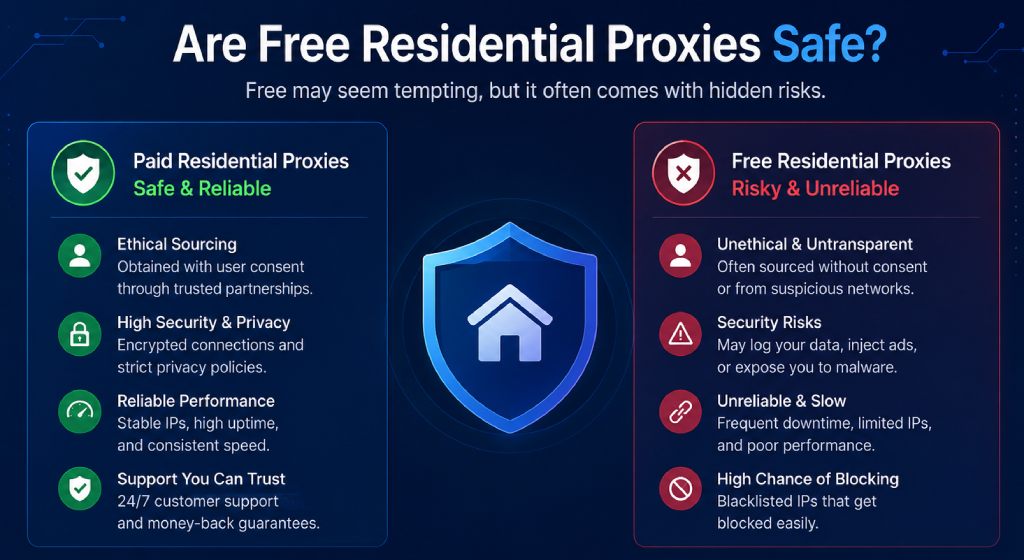
That does not mean every free proxy is automatically dangerous. Some may work for basic testing. But when your business data, customer accounts, login details, payment tools, or brand reputation are involved, free residential proxies are a risky choice.
This guide explains what free residential proxies are, why people use them, the main risks, when they may be acceptable, and what safer alternatives business owners should consider.
Are Free Residential Proxies Safe?
No, free residential proxies are generally not safe for business use. They may log your traffic, inject ads, expose sensitive data, use unstable IPs, or route your connection through unknown devices. A business should avoid free residential proxies for account management, data scraping, SEO tools, market research, payment-related tasks, or any login-based activity.
For low-risk testing, a free proxy may be okay for checking a public webpage. But for anything important, use a trusted paid residential proxy provider with clear sourcing, authentication, support, and privacy policies.
What Is a Free Residential Proxy?
A residential proxy is an IP address that comes from a real internet service provider, usually connected to a home device or real user network. Websites often trust residential IPs more than datacenter IPs because they look like normal user traffic.
A free residential proxy is a residential IP that someone offers without direct payment. These proxies may appear on public proxy lists, browser extensions, free VPN apps, online proxy tools, or private communities.
The problem is simple: running a proxy network costs money. Someone has to pay for servers, bandwidth, maintenance, abuse monitoring, and infrastructure. If you are not paying with money, you may be paying with something else, such as your data, your device resources, or your privacy.
Why Do Business Owners Search for Free Residential Proxies?
Business owners usually search for free residential proxies because they want to reduce costs. This is understandable, especially for small businesses, startups, agencies, and solo marketers.
Common reasons include:
| Use Case | Why Free Proxies Look Attractive | Real Risk |
|---|---|---|
| SEO rank checking | Quick location testing | Inaccurate or blocked results |
| Web scraping | No proxy budget needed | Data loss, bans, poor success rate |
| Competitor research | Easy access to geo pages | Slow speed and unstable IPs |
| Social media testing | Avoid using main IP | Account security risk |
| Ad verification | Check ads from different locations | Bad IP reputation |
| Market research | Test public pages | Unreliable results |
The main issue is not only safety. It is also reliability. A free proxy may work today and stop working tomorrow. It may show the wrong location. It may already be banned by Google, Amazon, Facebook, Instagram, LinkedIn, or other platforms.
For a business, unreliable data can create wrong decisions.
Main Risks of Free Residential Proxies
Free residential proxies can create several risks. Some risks are technical, some are legal, and some are business-related.
1. Your Data May Be Logged
When you use a proxy, your traffic passes through another server or device before reaching the target website. If the proxy owner is unknown, you do not really know what they are doing with your traffic.
They may log:
- Websites you visit
- IP address and device details
- Session information
- Search queries
- Cookies
- Request headers
- Account activity
If you log in to business tools while using an unsafe proxy, the risk becomes bigger. Your login session, account behavior, or sensitive request data may be exposed.
A business should never use a free proxy for dashboards, client accounts, CRM tools, payment portals, email accounts, advertising accounts, or admin panels.
2. Free Proxies May Not Encrypt Your Traffic
Many free proxies, especially public HTTP proxies, do not provide proper protection. If the connection is not secure, your data may be visible to the proxy operator.
HTTPS websites protect a lot of sensitive information, but that does not mean every proxy setup is safe. A bad proxy can still see metadata, domains, request patterns, and in some cases interfere with traffic.
For business owners, this is a serious issue. Even if passwords are not directly visible, activity patterns and account details can still be valuable.
3. Some Free Proxies Inject Ads or Scripts
Some free proxies make money by modifying the pages you visit. They may inject ads, popups, tracking scripts, or unwanted code.
This can create a bad browsing experience, but the bigger problem is trust. If a proxy can modify what you see, it may also interfere with your testing results.
For example, if you are checking a landing page, ad placement, checkout page, or search result, the proxy may change the page. That means your research data may not be accurate.
A business should never depend on modified or unstable browsing results.
4. Free Residential IPs May Come From Unclear Sources
Ethical sourcing is one of the biggest issues in the residential proxy industry. A safe residential proxy network should clearly explain how it gets IPs and whether device owners give permission.
Free residential proxies often do not give this clarity.
Some may come from:
- Free VPN apps
- Browser extensions
- Proxyware apps
- Compromised devices
- Unknown peer-to-peer networks
- Users who did not fully understand what they installed
This creates a business risk. If your company uses traffic from questionable sources, it can affect your reputation and compliance position.
A responsible business should choose proxies that are ethically sourced and clearly documented.
5. Bad IP Reputation Can Hurt Your Accounts
Free proxies are often used by many unknown users. Some users may use them for spam, fake signups, aggressive scraping, account abuse, or other risky activity.
As a result, many free proxy IPs are already flagged or blocked by websites.
If you use a bad IP to access your business account, the platform may see your login as suspicious. This can trigger:
- Account verification
- Temporary lock
- CAPTCHA
- Phone verification
- Password reset
- Account suspension
- Lower trust score
For business owners, this is not worth the risk. One account lock can cost more than a paid proxy plan.
6. Free Proxies Are Usually Slow and Unstable
Free proxies are popular because they cost nothing. That also means many people use the same IPs at the same time.
Common performance problems include:
- Slow loading
- Frequent timeout
- Wrong location
- Connection drops
- High failure rate
- Inconsistent speed
- Blocked websites
If you are running SEO tools, scraping workflows, price monitoring, ad checks, or QA testing, unstable proxies waste time and create incomplete data.
A business needs predictable performance, not random success.
7. You May Break Platform Rules Without Knowing
Different websites have different rules for automation, scraping, account access, and proxy usage. Free proxies make this risk worse because you often do not know who else used the IP before you.
Even if your intention is normal research, a platform may connect your activity with suspicious traffic from the same IP.
That can create problems with:
- Terms of service
- Account trust
- Compliance
- Client reporting
- Data accuracy
Business owners should not only ask, “Can I access the site?” They should also ask, “Is this method safe, ethical, and acceptable for my business?”
8. Free Proxies Can Damage Research Accuracy
Many business owners use proxies for market research. But if the proxy IP is poor quality, the result may not reflect a real user experience.
For example:
- Google may show CAPTCHA instead of normal results
- Ecommerce sites may block the page
- Social platforms may limit content
- Local results may show the wrong city
- Websites may show security pages
- Prices may not load correctly
That means your data can become misleading.
For SEO, price monitoring, and competitor analysis, wrong data is dangerous. It can lead to wrong strategy decisions.
Are Free Residential Proxies Ever Okay?
Free residential proxies may be acceptable for very basic, low-risk tasks.
For example, you may use one to:
- Check if a public webpage opens
- Test a non-sensitive page from another IP
- Learn how proxies work
- Run a small technical experiment
- Compare proxy speed in a test environment
But you should not use free residential proxies for:
- Logging into business accounts
- Managing social media accounts
- Accessing client dashboards
- Running paid ads accounts
- Handling payment pages
- Scraping important business data
- Sending forms
- Collecting customer information
- Long-term SEO tracking
- Any client project
A good rule is simple: if the task matters to your business, do not use a free proxy.
Free Residential Proxies vs Paid Residential Proxies
Here is a simple comparison for business owners.
Feature | Free Residential Proxies | Paid Residential Proxies |
|---|---|---|
Cost | Free | Paid per GB or package |
IP quality | Usually poor or unknown | Usually managed |
Privacy | Slow and unstable | More stable |
Speed | Unclear | Better policies |
Support | Usually none | Customer support available |
IP sourcing | Often unclear | Usually documented |
Authentication | Weak or none | Username/password or API |
Business safety | Risky | Safer |
Best use | Testing only | Business workflows |
Paid proxies are not automatically perfect. You still need to choose a trusted provider. But paid residential proxies usually give you better control, clearer policies, better performance, and support if something goes wrong.
How to Check If a Residential Proxy Is Safe
Before using any residential proxy provider, ask these questions.
1. Does the provider explain IP sourcing?
A trustworthy provider should explain where its residential IPs come from. Look for clear information about user consent, partner apps, SDK networks, or opt-in models.
If there is no explanation, be careful.
2. Does the provider have a privacy policy?
Check whether the provider explains what data it collects, how long it keeps logs, and how it protects users.
A vague privacy policy is a warning sign.
3. Does it offer authentication?
Business proxies should have secure authentication, such as username/password, IP whitelist, or dashboard access.
Open public proxies are not suitable for business use.
4. Does it provide location control?
If you need proxies for SEO, ad verification, or market research, you need accurate location targeting.
Free proxies often claim one location but show another.
5. Does it have support?
If your proxy fails during a business task, you need help. Free proxies usually do not offer real support.
6. Does it have clear terms of service?
A reliable provider should explain allowed and prohibited use cases. This protects both the provider and customers.
7. Does it have a stable dashboard or API?
For business use, you need control. A proper dashboard, usage tracking, API access, and session settings are signs of a more serious provider.
Warning Signs of an Unsafe Free Proxy
Avoid a free residential proxy if you notice any of these signs:
- No company name
- No privacy policy
- No terms of service
- No explanation of IP sources
- No support contact
- Too many popups
- Browser extension asks for too many permissions
- The proxy requires installing unknown software
- The IP changes randomly
- HTTPS pages fail
- Login pages show security warnings
- The proxy is listed on spam databases
- The speed is extremely unstable
- The service promises “unlimited free premium residential proxies”
If something looks too good to be true, it probably is.
Best Practices If You Still Want to Test a Free Proxy
If you are only testing and still want to try a free proxy, follow basic safety rules.
First, never use your main business device. Use a separate test browser or test environment.
Second, do not log in to any important account. Avoid email, social media, banking, CRM, ad platforms, hosting accounts, or client dashboards.
Third, do not submit personal or customer information.
Fourth, do not install unknown proxy apps or browser extensions unless you fully trust the source.
Fifth, test only public websites where no sensitive data is involved.
Sixth, clear cookies and browser sessions after testing.
Finally, do not use free proxies for client work. Your client expects safe and reliable methods.
Safer Alternatives to Free Residential Proxies
Instead of using free residential proxies, business owners can consider safer options.
1. Paid Residential Proxies
Paid residential proxies are better for tasks where trust and location accuracy matter. They are useful for SEO monitoring, ad verification, price monitoring, market research, and public web data collection.
Look for providers with ethical sourcing, clear documentation, good support, and stable performance.
2. Datacenter Proxies
Datacenter proxies are usually faster and cheaper than residential proxies. They are useful for high-volume tasks where residential trust is not required.
However, they are easier for websites to detect.
3. ISP Proxies
ISP proxies combine some benefits of residential and datacenter proxies. They use ISP-assigned IPs but are hosted on stable infrastructure.
They are useful when you need speed, stability, and a trusted IP type.
4. Official APIs
If a website offers an official API, it may be safer and more reliable than scraping through proxies.
APIs are often better for compliance, data accuracy, and long-term business use.
5. Manual Research
For small tasks, manual checking may be safer than using a random free proxy. This is especially true for sensitive business research.
Business Recommendation: Should You Use Free Residential Proxies?
For business owners, the answer is simple: avoid free residential proxies for serious work.
Free proxies may look like a cost-saving option, but they can create bigger costs later. You may lose time, damage accounts, collect inaccurate data, or expose sensitive information.
Use free proxies only for basic learning or public page testing. For business tasks, choose a trusted paid proxy provider or a safer data access method.
Final Verdict
Free residential proxies are not safe enough for most business use cases. They may be useful for small experiments, but they are not reliable for SEO, scraping, market research, account management, ad verification, or client work.
A business should care about more than getting a different IP address. It should care about privacy, security, uptime, data quality, compliance, and reputation.
If your business depends on accurate data and safe access, free residential proxies are not worth the risk.
FAQs About Free Residential Proxy Safety
Free residential proxies are generally not safe for business use. They may log data, use unclear IP sources, inject ads, or provide unstable connections. They should only be used for low-risk public testing.
A free proxy can potentially see parts of your traffic, metadata, browsing activity, and request patterns. If the proxy is malicious or poorly managed, it may create privacy and security risks.
Free residential proxies are not recommended for serious SEO work. They are often slow, unstable, blocked, or inaccurate. SEO tools need reliable location and clean IP reputation.
You can test public pages with free proxies, but they are not reliable for business scraping. They may fail often, produce incomplete data, or trigger blocks.
Paid residential proxies are usually safer than free proxies when the provider has clear sourcing, privacy policies, authentication, support, and usage controls. However, you should still choose carefully.
Free proxies are risky because you do not know who controls them, how they make money, what data they collect, or where the IPs come from.
Yes, using free proxies can trigger suspicious login alerts, CAPTCHA, verification checks, or account restrictions, especially if the IP was previously abused.
The safest option depends on your task. For public data, official APIs are best when available. For location-based research, trusted paid residential or ISP proxies are better than free proxies.
Small businesses should avoid free proxies for important work. The low cost is attractive, but the security and reliability risks are too high.
Check IP sourcing, privacy policy, authentication, terms of service, support quality, dashboard features, and user reviews. Avoid providers that hide basic company and sourcing information.