


Top Picks for Residential Proxy Services for Reddit
- Best overall for Bitcoin checkout: Proxy-Cheap — dedicated BTC, USDT, ETH, and LTC payment pages
- Cheapest serious option: DataImpulse at $1/GB with a 5GB free trial (note: crypto payments are non-refundable)
- Largest IP pool: Decodo with 115M+ IPs across 195+ countries
- Best non-expiring credits: IPRoyal — buy GBs once, use them indefinitely
- Cleanest IPs for social/multi-account: NodeMaven with 95% clean-IP rate via real-time filtering
Why Pay for Residential Proxies With Bitcoin?
People searching for "buy residential proxies with Bitcoin" usually want one of three things: privacy, cross-border payment freedom, or a way to test a provider without exposing a real card. Bitcoin handles all three reasonably well, but it isn't magic.
What Bitcoin gives you:
- No card statement trail. Your bank doesn't see "Proxy-Cheap" on your statement. Useful if you share finances or work in regulated industries.
- No VAT in some jurisdictions. IPRoyal and several others explicitly waive VAT on crypto payments, saving 18–25% in EU regions.
- Pseudonymous identity. No name, address, or bank details required for most providers. A fresh wallet and a working email is usually enough.
- Borderless payment. Works the same whether you're buying from Romania, Nigeria, or Bangladesh.
What Bitcoin does NOT give you:
- Full anonymity. Bitcoin is pseudonymous, not anonymous. Wallet addresses are public, and chain-analysis firms can often trace flows back to exchanges.
- Refunds. Most providers can refund to account balance, but converting back to BTC means paying network and exchange fees. DataImpulse explicitly marks crypto payments as final.
Comparison: 5 Best Providers at a Glance
Side-by-side breakdown of pricing, IP pool, crypto support, and KYC policy — verified from each provider's official documentation as of May 2026.
| Provider | Starting Price | IP Pool | Crypto Gateway | KYC? | Refundable? | Visit |
|---|---|---|---|---|---|---|
|
1Proxy-Cheap
|
$2.29 / month | 85M+ IPs · 120+ countries | BTC, ETH, USDT, LTC | Rarely | To account balance | Visit → |
|
2IPRoyal
|
$7.00 / GB | 32M+ IPs · 190+ countries | CoinGate (25+ coins) | Large orders only | Non-expiring credits | Visit → |
|
3Decodo
|
$3.75 / GB | 115M+ IPs · 195+ countries | BTC + others | Sometimes | Balance (traffic expires) | Visit → |
|
4DataImpulse
|
$1 / GB | 90M+ IPs · 195 countries | BTC, USDT TRC20 | No | Non-refundable | Visit → |
|
5NodeMaven
|
$4.00 / GB | 30M+ IPs · 1,400+ cities | BTC, ETH, USDT, SOL | Rarely | To account balance | Visit → |
Prices verified May 2026 directly against each provider's official pricing page. Always confirm at checkout, as crypto exchange rates and provider plans change frequently.
⚐ Affiliate disclosure: Buttons marked "Visit" are affiliate links. We may earn a commission if you buy through them, at no extra cost to you.
Comparison: 5 Best Providers at a Glance
The cleanest crypto-checkout experience in the residential proxy market. Proxy-Cheap built dedicated payment landing pages for Bitcoin, USDT, Ethereum, and Litecoin — meaning the workflow is designed for crypto buyers, not bolted on as an afterthought. The platform also keeps its dashboard simple enough for beginners and offers pay-as-you-go billing.
Pros:
Cons:
Best for: Buyers who want the smoothest possible Bitcoin checkout, dedicated payment guides per coin, and don't need enterprise-scale features. Ideal for SEO research, ad verification, and small-team scraping projects.

IPRoyal's standout feature is traffic that never expires. Buy bandwidth once with Bitcoin, use it across months — perfect for inconsistent workloads. Their crypto integration runs through CoinGate, supporting 25+ cryptocurrencies. The IP pool is ethically sourced via opt-in, which matters for compliance-sensitive workflows.
Pros:
Cons:
Best for: Freelancers and agencies whose proxy usage comes in spikes. The non-expiring credits mean you can buy 10GB once and burn it down over six months without losing anything. Also strong for users who care about ethical IP sourcing.

Rebranded from Smartproxy in 2025, Decodo carries the largest residential pool in this comparison — 115M+ IPs across 195+ countries — with a 99.7% measured success rate. Crypto payments including Bitcoin are supported through their checkout. Decodo balances enterprise capability with a relatively beginner-friendly dashboard, supports HTTP/3 and QUIC for faster connections, and offers 99.99% uptime.
Pros:
Cons:
Best for: Teams that consume traffic predictably each month and need a massive IP pool to avoid rotation patterns being detected. Especially strong for e-commerce scraping, search engine data extraction, and any workflow where pool size matters more than per-GB price.
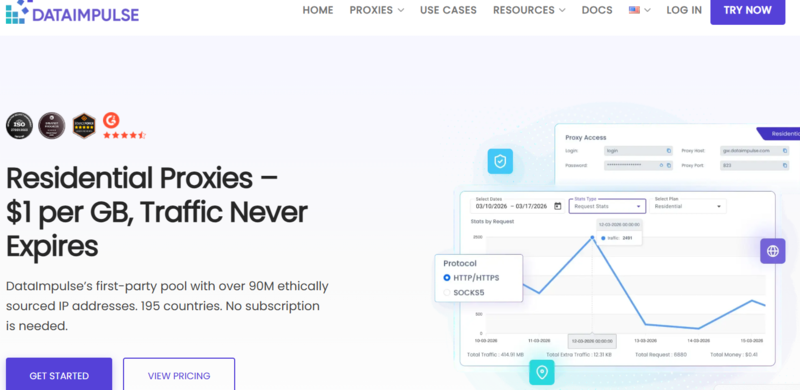
At $1/GB, DataImpulse is the cheapest credible option in this list. Pay-as-you-go billing, 90M+ IPs across 195 countries, and a 5GB free trial to test before paying. The one catch — they explicitly state that crypto payments are final and non-refundable, so test thoroughly with the free trial before scaling up.
Pros:
Cons:
Best for: Budget-conscious developers, indie projects, and anyone testing residential proxies for the first time. The 5GB free trial removes the no-refund risk entirely — validate the service before spending a single Satoshi.
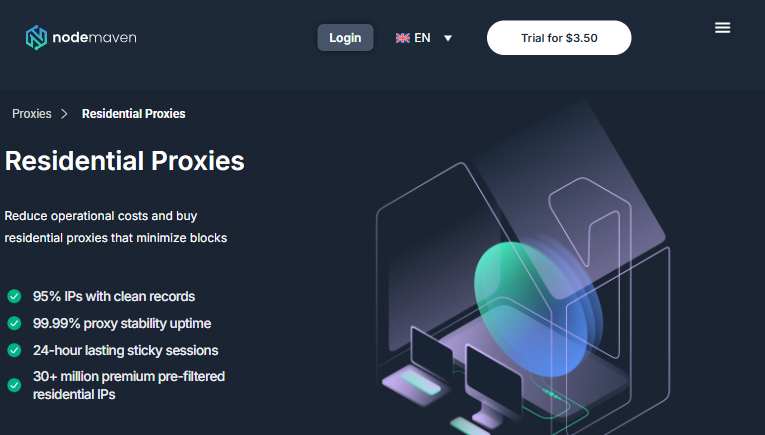
NodeMaven sells on IP quality, not bandwidth pricing. Their real-time filtering algorithms maintain a 95% clean-IP rate, leading to measurably fewer bans on aggressively monitored platforms. The pool covers 1,400+ cities across 150+ countries, with 24-hour sticky sessions available — and they accept BTC, ETH, USDT, and SOL. Starting price $4.00 / GB, IP pool 30M+ filtered
Pros:
Cons:
Best for: Best for: Social media managers, affiliate marketers running multi-accounts, and anyone whose other proxies keep getting banned on aggressive platforms (Instagram, TikTok, Facebook, Reddit). Pay more, ban less.
How to Buy Residential Proxies With Bitcoin (Step-by-Step)
The flow is roughly the same across all five providers. Here's exactly what to do, from wallet to working proxy, in under 10 minutes.
1) Fund a Bitcoin wallet
Any non-custodial wallet works (Electrum, Exodus, BlueWallet, Trust Wallet). If you're prioritizing privacy, fund the wallet from a fresh source rather than a KYC'd exchange. Send slightly more than your purchase price to cover network fees and BTC price volatility during checkout.
2) Create your provider account
Most providers ask only for an email address. Use a privacy-focused email like ProtonMail or Tutanota if anonymity matters. Skip phone verification if it's optional.
3) Pick the smallest GB package first
Always test with the smallest plan available — usually 1–5GB. Verify the IPs work for your target site, check rotation behavior, and confirm geo-targeting. Only scale up after the test succeeds.
4) Select "Crypto" or "Bitcoin" at checkout
The payment page redirects to CoinGate, Cryptomus, NOWPayments, or the provider's own gateway. Choose BTC from the dropdown. The page will display a wallet address, the exact BTC amount, and a 15-30 minute timer.
5) Send the exact BTC amount
Copy the wallet address (always double-check the first 4 and last 4 characters) and send the exact BTC amount from your wallet. Use medium-priority network fees for confirmation within 10-30 minutes. Save the transaction ID.
6) Wait for confirmation (10-60 min)
Most gateways require 1-3 network confirmations. Your account balance updates automatically once confirmed. If you don't see credit after 60 minutes, send the transaction ID to support — every legit provider will help.
7) Configure and connect
In the dashboard, generate proxy endpoints (host: port: username: password). Authenticate via username/password or whitelist your IP. Test with curl or your tool of choice. You're live.
Red Flags to Avoid When Buying Proxies With Bitcoin
Crypto-only proxy "providers" with no other payment methods, no company info, and absurdly low prices are almost always exit scams. Use this checklist.
 Green flags — provider is legitimate
- Lists a real company name, address, and country in the footer
- Has a Trustpilot or G2 page with 100+ reviews
- Offers a free trial or small paid trial under $5
- Documentation explains crypto payment workflow clearly
- Refund policy is published, not hidden in terms of service
- Multiple payment methods (not crypto-only)
- Active blog with recent posts and changelog
Which Provider Fits Your Use Case?
For web scraping and SEO research
Pick Decodo or DataImpulse. You need volume more than IP cleanliness. Decodo's 125M+ pool prevents pattern detection on large scrapes; DataImpulse at $1/GB makes high-volume scraping affordable. Both accept Bitcoin.
For social media account management
Pick NodeMaven. Aggressive platforms (Instagram, TikTok, Facebook, Reddit) detect dirty residential IPs within hours. NodeMaven's pre-filtered IPs and 24-hour sticky sessions make accounts last much longer. Pay more, ban less.
For affiliate marketing and ad verification
Pick Proxy-Cheap or IPRoyal. You need geo-flexibility, multiple country exits, and clean checkout. Both have wide country coverage and accept BTC easily. IPRoyal's non-expiring credits are a bonus if your campaigns run unevenly.
For testing on a tight budget
Pick DataImpulse. $1/GB pay-as-you-go with no expiry is unbeatable. Buy 1GB for one dollar in BTC, test against your target, scale only if it works.
For maximum privacy
Pick Proxy-Cheap or NodeMaven. Both rarely require KYC for standard residential plans, both accept multiple cryptocurrencies, and both have clean documentation about crypto workflows. Pair with a fresh wallet and ProtonMail signup for best results.
Is Buying Residential Proxies With Bitcoin Legal?
In nearly every jurisdiction, yes — both buying proxies and paying with Bitcoin are legal activities. The legality question is about how you use the proxies, not how you purchased them.
Legal use cases include market research, ad verification, SEO research, brand protection, price aggregation, and managing your own accounts across regions. Illegal use cases include credential stuffing, scraping copyrighted content for resale, unauthorized account access, and any activity that violates a target site's terms in ways that constitute fraud under local law.
Provider terms typically prohibit using their network for spam, fraud, credit card testing, or anything illegal in your jurisdiction. Violations get you banned and forfeit any unused balance — including crypto payments.
Frequently Asked Questions
Common questions about buying residential proxies with Bitcoin, KYC, refunds, and anonymity.
Can I really buy residential proxies with Bitcoin in 2026?
Yes. Every major provider on this list accepts Bitcoin via mainstream gateways like CoinGate, Cryptomus, or NOWPayments. Most also accept USDT, Ethereum, and several altcoins. Crypto checkout is now a standard payment option in the residential proxy industry.
Is KYC required when paying with Bitcoin?
For most providers, no — standard residential proxy plans typically don't trigger identity verification. IPRoyal requires KYC only for large purchases or "sensitive targets" like banking and government sites. Proxy-Cheap, DataImpulse, and NodeMaven generally allow anonymous checkout for everyday plans.
Are Bitcoin payments for proxies refundable?
It varies. DataImpulse explicitly states that crypto payments are final and non-refundable. Proxy-Cheap, IPRoyal, and Decodo can refund to your account balance — but converting that balance back to BTC costs exchange and network fees. Always start with the smallest GB package to limit refund risk.
Which is the cheapest provider that accepts Bitcoin?
DataImpulse at $1/GB pay-as-you-go, dropping to $0.45/GB at 1TB volume. IPRoyal is the strong runner-up at $1.75/GB on bulk plans, with the bonus of non-expiring credits. Both accept BTC via standard crypto gateways.
Can I stay fully anonymous when paying with Bitcoin?
Not fully — Bitcoin is pseudonymous, not anonymous. Wallet addresses are public on the blockchain and chain-analysis can trace flows back to exchanges. To approach real anonymity, combine: a fresh wallet, BTC obtained through peer-to-peer trades, a privacy-focused email signup, and access via Tor or a VPN. Even then, "anonymity" is best understood as raising the cost of identification, not eliminating it.
What's the difference between residential and datacenter proxies?
Residential proxies use real IPs assigned by ISPs to homes — websites see them as regular human visitors. Datacenter proxies use cloud-server IPs, which are faster and cheaper but easier for sites to detect and block.
For account management, social media, and aggressive anti-bot targets, residential is required. For simple geo-unblocking or bulk scraping of permissive sites, datacenter is fine.
Do these providers accept Monero (XMR) for maximum privacy?
Most don't accept Monero directly. The five providers in this guide route crypto payments through gateways (CoinGate, Cryptomus, etc.) that focus on top-cap coins like BTC, ETH, USDT, and LTC. If Monero is a hard requirement, look at smaller crypto-native providers — but you'll trade away IP-pool size and reliability for that privacy gain.
How long does the Bitcoin payment take to confirm?
Most providers require 1-3 network confirmations, which takes 10-30 minutes with medium-priority fees. Your dashboard balance updates automatically once the gateway sees the required confirmations. If you pay during a Bitcoin network congestion spike, expect up to 60 minutes.
Can I use one proxy purchase for multiple projects?
Yes — most residential plans allow unlimited concurrent connections, and you can set up multiple authentication credentials inside the dashboard. Pay-as-you-go bandwidth is shared across all of them. Just watch your usage to avoid burning through GB faster than expected.
What happens if my proxies get banned by the target site?
For rotating residential proxies, the provider automatically swaps to a fresh IP on the next request — bans are usually invisible to you. For sticky sessions, you may need to manually rotate or accept that one specific IP is burned for that target. NodeMaven and IPRoyal both have replacement policies for severely degraded IPs.
 Related guides