


If you want to test residential proxies without a large commitment, YumiProxy offers new customers 3GB for $2.70, equivalent to $0.90/GB. Its regular Standard rate is $1/GB and decreases to $0.80/GB at 100GB, $0.70/GB at 200GB, and $0.60/GB at 1TB. FloppyData offers straightforward traffic at $1/GB, while Shifter advertises lower rates for larger purchases but recorded a higher failure rate in our test.
Our disclosure: We may earn a commission when you purchase through links on this page, at no additional cost to you. Our partnerships do not change the test results, limitations, or ranking criteria reported below.
Our Top Picks at a Glance
Rank | Provider | Price relevant | Result |
|---|---|---|---|
1 | $1/GB; $0.80/GB at 1TB | 100% general test; 99.90% on Amazon | |
2 | $5 for 10GB trial; from $0.27/GB at high volume | 98.80%; 3.12s average | |
3 | $0.90/GB | Not benchmarked | |
4 | From $0.75/GB at higher volumes | 93.20%; 1.92s average | |
5 | $1/GB pay as you go | Not benchmarked |
How We Selected and Ranked These Providers
We did not rank these services by affiliate payout, homepage claims, or IP-pool size alone. We considered five practical questions:
- Can a buyer obtain residential traffic for $1/GB or less?
- How much traffic must be purchased to unlock the advertised rate?
- How many requests succeeded in our test?
- How quickly and consistently did requests complete?
- Does the service provide useful controls for location, rotation, sessions, and protocols?
For the providers we benchmarked, we sent 1,000 requests and recorded successful requests, failures, failure rate, average response time, and notable latency outliers. Our tests represent the configuration, target, location, and network conditions used at that time. They do not prove that every country, website, or session type will produce the same result.
We also separate measured results from provider-reported specifications. Statements about global IP-pool size, location coverage, uptime, or network-wide success rate remain provider claims unless our test directly measured them.
To learn more, you can Check our : Best Residential Proxies List
Benchmark Results Compared
Provider | Requests | Successful | Failed | Success rate | Average time |
|---|---|---|---|---|---|
DataImpulse | 1,000 | 999 | 1 | 99.90% | 2.72s |
Geonode | 1,000 | 988 | 12 | 98.80% | 3.12s |
Shifter | 1,000 | 932 | 68 | 93.20% | 1.92s |
These numbers should not be treated as a laboratory-style head-to-head test because the target and configuration were not identical in every run. They are evidence of what happened in our environment, not a guarantee of future performance.
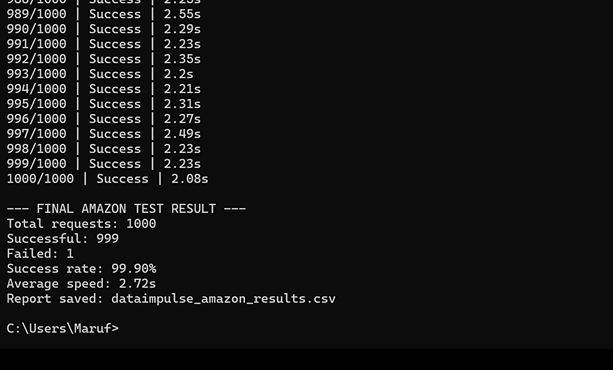
DataImpulse ranks first for its transparent pricing, non-expiring traffic, simple dashboard, and strong performance in our testing. Residential traffic costs $1/GB, with a $5 minimum purchase, while the 1TB package reduces the rate to $0.80/GB.
In our general benchmark, all 1,000 requests succeeded, averaging 1.50 seconds. DataImpulse also completed 999 of 1,000 Amazon requests, achieving a 99.90% success rate with a 2.72-second average.
According to DataImpulse, its network includes 90M+ residential IPs across 195+ countries, rotating and sticky sessions, up to 120-minute session control, and HTTP(S)/SOCKS5 support.
Pros
- Excellent results in both of our tests
- Affordable $5 minimum purchase
- Non-expiring traffic
- Rotating and sticky sessions
- $0.80/GB bulk pricing
Cons
- Small purchases cost exactly $1/GB
- The $0.80/GB rate requires 1TB
- Fewer managed tools than enterprise providers
Best for: Developers, SEO teams, e-commerce researchers, and agencies seeking affordable residential traffic without monthly expiration.
For complete test results, dashboard screenshots, setup instructions, and our scorecard, read our DataImpulse residential proxy review.
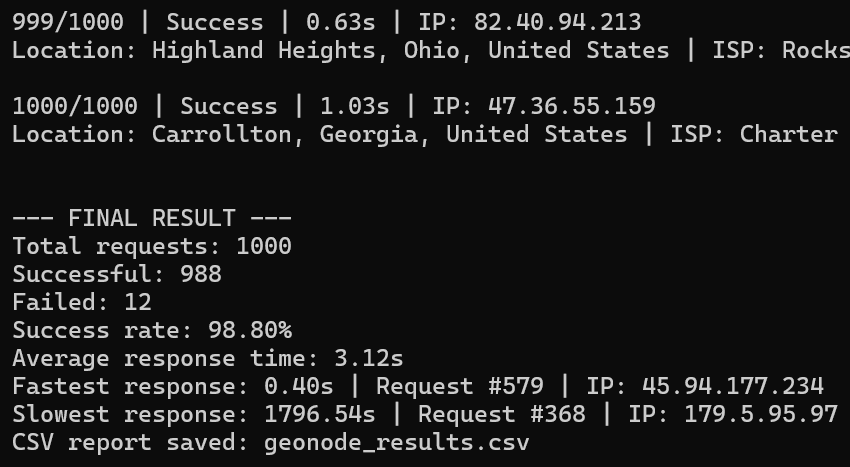
Geonode takes second place with a 10GB trial for $5, equivalent to $0.50/GB. Its residential proxy rates can fall to $0.27/GB for high-volume purchases.
In our 1,000-request benchmark, Geonode completed 988 requests, achieving a 98.80% success rate and a 3.12-second average response time. However, one extreme latency spike indicates that timeouts and automatic retries are advisable.
Geonode reports 30–50M monthly residential IPs across 195+ countries. It supports country, state and city targeting, rotating and sticky sessions, HTTP(S)/SOCKS5, unlimited concurrent sessions, and non-expiring traffic.
Pros
- Affordable 10GB trial
- 98.80% success rate in our test
- Detailed geographic targeting
- Rotating and sticky sessions
- Non-expiring traffic
Cons
- Twelve requests failed in our test
- Response times were not fully consistent
- The $0.27/GB rate requires a high-volume purchase
Best for: Budget-sensitive web scraping, localized SERP tracking, price monitoring, and workflows that can retry occasional failures.
For detailed test results, dashboard screenshots, setup instructions, and our complete scorecard, read our Geonode residential proxy review.
YumiProxy in our ranking because it offers a clearly documented residential proxy purchase below $1/GB. New customers can purchase 3GB for $2.70, equivalent to $0.90 per GB. Unlike many headline discounts, this offer does not require a 1TB or custom enterprise commitment.
Its regular rate is $1/GB, while published volume pricing falls to $0.80/GB at 100GB, $0.70/GB at 200GB, and $0.60/GB at 1TB.
According to YumiProxy, its residential network includes 50M+ IPs across 195+ countries and regions. It supports rotating and sticky sessions, HTTP and SOCKS5, username/password authentication, IP whitelisting, and country, state, city, and ASN targeting. These are provider-reported specifications; we have not yet completed our own 1,000-request benchmark.
Pros
- First 3GB costs $0.90/GB
- No large commitment required for the introductory rate
- Non-expiring residential traffic
- Rotating and sticky sessions
- Country, state, city, and ASN targeting
- HTTP and SOCKS5 support
Cons
- The $0.90/GB rate is limited to the first purchase
- Regular small-volume pricing is $1/GB
- We have not completed a controlled benchmark
- Network size and performance figures are provider-reported
Best for: First-time buyers who want to test residential proxies below $1/GB without purchasing hundreds of gigabytes.
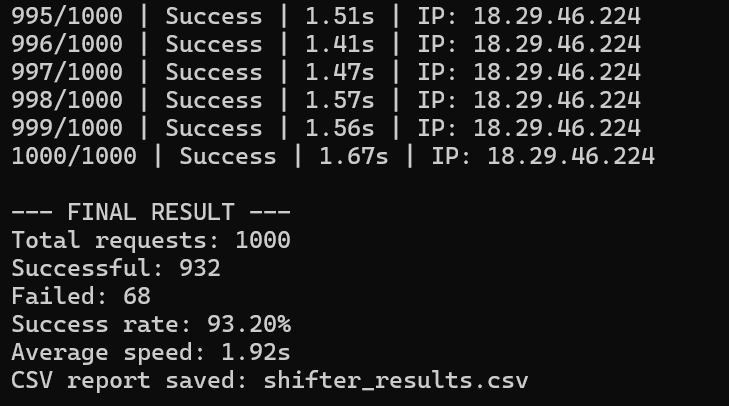
Shifter offers residential traffic from $0.75/GB at higher volumes. Its proxy controls include country, region, city and ASN targeting, along with per-request rotation, sticky sessions and configurable TTL settings.
In our 1,000-request benchmark, Shifter completed 932 requests, producing a 93.20% success rate and a 6.80% failure rate. Its 1.92-second average response time was fast, but the 68 failures could increase retry costs in larger workloads.
Shifter reports support for HTTP(S), SOCKS5 and unlimited concurrent connections. Users can configure targeting, session IDs and rotation duration through proxy credentials.
Pros
- Fast 1.92-second average response time
- Country, region, city and ASN targeting
- Flexible rotation and TTL controls
- HTTP(S) and SOCKS5 support
- Sub-$1 pricing at higher volumes
Cons
- 68 of 1,000 requests failed
- Lowest success rate among our tested options
- Sub-$1 pricing requires a larger purchase
- Retries may increase the effective cost
Best for: Geo-targeted research and lighter automation workloads that can tolerate and retry occasional connection failures.
For complete benchmark results, dashboard screenshots, configuration instructions and our scorecard, read our Shifter residential proxy review.
FloppyData offers residential proxy traffic at $1/GB through a pay-as-you-go model. Unlike providers that place their attractive unit rate behind a 1TB commitment, its standard price is easy to understand.
FloppyData reports 65M+ residential IPs across 190+ countries, with rotating and sticky sessions and support for HTTP, HTTPS, and SOCKS5. It positions the product for scraping, SEO rank tracking, market research, ad verification, and automation.
We reviewed FloppyData’s features, pricing, and setup, but we do not have a directly comparable 1,000-request benchmark to place beside DataImpulse, Geonode, YumiProxy, and Shifter. We therefore rank it below providers supported by our measured test data.
Pros
- Straightforward $1/GB pay-as-you-go pricing
- No enterprise-scale purchase needed to receive the standard rate
- Rotating and sticky sessions
- HTTP(S) and SOCKS5 support
- Broad provider-reported location coverage
- Simple option for smaller projects
Cons
- It is at $1/GB rather than strictly below it
- We have not completed the same 1,000-request benchmark
- Fewer advanced tools than premium enterprise providers
- Network-size and uptime figures remain provider claims
Who should choose FloppyData?
FloppyData is suitable for users who value simple pricing and do not need a complex enterprise platform. It is worth considering for small scraping jobs, SEO monitoring, ad checks, and early-stage automation.
What "under $1 per GB" gets you (and what it doesn't)
A sub-$1/GB rate is genuinely useful for high-volume, less-sensitive tasks: price monitoring, SEO rank tracking, ad verification, general web scraping, or testing. It's a meaningfully worse fit if you need:
- High trust scores on strict targets — major social platforms, ticketing sites, banks. Budget residential pools tend to have more shared/flagged IPs than premium pools.
- Guaranteed uptime SLAs and dedicated support — ultra-cheap plans are usually self-serve with community or ticket-based support only.
- Sticky sessions at scale — some budget providers limit session length or concurrent connections on entry plans.
If your use case is lightweight and volume-driven, the sub-$1/GB tier is the right place to start. If it's compliance-sensitive or mission-critical, the extra $1–3/GB at a mid-tier provider is often worth it in reduced block rates.
How to choose a cheap proxy provider without getting burned
Confirm the price at your actual volume.
A "$1/GB" homepage number that only applies at 1TB+ isn't a $1/GB plan for a 10GB user — check the pricing calculator, not just the hero banner.
Check whether traffic expires.
Non-expiring balances (PacketStream, DataImpulse) protect you from paying for unused data at month-end.
Look for pay-as-you-go options.
Subscription-only plans can lock you into recurring costs even in low-usage months.
Test the free trial or smallest plan first.
Success rates against your specific target sites vary far more between providers than the sticker price does.
Read the acceptable use policy.
Cheap proxy pools are more likely to include IPs your target site has already flagged; check the provider's refresh/replacement policy for blocked IPs.
Frequently asked questions
Evomi currently has the lowest verified residential proxy rate at $0.49/GB pay-as-you-go, dropping to $0.45/GB at higher volume. For flat, no-minimum pricing, PacketStream and DataImpulse both sit at roughly $1.00/GB.
Datacenter proxies are cheaper — often $0.30–$0.60/GB equivalent versus $2–$8/GB for residential — but they're easier for websites to detect and block, since the IPs come from data centers rather than real home internet connections.
Yes. PacketStream and DataImpulse both offer pay-as-you-go residential proxies at or near $1/GB with no recurring subscription; IPRoyal also offers pay-as-you-go pricing, though its entry rate is $1.75/GB.
For lightweight, tolerant targets (price monitoring, general scraping, SEO tools), budget providers under $1/GB are generally sufficient. For strict, high-security targets, a mid-tier provider with a cleaner IP pool typically performs better despite the higher cost.
Not always. Independent pricing research in 2026 found some providers advertise headline rates (e.g., "$1.40/GB") that only apply at multi-terabyte volumes, while small-plan buyers pay several times more. Always check the price at the specific volume you plan to buy.
