
How Residential Proxies Work for Web Scraping (Prices & Data)

by Jayden Sprent // March 4, 2026
Residential proxies work for web scraping to collect publicly available price and data information from websites using real residential IP addresses. They help support price tracking, data extraction, and market analysis across different locations while reducing access limitations during large-scale data collection.

What Are Residential Proxies for Web Scraping Used For?
Residential proxies for web scraping are used to collect publicly available price and data information from websites across different locations. By routing requests through real residential IP addresses, they help access web pages as local users would see them.
They are commonly used for price tracking, product monitoring, competitor analysis, and large-scale data collection, where location accuracy and repeated access are important. Residential proxies also help reduce access limitations when scraping data from sites that apply regional content variations or IP-based restrictions.
Price Tracking
Monitor product prices across different regions to identify price changes, regional differences, and market trends. Learn More
Competitor Data Collection
Collect publicly available competitor data such as product listings, pricing, and availability across multiple websites.
Product & Inventory Monitoring
Track product availability, stock levels, and listing changes as they appear to users in different locations.
Market & Trend Analysis
Gather large datasets to analyze market trends, demand patterns, and regional differences over time.
Location-Based Content Scraping
Access region-specific content, offers, or pricing by scraping websites from specific geographic locations.
Large-Scale Data Extraction
Support repeated and structured data collection by distributing requests across residential IPs to reduce access interruptions.
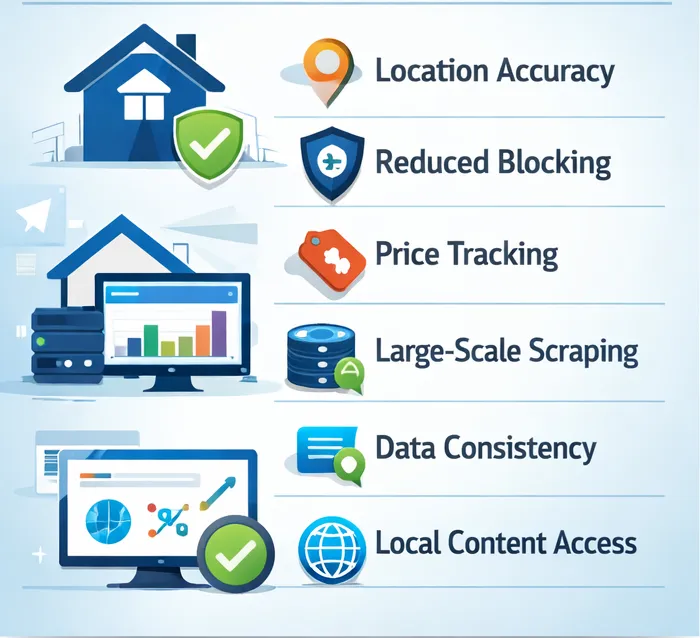
Benefits of Residential Proxies for Web Scraping (Prices & Data)
How Residential Proxies Improve Web Scraping Accuracy (Prices & Data)
Residential proxies improve web scraping accuracy by allowing data to be collected through real residential IP addresses instead of a single server or data-center location. This helps reduce distortions caused by IP-based filtering, regional content differences, or access limitations.
By scraping websites from specific locations, residential proxies make it possible to capture prices, product availability, and content exactly as local users see them. This is especially important for price comparison, market analysis, and region-specific data where results can vary significantly by country or city.
Residential proxies also support more consistent scraping at scale. Distributing requests across multiple residential IPs helps reduce interruptions during repeated data collection, leading to more stable datasets and more reliable price and market insights over time.
Frequently Asked Questions (FAQs)
Residential proxies for web scraping are used to collect publicly available price and data information from websites across different locations. They help access region-specific prices, content, and listings as local users would see them.
Prices often vary by country, city, or user location. Residential proxies allow price data to be scraped from specific regions, helping produce more accurate and location-aware price comparisons.
They can help reduce access limitations by distributing scraping requests across multiple residential IP addresses instead of relying on a single IP.
Yes. Residential proxies are commonly used for large-scale data collection where repeated access and location diversity are required.
No. For small-scale or single-location scraping, proxies may not be necessary. They are most useful when scraping data across multiple regions or at scale.
No. While they improve location accuracy and access consistency, data accuracy still depends on scraper quality, site structure, and data validation methods.
They are typically used to access publicly available data. Legality depends on local laws, website terms of service, and how the data is collected. Reviewing applicable policies is recommended.
No. Some websites apply advanced protections or restrict automated access regardless of IP type. Residential proxies help with access but do not override website rules.
Author
Jayden Sprent (Proxy Specialist)
Hi, I'm Jayden Sprent. Dive into the world of proxy servers with my expert evaluations and insightful analyses based on thorough research. I'll share my experiences and comprehensive guides to help you make informed decisions about proxy services.
Learn More About Jayden Sprent