
Buyresidentialproxy / Reviews / Proxy Seller Review

Proxy Seller Review
Proxy-Seller Residential Proxies Review (2026): Our Hands-On Test
We purchased and tested Proxy-Seller residential proxies with 1,000 requests to Amazon. In this run, 999 requests succeeded, with no CAPTCHA events or blocks recorded and a 2.91-second average response time.

Rating 4.7 / 05
Based on this test, Proxy-seller delivered excellent connection reliability. The response time was usable rather than exceptionally fast, so our initial impression is that reliability is a bigger strength than raw speed.
Quick verdict: Proxy-Seller delivered a very strong result in our Amazon benchmark. Its control panel is easy to understand, bandwidth usage is visible at a glance, and proxy lists can be created by location with selectable rotation settings. Based on this test, it is a practical option for users who need rotating residential proxies for public-web data collection, geo-testing, and browser-based workflows.
Proxy-seller Test Results at a Glance
Metric | Our result |
|---|---|
Total requests | 1,000 |
Successful requests | 999 |
Success rate | 99.9% |
Other failures | 1 |
CAPTCHA events | 0 |
Blocked requests | 0 |
Average response time | 2.91 seconds |
Test #1: Proxy-Seller 1,000-Request Success Rate
We sent 1000 requests through Proxy-seller residential proxies and recorded every successful and failed request.
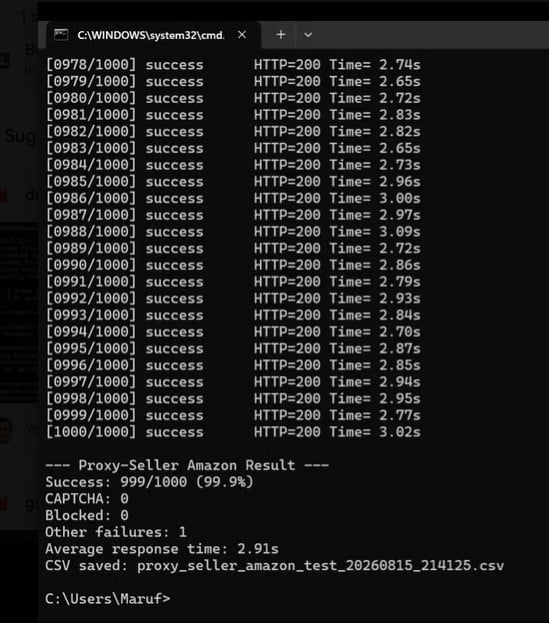
Proxy Seller Results:
Successful: 999/1000
Failed: 1/1000
Success Rate: 99.9%
Failure Reasons
Proxy Error
Disconnection
For residential proxies, a success rate above 95% is generally considered excellent. Our testing result of 99.9% indicates high-quality, clean IPs.
Test #2: Proxy seller Response Time
Success rate tells us whether requests complete successfully.
But it does not tell us how long each request takes.
So, we also recorded response time during our 1,000-request Amazon test.
Our Average Response Time: 2.91 Seconds
Across our benchmark, Proxy-Seller residential proxies averaged 2.91 seconds per request.
The individual successful requests shown in our test log were generally completed in around 2.6 to 3.1 seconds, with some variation during the run.
Speed needs context.
Residential proxies route requests through real residential internet connections rather than conventional datacenter infrastructure. Location, routing distance, Amazon’s response time, and the quality of individual residential connections can all affect latency.
For our test, the more important finding was the combination of:
99.9% success rate + 2.91-second average response time
Proxy-Seller completed 999 of 1,000 Amazon requests successfully. Our benchmark recorded 0 CAPTCHA events, 0 blocked responses, and 1 other failure.
The script ran uninterrupted against Amazon for a little over two minutes. Here's what came back:
Proxy seller Residential Proxy Features
Proxy-Seller offers rotating residential proxies that use real-user IP addresses across 220+ locations. Users can target a country, region, city, or ISP, then choose rotating or sticky sessions based on their task. The service is designed for compliant public-data collection, localized research, price monitoring, ad testing, and automation workflows.
| Feature | Proxy-Seller Specification |
|---|---|
| IP Pool | 47M+ advertised residential IPs |
| Locations | 220+ locations worldwide |
| Geo Targeting | Country, region, city & ISP targeting |
| Rotation | Rotate by request, by time interval, or use sticky sessions |
| Concurrent Sessions | Unlimited |
| Session Control | Custom session TTL controls |
| Protocols | HTTPS & SOCKS5 |
| Authentication | Username/password or IP allowlisting |
| Average Response Time | ~0.35 seconds (advertised) |
| Success Rate | 99.9% |
| Starting Price | start from $3.50/GB |
Dashboard & Setup Experience
Proxy-Seller uses a simple proxy-list generator inside its dashboard. Users can configure residential proxies through this setup flow:
List type → Authorization method → Country → Region → City → ISP → Ports → Session type
You can then export the generated proxy list and connect it with your browser, anti-detect profile, or scraping tool. The dashboard also shows traffic usage, making it easier to manage available bandwidth.
Purchased Residential Traffic
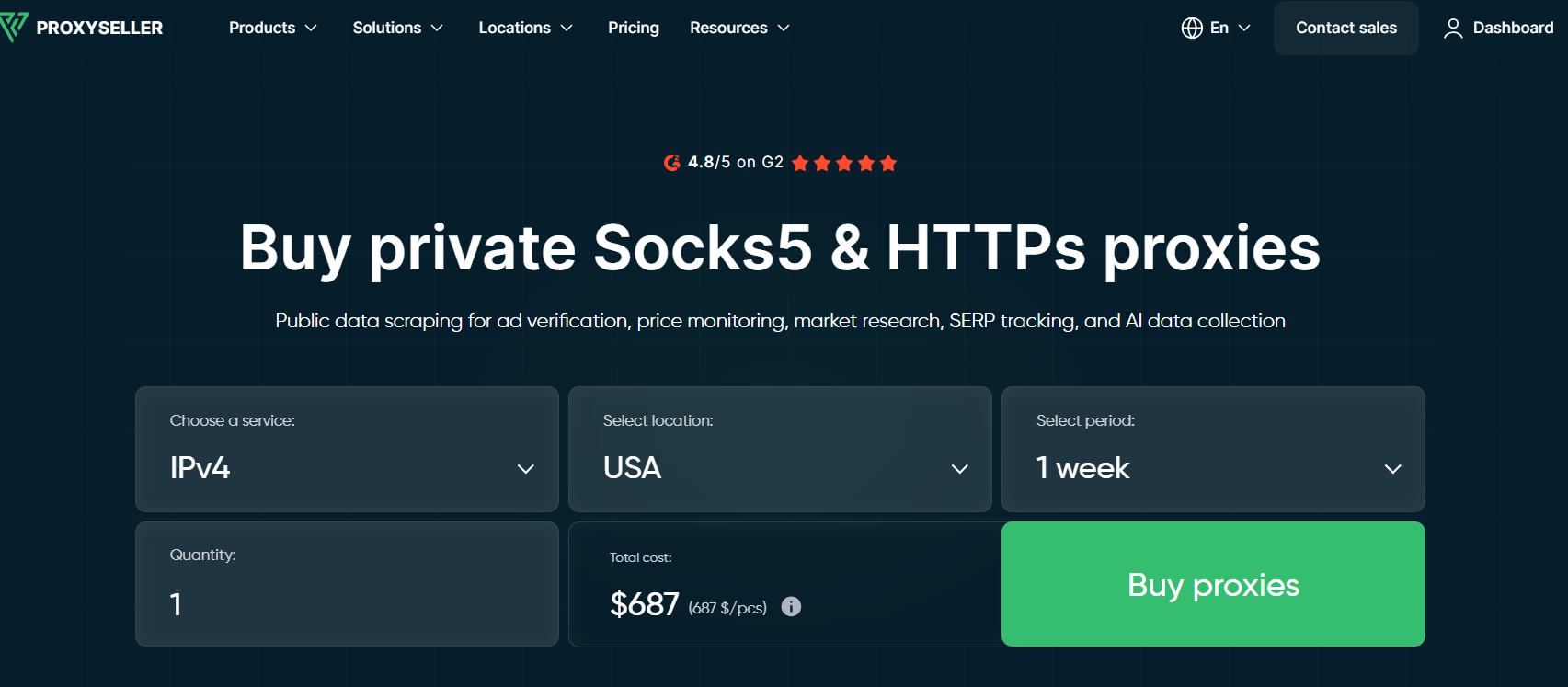
Now let’s separate what we tested ourselves from the features that Proxy-Seller currently advertises.
Our 1,000-request Amazon benchmark confirms that the residential proxy product worked reliably in our test environment. However, a performance test does not independently verify the provider’s full IP-pool size, worldwide coverage, or every available targeting option.
According to the Proxy-Seller residential proxy page, its service includes rotating residential IPs, city- and ISP-level targeting, flexible session controls, and access to a 47M+ IP pool across 220+ locations.
Proxy Generator
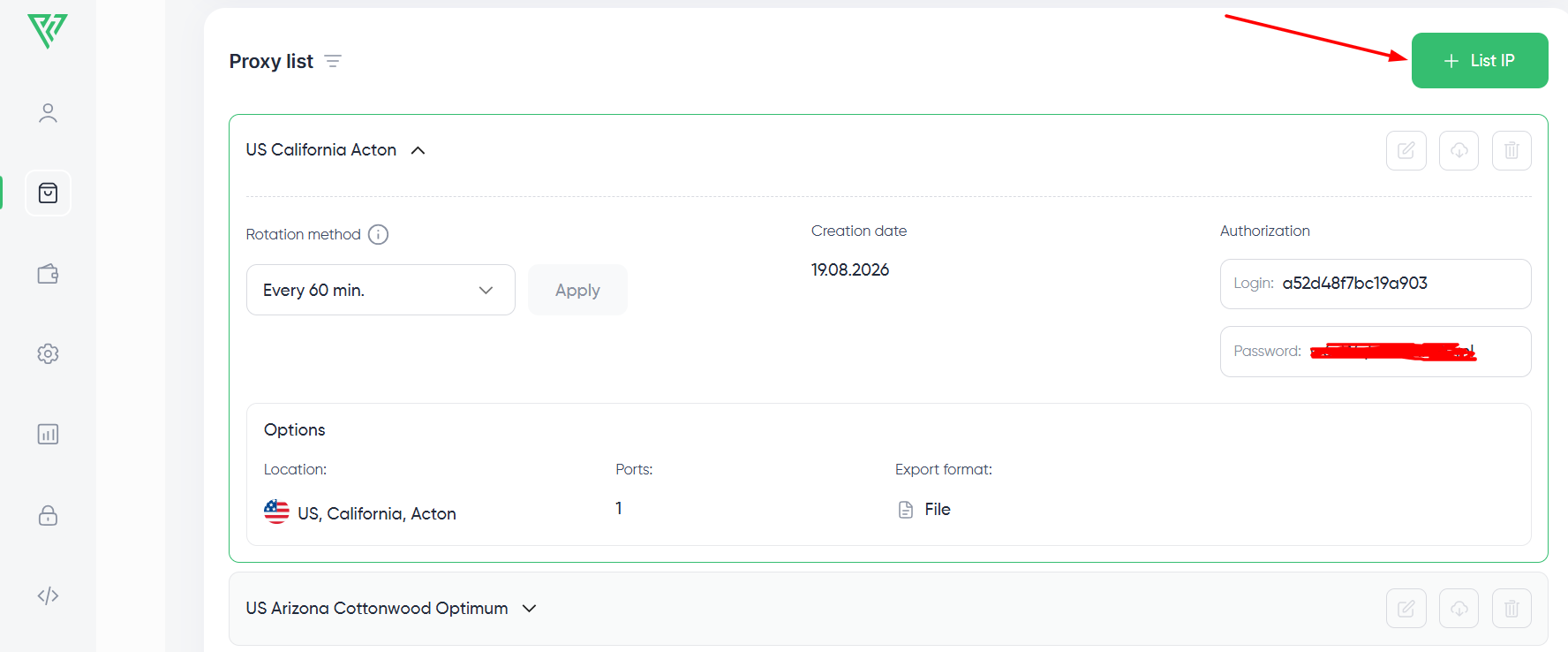
Proxy-Seller Rotation, Proxy Lists, and Geo-Targeting
We created and reviewed Proxy-Seller residential proxy lists directly in the dashboard.
The list-creation page lets users choose the list type, authorization method, location filters, port quantity, session settings, and export format before generating proxies.
Create a Usual or Special Proxy List
Proxy-Seller provides two list options:
- Usual list: A standard proxy list created and managed directly in the dashboard.
- Special list: A proxy list configured and controlled through the Proxy-Seller API.
For most individual users, beginners, and browser-based workflows, the Usual list is the simpler option. The Special list may be more useful for teams that need API-based proxy management.
Authorization Options
Proxy-Seller supports two authorization methods:
- Username and password
- IP authorization
Username and password authentication is useful when connecting through software, scripts, or browser profiles. IP authorization can be useful when a server has a fixed IP address and you do not want to enter proxy credentials repeatedly.
Geo-Targeting
The proxy-list creator includes location filters for:
- Country
- Region
- City
- ISP
This allows users to create residential proxy lists for broader country-level tasks or narrow the selection when a city or ISP requirement is important.
For example, country-level targeting can be enough for general public-web research, while city or ISP targeting may be more useful for localized SERP checks, ad verification, and geo-testing.
However, available location filters are not the same as independently verified geo accuracy.
Proxy-Seller Session Types
Proxy-Seller lets users choose a session type when creating a residential proxy list. In the dashboard, we found three options:
- General
- Sticky
- Rotation
This is helpful because not every proxy task needs the same IP behavior.
General Session
The General option follows the account’s default rotation rule.
This is useful for users who want to use the same standard session setting across multiple proxy lists without configuring each list individually.
Sticky Session
A Sticky session is designed to keep the same residential IP for a longer session.
This can be useful when you need to browse multiple public pages with the same IP, such as completing a longer research workflow, checking location-based content, or maintaining a consistent browsing session.
We confirmed that the Sticky option is available in the Proxy-Seller dashboard. However, we have not yet completed a dedicated test to measure how long the same IP remains active. Sticky-session test status: Not yet benchmarked
Rotation Session
The Rotation option changes the IP address during your workflow.
In our dashboard, Proxy-Seller allowed the rotation method to be set to:
For each request
This means a new residential IP can be assigned for every new request. This setting is useful when collecting public web data at scale and when IP diversity is more important than keeping one consistent session.
Proxy-seller Residential Proxies Pros and Cons
Pros:
Cons:
Proxy-Seller Residential Proxy Pricing & Plans
Proxy-Seller offers several proxy categories, including rotating residential, static/ISP, mobile, and datacenter proxies. The right plan depends on whether you pay by traffic, need fixed IPs, or require a particular location.
Rotating residential
From $3.50/GB for a small plan at the time of writing.
Best for: rotating public-web requests, geo-testing, and scraping workloads.
Static / ISP proxies
$3 Month. options for workflows that need a more consistent connection.
Best for: anti-detect browsers, account workflows, and long-running sessions.
Mobile proxies
$109 1 IP Month- options for use cases where carrier IPs are needed.
Best for: use cases that specifically require mobile IP reputation.
Pricing and plan availability can change. Confirm the final price, traffic rules, and location availability on Proxy-Seller before ordering.
Compare Our Features Side-by-Side
A quick comparison of Proxy-Seller and six established residential proxy providers. Prices are the publicly listed starting rates for smaller plans.
| Provider | IP Pool | Starting Price | Best For |
|---|---|---|---|
| Proxy-Seller | 47M+ residential IPs | $3.50/GB | Budget-friendly scraping, geo-testing and automation |
| Bright Data | 400M+ residential IPs | $4/GB | Enterprise data collection and advanced targeting |
| Oxylabs | 175M+ residential IPs | $6/GB | Large-scale web data extraction and enterprise teams |
| IPRoyal | 64M+ residential IPs | $7/GB | Flexible pay-as-you-go scraping and research |
| SOAX | 155M+ residential IPs | $5/GB | Granular location targeting and managed proxy access |
| Infatica | 40M+ residential IPs | $4/GB | Pay-as-you-go projects and international targeting |
| HydraProxy | Residential proxy network | $5/GB | Smaller projects needing non-recurring traffic plans |
Pricing and pool-size claims are provider-advertised and may change with promotions, billing terms, or volume discounts.
Lear more about Proxy-Seller Alternatives
Final Verdict & Scorecard
Category | Score | Why |
|---|---|---|
Success Rate | 4.9/5 | 999 / 1,000 Amazon requests succeeded (99.9%) |
Reliability | 4.9/5 | Only 1 / 1,000 request failed (0.1%); |
Speed | 4.5/5 | 2.91s average response time |
Pricing | 4.5/5 | Competitive volume discounts; lower per-GB pricing on larger plans |
Setup & Dashboard | 4.6/5 | Straightforward dashboard with location filters, session types, authorization options, and flexible proxy-list export |
Overall Rating:  4.7 / 5 — Very Good
Proxy-Seller performed reliably in our Amazon benchmark, with 999 successful requests out of 1,000 and a 2.91-second average response time. Its easy dashboard, location targeting, and session controls make it a solid choice for public-web data collection and geo-testing.
Frequently asked questions
Yes. It's been operating since 2014 with a claimed 500,000+ client base, and in our own 1,000-request test against Amazon, 999 requests succeeded with zero CAPTCHAs and zero blocks.
Yes. It issues standard SOCKS5/HTTP host, port, username, and password credentials that work in any antidetect browser's custom-proxy field. We configured and tested this directly in AdsPower.
Residential proxies range from $3.98/GB at the smallest 0.5GB tier down to $1.30/GB+ at high volume, with a 10GB plan landing around $2.50/GB. A 3-day trial is available for $1.99.
In our benchmark, 1,000 requests to Amazon through a rotating residential IP returned a 99.9% success rate with zero CAPTCHA challenges, at an average of 2.91 seconds per request.
Yes — each proxy has a configurable rotation interval (we tested a 60-minute rotation), plus support for sticky sessions or per-request rotation depending on the use case.
Coupon code: KPOGIL_615776
Author
Jayden Sprent (Proxy Specialist)
Hi, I'm Jayden Sprent. Dive into the world of proxy servers with my expert evaluations and insightful analyses based on thorough research. I'll share my experiences and comprehensive guides to help you make informed decisions about proxy services.
Learn More About Jayden Sprent