
How to Use Residential Proxies for Social Media?

by Jayden Sprent // March 5, 2026
Residential proxies for social media are used to access and monitor social platforms through real residential IP addresses. They help analysts and marketers observe content, engagement, and platform behavior as real users would see it across different locations and networks.
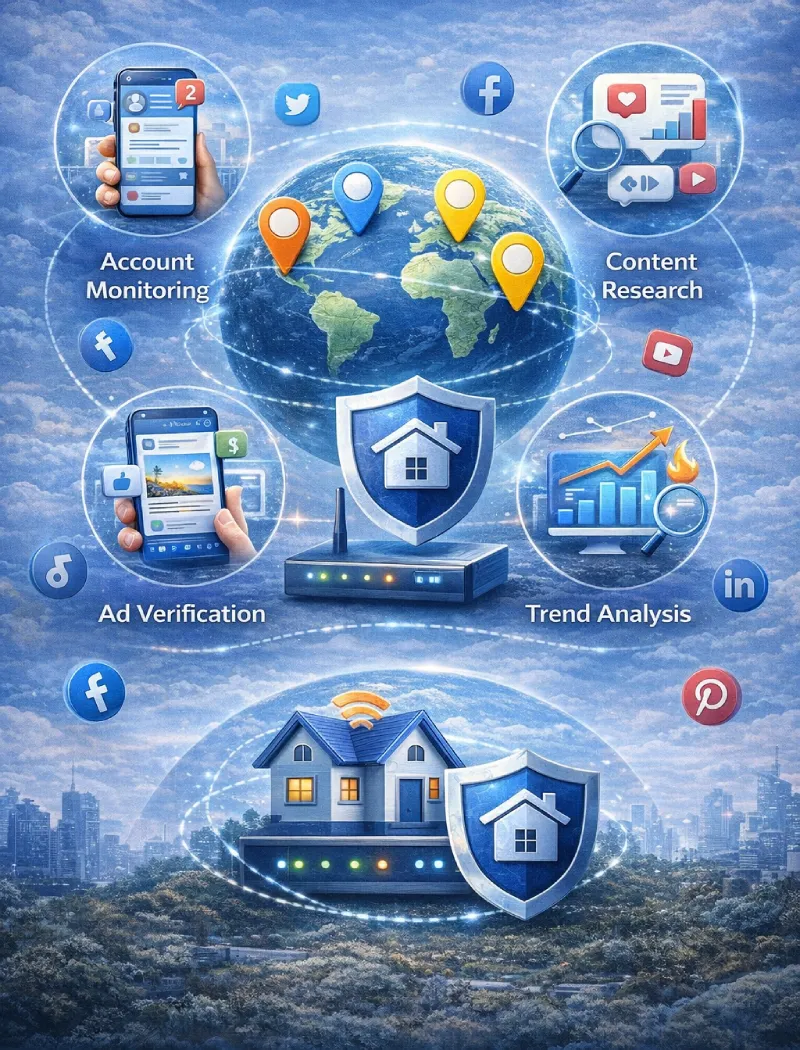
What Are Residential Proxies for Social Media, and When Should You Use Them?
Residential proxies for social media let you view platforms like Facebook, Instagram, TikTok, X/Twitter, LinkedIn, YouTube, Reddit, and Pinterest from real residential IP addresses. This helps you see content, ads, trends, and engagement the way real users see them in different locations.
They are useful for social media monitoring, ad verification, competitor research, trend tracking, audience analysis, and checking regional content visibility. Use them for legitimate research and brand monitoring — not for spam, fake engagement, or account abuse.
Anonymous Browsing
Residential proxies allow social media platforms to be accessed without exposing the original IP address, helping maintain anonymity during analysis and monitoring.
Geo-Targeting
Residential proxies enable access to social media content as it appears in different regions, supporting location-based analysis and monitoring.
Account Management
Residential proxies support account management by allowing access and monitoring across regions while reducing IP-related access issues.
Data Scraping
Residential proxies support social media data scraping by enabling access to public posts, profiles, and engagement data with fewer access restrictions.
Ad Verification
Residential proxies help verify how social media ads appear across different locations, devices, and user environments.
OnlyFans
Residential proxies are used to analyze publicly accessible content, trends, and platform behavior on OnlyFans from different locations.
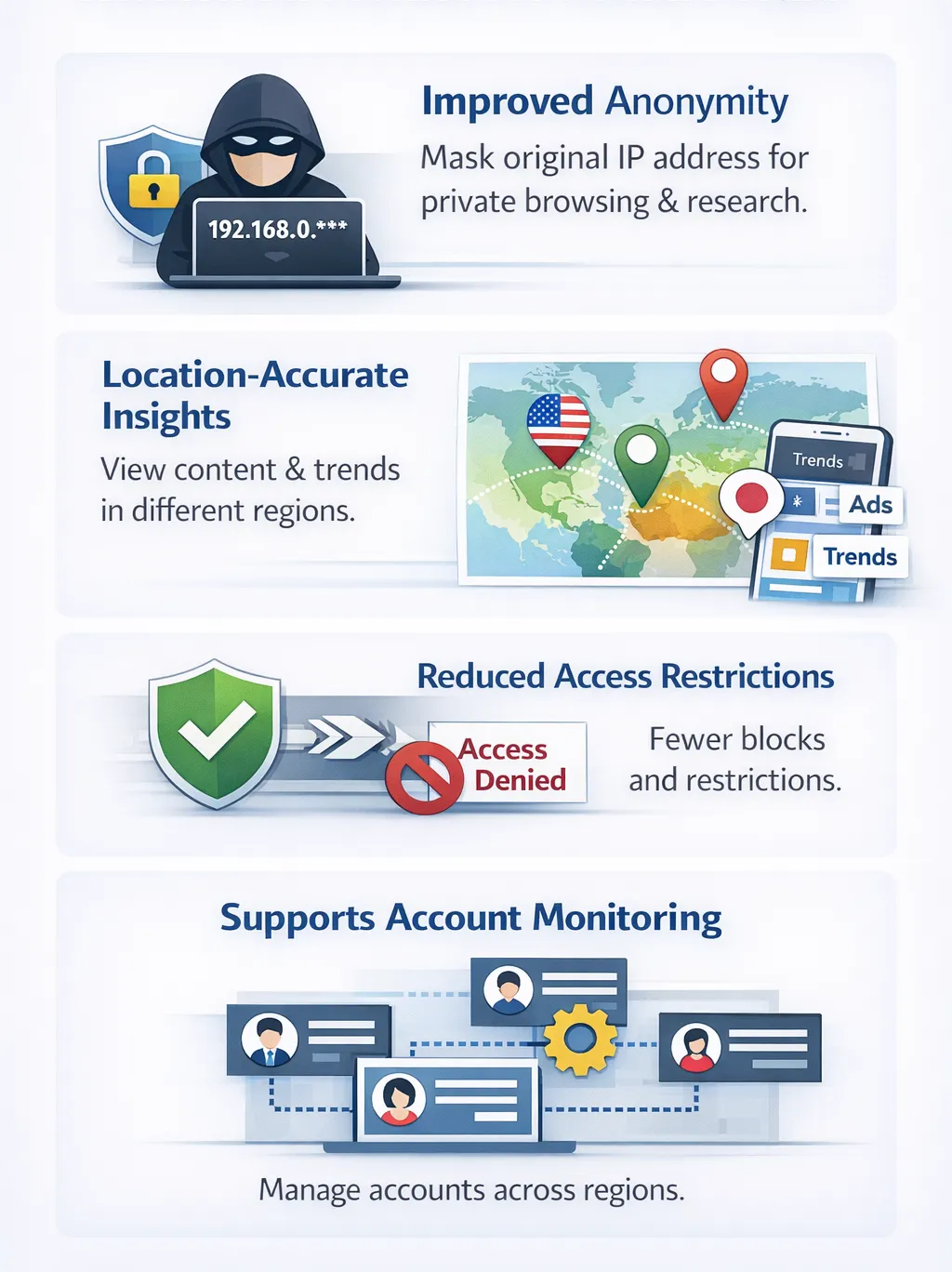
Benefits of Residential proxies for social media
The Role of Residential proxies for social media Tracking Accuracy
Social media platforms often display different content, engagement metrics, and ads based on user location, network type, and behavior patterns. Residential proxies play an important role in improving tracking accuracy by allowing analysts to access platforms through real residential IP addresses that closely resemble genuine user traffic.
By using residential proxies from different regions, it becomes possible to observe how posts, trends, ads, and engagement appear to users in specific locations. This helps reduce distortions caused by single-IP access, regional limitations, or platform restrictions.
Residential proxies also support consistent data collection when tracking social media activity at scale. By distributing requests across multiple residential IPs, they help minimize access issues and provide more reliable insights into platform behavior over time.
Multi-Account Management with Residential Proxies (Safely & More Consistently)
Managing multiple social media accounts (for clients, brands, or different campaigns) can be tricky because platforms often look for unusual login patterns—like many accounts logging in from the same IP, frequent IP changes, or logins from different countries in a short time.
Residential proxies can help by giving each account a more consistent “home-like” IP address pattern—especially when teams, VAs, or agencies manage accounts from different places.
Why IP management matters for multi-account work
When many accounts share the same IP (or switch IPs too often), platforms may treat it as suspicious. That can lead to:
A residential proxy doesn’t “guarantee safety,” but it can reduce obvious IP-related red flags when used carefully.
Best practice setup (simple model)
A safe approach is to create a stable IP routine:
1) One account (or one client) = one proxy profile
- Assign a dedicated (or “sticky”) residential IP to a single account or a small group of accounts for the same client.
- Avoid sharing one proxy across many unrelated accounts.
2) Use sticky sessions when possible
- “Sticky” means you keep the same IP for a longer time (ex: 10–30 minutes, or longer).
- This helps reduce sudden IP changes during logins, posting, or messaging.
3) Match account location to proxy location
- If an account is based in New York, using a New York (or at least US) IP is usually more consistent than switching to a random country.
- Avoid unnecessary geo-jumps.
4) Keep a consistent device/browser fingerprint
Residential proxies help with IP. But platforms also look at:
- Browser profile/cookies
- Device type
- Timezone/language
- Login habits
So for multi-account work, it’s smarter to use separate browser profiles (or anti-detect profiles) and keep them consistent for each account.
Common agency workflows
Here are realistic ways people use residential proxies for social media account management:
- Client account access (agency/VA): Log in from a “client-like” IP instead of constantly changing locations.
- Team-based management: Multiple team members working without triggering repeated “new location” checks.
- Account warming / gradual growth: Avoiding extreme behavior signals (not automation), while keeping access patterns steady.
- Monitoring & publishing: Scheduling posts and monitoring comments/messages without frequent session drops.
Mistakes that increase risk
Even with residential proxies, these habits often cause problems:
- Using one proxy IP for 10–50 accounts in different niches
- Switching countries/states every login
- Rotating IP every request while logged into a social platform
- Logging into the same account from multiple devices + multiple IPs in the same hour
- Aggressive automation (too fast, repetitive actions)
Residential proxies are helpful, but they’re not magic—behavior consistency still matters most.
What to look for in a proxy for multi-account management
If your goal is multi-account social media work, prioritize:
- Sticky sessions/session control
- City/State targeting (or at least country targeting)
- Low failure rate (stable connections)
- ISP/residential quality (not datacenter labeled)
- Clear usage rules + support
- Enough IP pool size to avoid reusing the same IP too often
Frequently Asked Questions (FAQs)
Not safely. It’s better to assign separate IPs or separate sticky sessions per account/client. Sharing one IP across many unrelated accounts increases risk.
No. Platforms evaluate many signals (behavior, device, login patterns). Proxies only help with IP consistency.
Usually sticky for logins and active sessions. Rotating can be useful for public page checks, but rotating during logged-in actions can cause challenges.
Residential proxies for social media are used to observe, monitor, and analyze social platforms as real users would see them. They help with content monitoring, trend analysis, ad verification, and location-based research.
Residential proxies route traffic through real residential IP addresses, which helps reduce access limitations and provides more accurate visibility into social media content and behavior across regions.
Yes. By accessing platforms from multiple residential IPs and locations, residential proxies help reduce distortions caused by single-IP access and support more reliable tracking of content, engagement, and ads.
They are commonly used to mask the original IP address during research or monitoring tasks, helping maintain anonymity and reduce exposure of internal or personal network details.
Yes. Residential proxies allow access from specific countries or regions, making it possible to analyze location-based trends, ads, and content visibility on social platforms.
No. For basic or small-scale checks, proxies may not be necessary. They become more useful when analysis requires geographic diversity, repeated access, or anonymity.
They are often used to verify how ads appear across different regions, devices, or user environments, helping ensure accurate visibility checks.
Use typically focuses on publicly accessible content. However, legality depends on local laws, platform policies, and how the data is collected. Reviewing platform terms and seeking legal guidance is recommended for sensitive use cases.
Author
Jayden Sprent (Proxy Specialist)
Hi, I'm Jayden Sprent. Dive into the world of proxy servers with my expert evaluations and insightful analyses based on thorough research. I'll share my experiences and comprehensive guides to help you make informed decisions about proxy services.
Learn More About Jayden Sprent