
Buyresidentialproxy / Reviews / Decodo Residential Proxy

Decodo Review
Decodo Residential Proxies Review (2026): Our Hands-On Test
Rating 4.7 / 5
We purchased and tested Decodo residential proxies ourselves instead of relying only on advertised performance figures. In our 1,000-request benchmark, 999 requests succeeded and only 1 failed, producing a 99.90% success rate, with an average response time of 2.12 seconds.
Based on this test, Decodo delivered excellent connection reliability and a fast average response time. While one request took 14.21 seconds, the overall result suggests that Decodo’s strengths are both reliability and speed.

Decodo Test Results at a Glance
Metric | Our Test Result |
Total Requests | 1,000 |
Successful Requests | 999 / 1,000 |
Failed Requests | 1 / 1,000 |
Success Rate | 99.90% |
Failure Rate | 0.1% |
Average Response Time | 2.12 seconds |
We Purchased and Tested Decodo Ourselves
A proxy provider can advertise a large IP pool and high success rates, but those claims do not always show how the network performs when real requests pass through it.
That is why we tested Decodo ourselves.
We purchased residential proxy traffic, configured the proxies, and ran our own benchmark rather than simply repeating the specifications published on the Decodo website.
Our main performance benchmark consisted of 1,000 real requests.
We recorded:
- successful requests;
- failed requests;
- success rate;
- failure rate; and
- average response time.
The result was excellent: 999 of 1,000 requests completed successfully, with only one failure and a 2.12-second average response time.
Test #1: Decodo1,000-Request Success Rate
We sent 1,000 requests through Decodo residential proxies and recorded every successful and failed request.
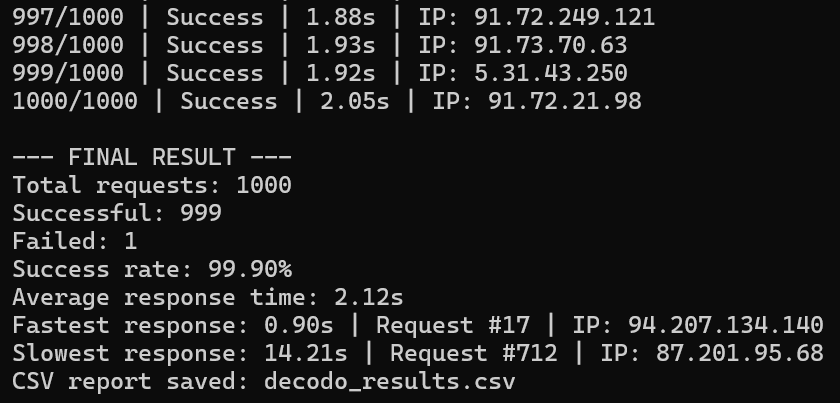
Results:
Successful: 999/1000
Failed: 1/1000
Success Rate: 99.9%
Failure Reasons 0.10%
Proxy Error, Disconnection
Decodo completed virtually every request in our benchmark. A 99.90% success rate is an excellent result for residential proxies and indicates strong connection reliability in our test environment.
Test #2: Decodo Response Time
Success rate tells us whether requests complete. It doesn't tell us how long they take. So we also recorded response time during our test. Our Average Response Time: 2.12 Seconds
Across our benchmark, Decodo averaged 2.12 seconds per request. We would describe this as fast for a residential proxy network. But speed needs context.
Residential proxies route traffic through residential devices rather than conventional datacenter infrastructure. Location, routing, the target server, and the quality of individual residential connections can therefore affect latency.
For our test, the more interesting finding was the combination of:
99.90% success rate + 2.12-second average response time
Decodo delivered both reliable request completion and a fast average response time in our benchmark. Although one request took 14.21 seconds, the overall result remained strong.
Decodo Residential Proxy Features
Now let’s separate our hands-on test results from what Decodo advertises and what we could configure in its dashboard.
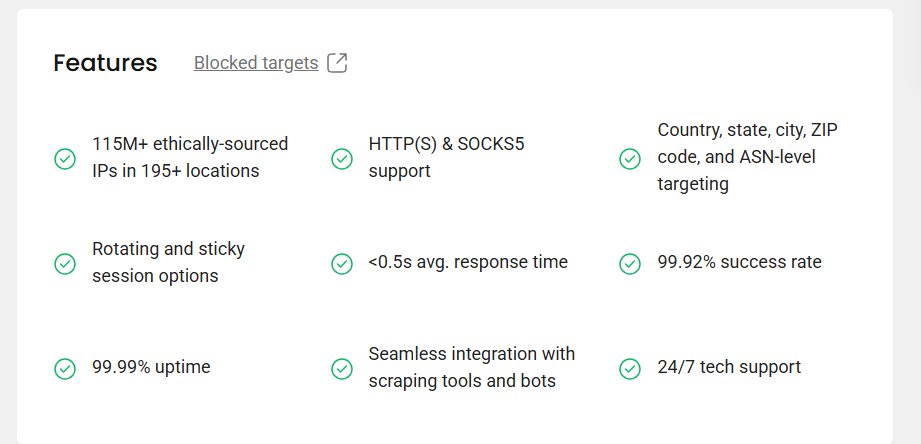
Decodo advertises 115M+ ethically sourced residential IPs across 195+ locations. Its residential network supports HTTP(S) and SOCKS5, rotating and sticky sessions, and targeting by country, state, city, ZIP code, and ASN.
These are provider-reported specifications. Our 1,000-request benchmark measures performance in our test environment; it does not independently verify Decodo’s full IP pool, all locations, or every targeting option.
Decodo Residential Proxy Overview
Feature | Decodo Specification |
|---|---|
IP Pool | 115M+ advertised ethically sourced residential IPs |
Countries | 195+ advertised locations |
Geo Targeting | Country, state, city, ZIP code, and ASN |
Rotation | Rotating + sticky |
Concurrent Sessions | Unlimited |
Traffic Expiration | Does not expire |
Protocols | HTTP(S) and SOCKS5 |
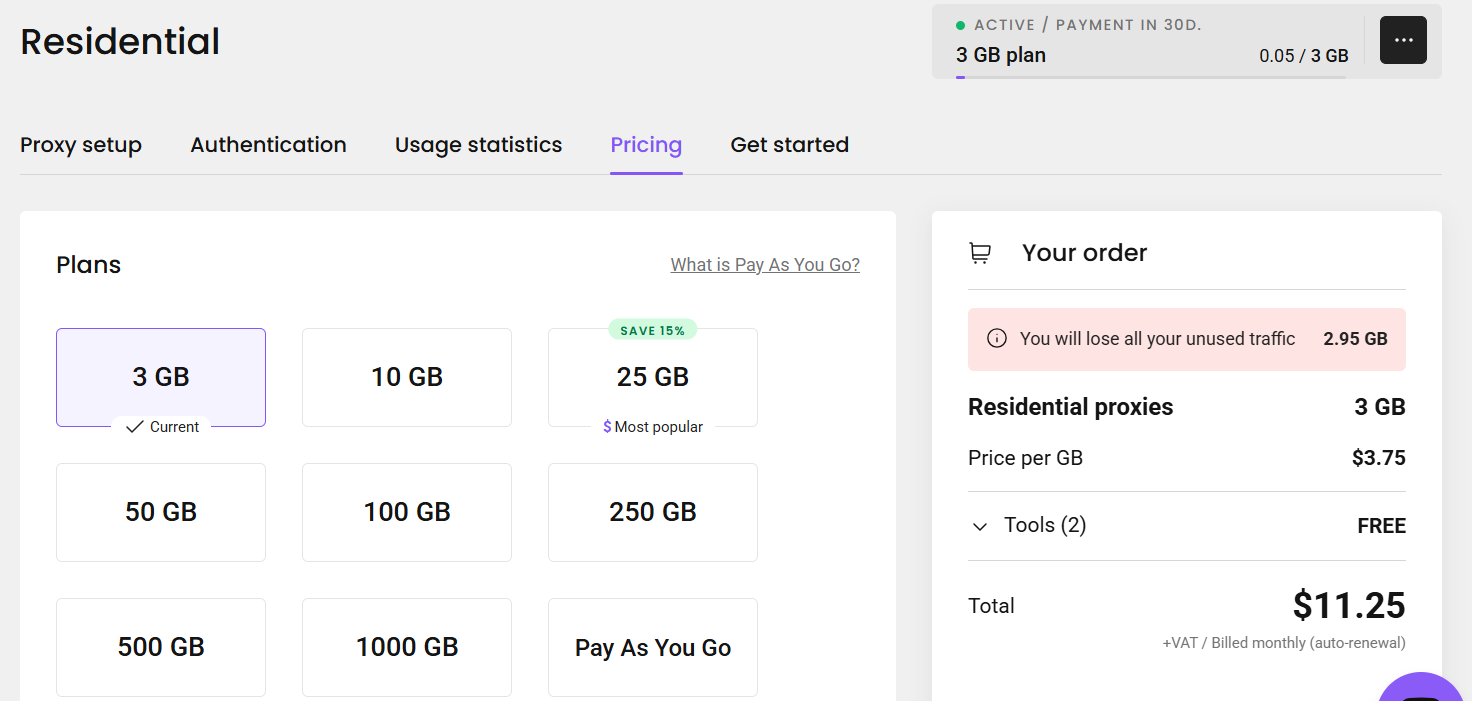
Starting Price | $3.75/GB on the 3GB plan we viewed |
Dashboard & Setup Experience
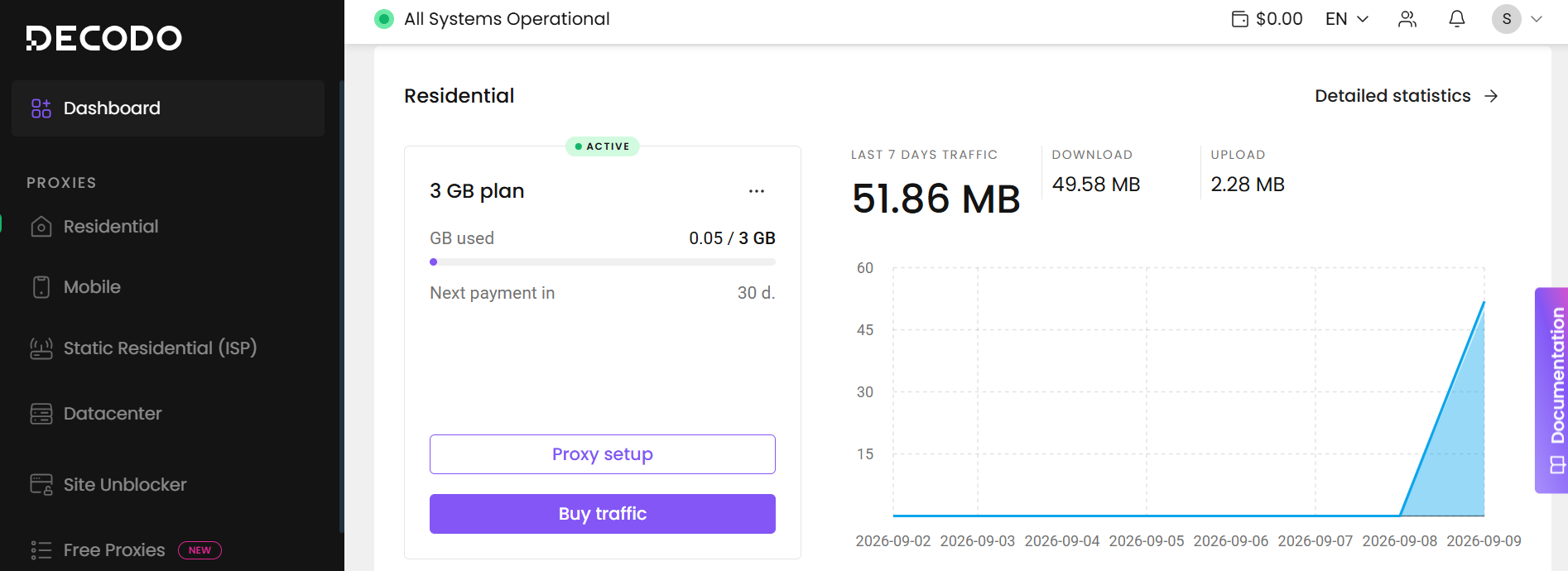
The Decodo dashboard gives residential proxies their own workspace, with tabs for Proxy setup, Authentication, Usage statistics, Pricing, and Get started.
In our dashboard, the proxy setup flow allowed us to configure:
Authentication → Location → ASN → ZIP Code → Session Type → Protocol → Endpoints
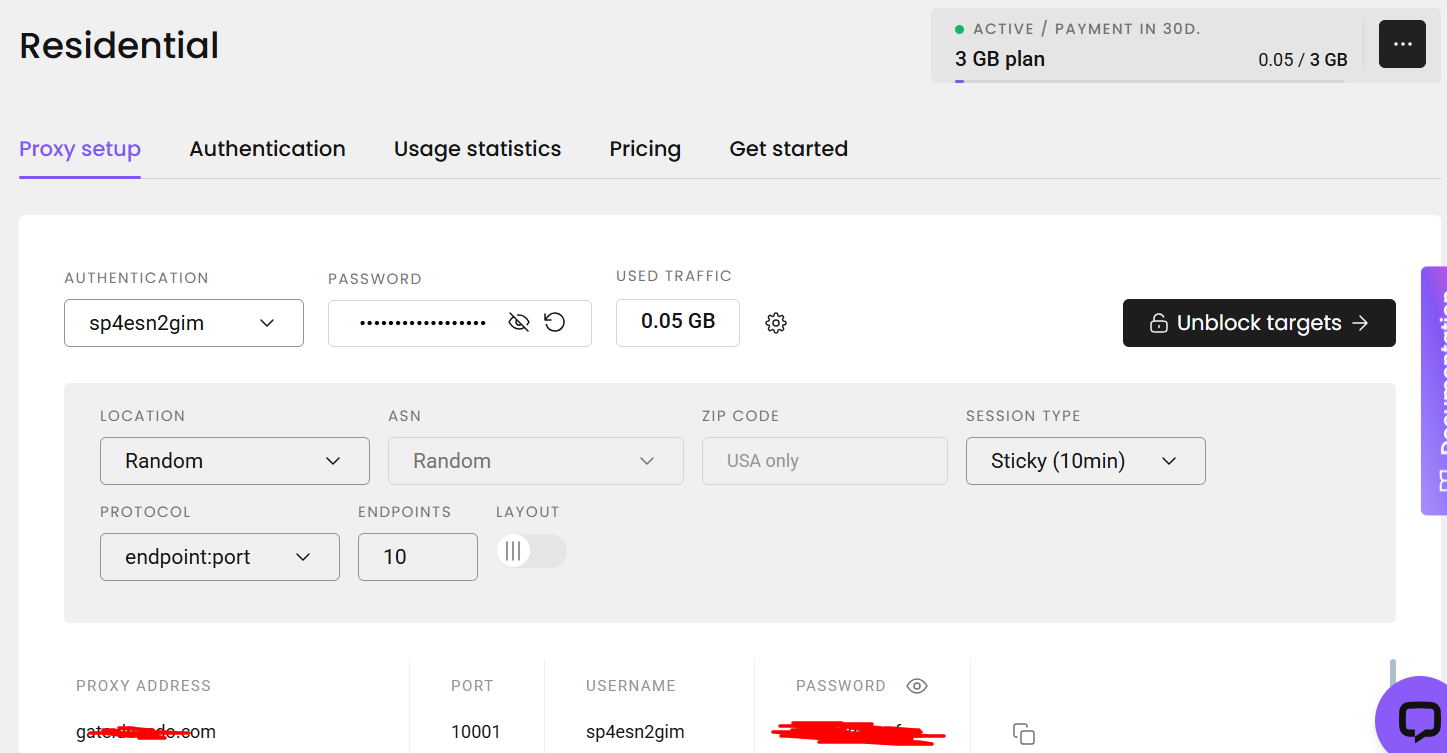
We could choose a location or leave it random, apply an ASN filter, select a sticky-session duration, choose the output format, and generate multiple endpoints. The dashboard also showed available residential traffic, plan status, upcoming billing, and recent upload/download usage.
The pricing screen displayed selectable bandwidth plans from 3GB upward, including a pay-as-you-go option. It also clearly warned that unused traffic on the active plan would be lost, so users should check renewal and rollover terms before purchasing.
Decodo also offers mobile, static residential (ISP), datacenter, and site-unblocker products. These are separate services from the rotating residential proxies tested in this review.
Features Residential Traffic
Decodo desbord
Generated Proxy
Decodo residential pricing
Decodo Geo-Targeting, Routing, and Session Controls
Decodo gives users flexible controls for choosing where requests come from and how long an IP address remains assigned.
Geo-Targeting
In the residential proxy setup panel, we could choose a location, apply an ASN filter, and enter a ZIP code for U.S. targeting. Decodo also advertises targeting by country, state, city, ZIP code, and ASN.
This is useful for localized tasks such as checking search results, ad placements, product availability, and website content from a selected market.
Rotating Proxies
Selecting Rotating assigns a new residential IP for each request. This is the better choice for large-scale public web data collection, price monitoring, or other tasks where repeated requests should not come from the same IP address.
Sticky Sessions
Decodo’s dashboard lets users select preset sticky-session durations of:
- 1 minute
- 10 minutes
- 30 minutes
- 60 minutes
A sticky session keeps the same IP for the selected period. This is useful for browser automation, account sessions, multi-step forms, shopping carts, or any workflow that needs a consistent IP address.
Our 1,000-request benchmark used Decodo’s residential network, but it does not independently measure geo-targeting accuracy or compare every session duration.
Decodo Residential Proxies Pros and Cons
Pros
- 99.90% success rate in our 1,000-request test
- Only 1 failure in 1,000 requests
- 2.12-second average response time in our benchmark
- Country, state, city, ZIP code, and ASN targeting
- Rotating and sticky sessions
- Rotating IPs plus preset and custom sticky sessions
Cons
- One request took 14.21 seconds, showing occasional response-time variability
- Residential traffic is bandwidth-based, so high-volume use can become costly
- The 3GB plan we viewed showed unused traffic would be lost at renewal
Who Should Consider Decodo Residential Proxies?
Based on its available controls and our hands-on test, Decodo is worth considering for users who need reliable residential proxies with fast average response times and flexible targeting.
Public Web Data Collection
Decodo’s 99.90% success rate in our 1,000-request benchmark makes it a strong option for repeated public-data requests where stable completion matters.
Price Monitoring
Residential IPs with country, state, city, ZIP code, and ASN targeting can help teams check publicly available product pricing and availability across markets.
SEO and SERP Research
Location targeting can support research into how public search results appear in different countries, cities, or U.S. ZIP-code areas.
Ad Verification and Geo-Testing
Decodo’s geographic controls are useful for checking how publicly accessible ads, offers, and website content appear from selected locations.
Browser Automation and Multi-Step Workflows
Sticky-session options from one minute to custom durations can be useful when a workflow needs to keep the same IP address across multiple steps.
Market Research
Rotating residential IPs can support geographically distributed public-web research, provided users follow website terms, applicable laws, and responsible request rates.
Feature-by-Feature Comparison With Other Providers
The table below provides a detailed side-by-side comparison of key features across both providers.
Provider | IP Pool | Starting Price |
|---|---|---|
Decodo | 115M+ advertised residential IPs | $3.75/GB |
Bright Data | 400+M residential | From $8/GB |
Oxylabs | Enterprise residential network | From $6/GB |
GSocks | Residential proxy network | From $4/GB |
Final Verdict & Scorecard
Category | Score | Why |
Success Rate | 4.9/5 | 999 / 1,000 requests succeeded (99.90%) |
Reliability | 4.9/5 | Only 1 / 1,000 requests failed (0.10%) |
Speed | 4.7/5 | 2.12-second average response time |
Pricing | 4.2/5 | $3.75/GB on the 3GB plan we viewed; unused traffic was shown as expiring at renewal |
Setup & Dashboard | 4.7/5 | Clear setup controls, targeting options, session controls, and usage statistics |
Overall Rating:  4.7 / 5 — Very Good
Decodo delivered one of the strongest hands-on results in our testing, combining a 99.90% success rate with a 2.12-second average response time. Its dashboard is also practical for users who need targeting and session controls. The main point to check before purchasing is the plan’s unused-traffic policy.
Frequently Asked Questions (FAQs)
Decodo residential proxies can be used for public web data collection, price monitoring, SEO and SERP research, ad verification, geo-testing, and browser automation that needs rotating or sticky IP sessions.
In our dashboard, Decodo’s 3GB residential plan showed a price of $3.75 per GB, or $11.25 before applicable taxes. Pricing and plan terms can change, so check the current checkout page before buying.
Based on our benchmark, Decodo performed very well for public web data collection: 999 of 1,000 requests succeeded with a 2.12-second average response time. Actual results will still vary by target website, location, request volume, and configuration.
Yes. Decodo provides rotating IPs for requests that need frequent IP changes, plus sticky sessions with preset durations of 1, 10, 30, or 60 minutes and a custom-duration option.
Author
Jayden Sprent (Proxy Specialist)
Hi, I'm Jayden Sprent. Dive into the world of proxy servers with my expert evaluations and insightful analyses based on thorough research. I'll share my experiences and comprehensive guides to help you make informed decisions about proxy services.
Learn More About Jayden Sprent