

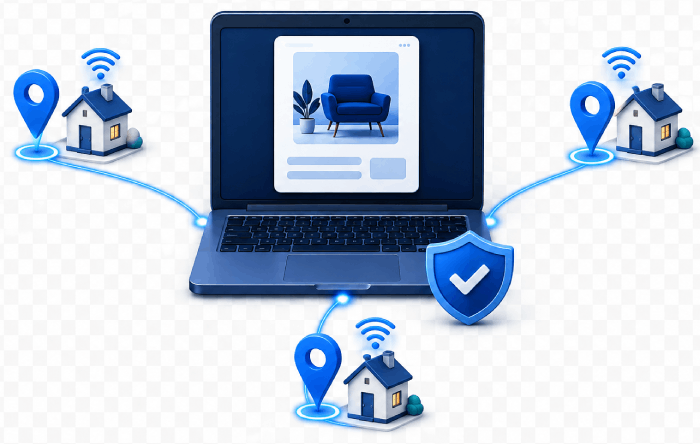
Top Picks for Residential Proxy Services for Geo-Testing Ads
- Best for large-scale, compliance-heavy verification → Bright Data
- Best for reliability & uptime → Oxylabs
- Best price-to-city-targeting balance → Decodo
- Best for fine-grained geo + carrier targeting → SOAX
- Best budget / pay-as-you-go pick → DataImpulse
What Geo-testing ads actually means
Geo-testing ads is the process of verifying that a digital ad campaign is being served correctly to the geography it's targeted at — the right creative, the right offer, the right language, and the right landing page for a given country, region, city, or even ZIP code. Agencies and in-house marketing teams run these checks to confirm:
- The ad platform is actually honoring geo-targeting rules (not just serving nationally and calling it local)
- Localized pricing, promotions, or compliance disclaimers appear correctly
- Competitors' geo-specific campaigns are visible for benchmarking
- A campaign hasn't accidentally leaked into markets it shouldn't reach (regulatory or budget risk)
Because ad networks personalize what they show based on the visitor's IP location, you can't reliably do this from your own office connection. You need to browse from the target location — which is where residential proxies come in.
To learn more, you can Check our : Best Residential Proxies List
Why residential proxies (and not datacenter or mobile)
Ad platforms and ad-tech systems are good at spotting datacenter IPs and will often serve a generic or fallback ad rather than the geo-targeted creative — which defeats the point of the test. Residential proxies route traffic through real IP addresses assigned by internet service providers to home connections, so the request looks like a genuine local user.
That's what makes them the default choice for ad verification work, ahead of datacenter proxies (too easily flagged) and mobile proxies (useful for app-based ad checks, but usually a smaller, pricier pool for browser-based testing).
The criteria that actually decide "best" for this use case
Reviews that rank proxies purely by price or headline pool size miss the factors that matter for ad verification specifically. Based on how ad-verification workflows are typically evaluated, these are the ones worth checking before you buy:
Geo-targeting granularity
Confirm the provider can filter by the level your test actually needs — country, city, ZIP/postal code, or even coordinates. Match the targeting layer to the decision you're making: country-level is fine for national rollouts, city-level covers most local ad and SEO checks, and ZIP or DMA-level targeting is only necessary when the campaign itself is built around delivery zones that tight. Going more granular than you need shrinks your usable IP sample and adds cost for no benefit.
IP pool size and cleanliness
A large pool of unique, unflagged residential IPs reduces the chance of hitting rate limits or landing on an IP that's already been blocked or flagged by the ad network. Pool size matters less than pool quality — a smaller pool of well-maintained IPs will outperform a huge pool full of stale or blacklisted addresses.
Success rate and uptime
Look for providers publishing concrete reliability numbers (high uptime, low failure rates) rather than vague marketing claims. Automated ad-monitoring scripts need consistent connections — frequent failures mean gaps in your verification coverage, not just wasted time.
Session control
Ad verification often means following redirect chains, checking multiple creative variants, or revisiting the same landing page to confirm consistency. That requires sticky sessions (the same IP held for a set duration) alongside rotating sessions for scale. A provider that only offers one or the other will limit what checks you can run.
ASN awareness
Some sites and ad platforms behave differently depending on the network operator behind an IP, not just its geography. If you're troubleshooting inconsistent ad delivery within the same city, checking ASN diversity in the provider's pool can explain results that pure geography can't.
Ethical sourcing and compliance
Residential IPs should come from users who've knowingly opted into a proxy network (e.g., through an SDK or app they've consented to), not from compromised devices. This matters both ethically and practically — proxies built on non-consensual sourcing tend to get blocklisted faster, which undermines the accuracy of your tests.
A simple way to test before you commit
Most reputable providers offer a trial or small pay-as-you-go allowance. Before signing a contract:
- Run your actual target geography through the trial, not a generic location, and confirm the ad or landing page you expect actually appears.
- Test both a sticky session (same IP for several minutes) and a rotating session to see how each behaves with your target ad platform.
- Check response times from the specific city or region your campaigns run in, not just the provider's fastest region.
- Ask about how IPs are sourced — a straight answer here is itself a trust signal.
So, what's the best residential proxy for geo-testing ads?
It's the one that matches your targeting granularity, has a clean pool in the exact regions you're testing, and gives you the session control your verification workflow needs — not necessarily the biggest name or the biggest pool on paper.
Since proxy pricing, pool size, and city-level coverage change often, it's worth checking a current, side-by-side comparison rather than relying on a single provider's own claims. BuyResidentialProxy maintains an independently updated comparison of residential proxy providers, including pool size, geographic coverage, and pricing, which is a useful starting point for narrowing down options against the criteria above.
FAQs: About Geo-Testing Ads Residential Proxies
For most ad verification, residential is the safer choice. Ad platforms are more likely to flag datacenter IPs and serve a fallback ad instead of the geo-targeted version you're trying to check, which can make your test results unreliable.
It depends on how the campaign itself is targeted. If the campaign targets a metro area, city-level IP targeting is usually sufficient. If it targets specific delivery zones or store radii, you'll want ZIP/postal-level targeting instead.
Fewer than most pool-size marketing suggests. What matters more is having enough clean, unflagged IPs in the specific city or region you're testing — a targeted pool of a few thousand relevant IPs will usually serve ad verification better than a huge global pool with only a handful of addresses in your actual target market.
No. City-level IP geolocation is generally reliable for ad and QA workflows but isn't a guarantee of street-level precision. Always validate results against visible page evidence — the actual ad creative, pricing, or landing page shown — rather than treating a successful connection alone as proof the geo-targeting worked.
