


Top Picks for Residential Proxy Services for Reddit
- SOAX — Best overall Japan residential proxy
- IPRoyal — Best low-cost Japan proxy alternative
- Bright Data — Best enterprise Japan proxy
- Decodo — Best balanced Japan proxy
- DataImpulse — Best cheap Japan residential proxy
- Oxylabs — Best for large-scale Japan scraping
Why You Need a Japan-Specific Residential Proxy
Generic "global" residential proxies won't cut it on Japanese targets. Sites like Rakuten Ichiba, Yahoo Japan Shopping, Mercari, ZOZOTOWN, and the major Japanese sneaker retailers (atmos, Mita Sneakers) employ aggressive bot detection that includes IP reputation checks, ASN filtering, and geographic consistency validation.
A Japan residential proxy gives you:
- Real Japan IPs from local ISPs (NTT, KDDI, SoftBank, J:COM) — indistinguishable from a normal home user in Tokyo or Osaka
- City-level geo-precision — critical for ad verification (different regions see different campaigns), price monitoring (regional pricing on appliances and electronics), and bot operations on city-specific releases
- Bypass for JP-only content — anime streaming sites, regional ticketing platforms (Ticket Pia, e+, Lawson Ticket), banking-region restrictions
- Account management at scale — Mercari, Rakuten, and Yahoo Japan accounts stay alive longer when traffic originates from clean Japanese IPs
What it does not give you: a way to ignore Japanese law on automated access. Provider terms always prohibit fraud, credential stuffing, and any activity illegal in your jurisdiction. Use proxies for legitimate research, monitoring, and account management only.
Top 6 Japan Residential Proxies — Compared
Side-by-side breakdown of pricing, total IP pool, Japan city targeting, and ISP-level filtering — verified from each provider's official documentation as of May 2026.
| Provider | Starting Price | Total IP Pool | Japan City Targeting | ISP Filtering | Action |
|---|---|---|---|---|---|
|
1SOAX
|
$2.20 / GB | 191M+ IPs | Tokyo, Osaka, Yokohama, Nagoya |  NTT, KDDI, SoftBank NTT, KDDI, SoftBank |
Buy Now |
|
2IPRoyal
|
$1.75 / GB | 32M+ IPs | State-level Japan |  Limited Limited |
Buy Now |
|
3Bright Data
|
$5.04 / GB | 150M+ IPs | Tokyo, Osaka + ASN-level | Full ASN targeting |
Free Trial |
|
4Decodo
|
$3.75 / GB | 115M+ IPs | Tokyo, Osaka, Yokohama | Country + city |
Free Trial |
|
5DataImpulse
|
$1 / GB | 90M+ IPs | Country + city (select plans) | Limited |
Free Trial |
|
6Oxylabs
|
$8.00 / GB | 175M+ IPs | Tokyo, Osaka, city-level | Full coverage |
Free Trial |
Pricing reflects published list rates as of May 2026; enterprise volume discounts are available on Bright Data and Oxylabs. Japan-specific pool numbers are rarely published — these reflect overall pool size with confirmed Japan coverage.
6 Japan Residential Proxies at a Glance
SOAX runs one of the largest ethically sourced proxy networks in the industry — 191M+ IPs total — and the Japan slice is one of their best-documented strengths. What sets it apart for Japan work is the granular targeting: you can filter by country, region, specific city (Tokyo, Osaka, Yokohama, Nagoya), and individual ISPs (NTT, KDDI, SoftBank). For ad verification, regional pricing audits, and any workflow where Tokyo IPs need to look distinct from Osaka IPs, SOAX is the cleanest fit at a reasonable price. For more information, read our Soax Review.
Pros:
Cons:
Best for: Best for: Regional price monitoring, ad verification, sneaker bot operations on Japan releases, and any workflow where you need to differentiate Tokyo traffic from Osaka traffic.
IPRoyal's standout feature is bandwidth that never expires. Buy 10GB of Japan traffic once, and use it across six months without losing anything. That's a meaningful difference when JP-target workflows are uneven (sneaker drops, seasonal product launches, monitoring cycles tied to Japanese holidays). The 32M+ pool is ethically sourced through opt-in apps, and Japan coverage is solid, though city targeting is state-level rather than city-precise. For more information, read our IPRoyal Review.
Pros:
Cons:
Best for: Freelancers and small teams running uneven JP workloads. The non-expiring credits mean you don't lose unused GB at the end of a billing cycle.
Bright Data is one of the few residential proxy providers that publicly lists Japan among its strongest geographic concentrations — Japan IPs sit alongside the US, Germany, Brazil, and South Korea in their documented pool composition.
The 150M+ pool combined with ASN-level targeting makes it the most precise tool for anything in Japan where carrier identity matters: telecom-specific ads, region-locked apps, or compliance audits on Japanese carrier networks. The trade-off is enterprise pricing and a steeper onboarding curve. For more information, read our BrightData Review.
Pros:
Cons:
Best for: Enterprise teams running compliance-sensitive Japan workflows (telecom monitoring, banking research, carrier-level ad verification) where ASN precision and audit posture matter more than per-GB cost.
Rebranded from Smartproxy in 2025, Decodo carries 115M+ IPs across 195+ countries with documented Japan coverage, a measured 99.7% success rate, and HTTP/3 plus QUIC support for faster connections — meaningful when you're scraping at concurrency. For high-volume Japan workflows (price monitoring across thousands of Rakuten SKUs, large-scale Mercari listing extraction), Decodo's combination of pool size and pipe speed is hard to beat at the mid-tier price point. For more information, read our Decodo Review.
Pros:
Cons:
Best for: Mid-to-large teams scraping Japanese e-commerce at scale where pool depth and request speed matter more than ISP-level precision.
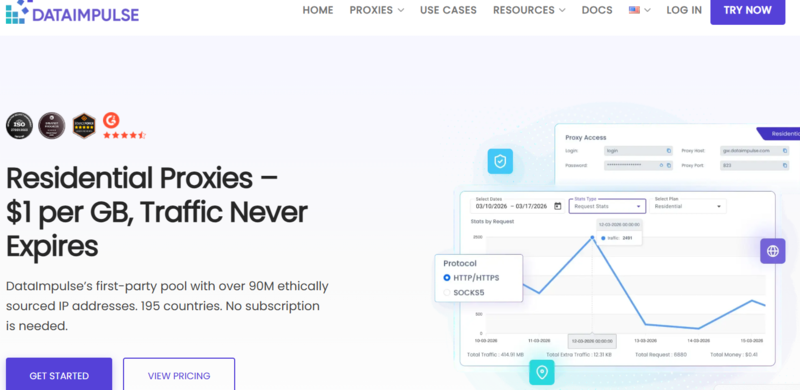
At $1/GB, DataImpulse is the cheapest credible Japan proxy option. The 90M+ IP pool covers 195 countries including Japan, with country-level targeting standard and city-level filtering available on select plans. The 5GB free trial removes test risk completely — validate Japan coverage and target site success rates before spending a dollar. For more information, read our DataImpulse Review.
Pros:
Cons:
Best for: Indie developers, first-time Japan proxy buyers, and budget-constrained projects. Use the free trial first — it costs nothing to validate.
Oxylabs runs a 175M+ residential pool with independently measured sub-0.6 second response times — among the fastest in the industry. For Japan workflows where speed matters (live pricing on financial sites, real-time inventory monitoring), Oxylabs is the performance pick. City-level Japan targeting is supported, and the AI-assisted scraping studio adds value for non-engineer teams. The catch: it's an enterprise-pricing platform with monthly minimums and no pay-as-you-go option. For more information, read our Oxylabs Review.
Pros:
Cons:
Best for: Time-sensitive Japan workflows — live financial data, real-time inventory monitoring, fast-moving auction sites — where every millisecond of latency costs you a result.
Common Use Cases for Japan Residential Proxies
The right Japan proxy depends entirely on what you're doing with it. Here are the most common workflows we see at BuyResidentialProxy and which provider fits each best.

E-commerce price monitoring
Tracking Rakuten, Mercari, ZOZOTOWN, and Yodobashi prices across Japanese regions — useful for resellers, repricing tools, and competitive intelligence on JP marketplaces.
Best pick: SOAX or Decodo for city-level regional pricing differences.
Sneaker bots on JP drops
Copping releases on atmos, Mita Sneakers, Yodobashi sneaker drops, and Japanese SNKRS releases where Tokyo IPs and long sticky sessions are required to clear queue checks.
Best pick: SOAX or Bright Data for clean Tokyo IPs with sticky sessions.
Anime & manga site access
Monitoring or accessing JP-region-locked content on Niconico, dmm, Crunchyroll JP, Bandai Channel, and other geo-restricted Japanese streaming platforms.
Best pick: Decodo or IPRoyal for cost-effective JP IPs at scale.
JP market research
Scraping Japanese SERPs, competitor research, content audits on .jp domains, and keyword tracking across Japanese search engines for SEO and brand strategy.
Best pick: Decodo or DataImpulse for high-volume request economics.
Social media account management
Running multiple Japan-region accounts on X (Twitter), Instagram, LINE, or TikTok Japan where account longevity depends on clean residential IPs from real Japanese carriers.
Best pick: SOAX for sticky sessions with NTT and KDDI ISP filtering.
Compliance & ad verification
Auditing how ads render across Japanese carriers, verifying regional ad campaigns, and brand-protection monitoring on Japanese marketplaces for trademark misuse.
Best pick: Bright Data for ASN-level precision and audit posture.How to Choose a Japan Proxy Provider
Five questions to answer before you spend money. Going in order, these resolve 95% of buyer mistakes we see.
1. Do you need city-level precision in Japan?
If yes (price monitoring, regional ad verification, sneaker bots) → SOAX, Bright Data, Decodo, or Oxylabs. If no (general scraping, country-level only) → IPRoyal or DataImpulse will save you money.
2. How much traffic per month?
Under 10GB/month → DataImpulse or IPRoyal. 10-100GB → SOAX or Decodo. 100GB+ → Bright Data or Oxylabs at negotiated rates.
3. Will you actually use what you buy each month?
If usage is uneven → IPRoyal (non-expiring) or DataImpulse (non-expiring). If usage is predictable → any provider works.
4. Are you running on protected targets?
Rakuten, Mercari, Yahoo Auctions, ZOZOTOWN, sneaker sites → SOAX, Bright Data, or Oxylabs. Less protected scraping → any provider works.
5. Do you have compliance requirements?
If yes (regulated industry, enterprise audit) → Bright Data or Oxylabs for documented sourcing and audit posture. If no → any provider.
Is Using a Japan Residential Proxy Legal?
In most cases, yes. Buying and using residential proxies for Japan is legal under Japanese law (no specific law prohibits proxy use). What matters is what you do with them.
Legal uses include market research, SEO monitoring, ad verification, brand protection, price comparison aggregation, accessing publicly available data, and managing your own accounts. Illegal uses include unauthorized account access, credit card fraud, copyright violations, scraping personal data without consent (PIPA applies in Japan), and any activity covered by Japan's Unauthorized Computer Access Law.
Provider terms additionally prohibit spam, fraud, credential stuffing, and violations of local law in your jurisdiction. Violations result in account termination and forfeiture of unused balance.
Frequently Asked Questions
Common questions about buying Japan residential proxies — pricing, city targeting, ISP filtering, and use cases.
What is the best residential proxy service for Japan in 2026?
It depends on use case. SOAX is the best overall pick for Japan because of granular city and ISP targeting across Tokyo, Osaka, and Yokohama. IPRoyal offers the best value with non-expiring credits. Bright Data is the strongest enterprise option with documented Japan presence in its 150M+ pool. For budget testing, DataImpulse at $1/GB with a 5GB free trial is hard to beat.
Do these providers offer Tokyo and Osaka city-level targeting?
SOAX, Bright Data, Decodo, and Oxylabs all support city-level targeting in Japan including Tokyo, Osaka, Yokohama, and Nagoya. IPRoyal supports state-level Japan targeting. DataImpulse offers country-level Japan targeting with city filtering available on select plans.
How much do Japan residential proxies cost in 2026?
Japan residential proxy pricing ranges from $1/GB (DataImpulse) at the low end to $7–15/GB (Bright Data, Oxylabs) at the enterprise tier. Mid-market providers like SOAX, Decodo, and IPRoyal sit between $1.75 and $3.75/GB depending on volume commitment.
Are Japan proxies good for scraping Rakuten, Mercari, and Yahoo Japan Auctions?
Yes, but quality matters. Rakuten and Mercari deploy aggressive bot detection, so you need providers with clean Japan residential IPs and city-level rotation. SOAX, Bright Data, and Oxylabs perform consistently well on these targets. Cheaper providers can work but expect higher block rates without proper request pacing.
Why use a Japan residential proxy instead of a datacenter proxy?
Japanese websites — especially major e-commerce platforms — flag datacenter IPs almost instantly. Residential proxies route your traffic through real ISP-assigned Japan IPs (NTT, KDDI, SoftBank), making your requests indistinguishable from local Japanese users. For production scraping or account management on Japanese sites, residential is the only reliable option.
Can I get sneaker bot proxies for Japan releases?
Yes. SOAX and Bright Data offer city-level Japan IPs with sticky sessions long enough for sneaker drops on Japanese release calendars — atmos, Mita Sneakers, and Yodobashi sneaker drops. Sticky sessions of 10 to 30 minutes are typically enough to clear queue checks on Japanese release calendars.
Do Japanese ISPs (NTT, KDDI, SoftBank) appear in these proxy pools?
Yes. SOAX and Bright Data offer explicit ISP-level filtering for major Japanese carriers including NTT Docomo, KDDI au, and SoftBank. Other providers route through whichever Japanese ISP their network has at request time, with no ability to filter by specific carrier.
How many Japan IPs does each provider have?
Exact Japan-specific pool sizes are rarely published. Based on overall pool size and Japan presence: Bright Data, SOAX, and Oxylabs each have hundreds of thousands of Japan IPs minimum. Decodo and DataImpulse have substantial Japan coverage. IPRoyal has documented Japan IPs across its 32M total pool. Always test with a small package first.
Do I need a Japan VPN or a Japan residential proxy?
Different tools. A Japan VPN routes your entire device traffic through one Japan IP — good for personal browsing or streaming. A Japan residential proxy gives you programmatic access to thousands of rotating Japan IPs, designed for scraping, bot operations, or running automated tools. For commercial or automated workflows, you need residential proxies.
Are these Japan proxies ethically sourced?
SOAX, IPRoyal, Bright Data, and Oxylabs all publicly document ethical sourcing programs through opt-in apps and partner SDKs with consent flows. Decodo and DataImpulse also state ethical sourcing on their official pages. For compliance-sensitive workflows, SOAX and IPRoyal are the most transparent in their documentation.
 Related guides