


Rank | Provider | Best for | Starting price |
|---|---|---|---|
Best overall and lowest daily rate | $78.60/day | ||
02 | Flexible daily, weekly or monthly terms | $200/day (100 Mbit) | |
03 | Best budget monthly plan, plus state, city and ASN targeting on Premium | $51.99/month (5 ports) | |
Long-term flat monthly pricing | $1,800/month (200 Mbps) | ||
05 | Largest pool with city and ISP targeting | $300/month (100 threads) | |
06 | Cheapest way to test: hourly plans | $15/hour (200 Mbps) |
What "unlimited bandwidth" really means
Unlimited bandwidth means you are not billed per GB, not that nothing is capped. Each provider replaces the GB meter with one of four other limits, and that limit decides how much work you can actually push through.
What is capped | How it works | Providers here |
Speed (Mbps) | You buy a throughput tier, such as 200 Mbps. Data is unlimited, but only as fast as the tier allows. | ProxyEmpire, ProxyOmega Premium, Geonode, RainProxy |
Ports | You buy a number of ports; each port carries unlimited traffic on one IP at a time. | ProxyOmega Budget Unlimited |
Threads | You buy a number of concurrent connections; more threads means more parallel requests. | ProxyRack |
ProxyRack | You buy a fixed period, from one hour to 60 days. | ProxyScrape (daily), RainProxy (hourly to 60 days), and most speed-tier plans |
A useful rule of thumb: a 200 Mbps tier running flat out moves about 2.2TB per day. Few scraping jobs sustain that, so the speed tier is rarely the first bottleneck; target blocking and pool size usually are.
How We Evaluated
We compared each provider's unlimited plan on six points: price, what is capped, IP pool, geo-targeting depth, rotation options, and trial terms. Plan details come from each provider's own product page, checked on October 14, 2026.
- Hands-on Testing: We use Python, Requests, and cURL to run 1,000 HTTP requests per tested residential proxy provider, including tests against Amazon and IP verification services. Unlimited bandwidth plans are evaluated separately where test data is available.
- Pricing and limits: taken directly from each provider's published unlimited plan page (see Sources).
- What We Measured: We record total requests, successful and failed requests, success rate, average response time, fastest and slowest responses, and unique IP addresses used. Total bandwidth consumption is measured only when usage data is available.
- Terms check: we read each plan's terms for fair-use or acceptable-use clauses that could slow or stop heavy users.
Pool sizes and success rates marked "provider-advertised" come from the provider and were not independently verified. Prices change often, so confirm on each provider's site before buying.
What to look for before you buy
The most important question is what the plan caps instead of GB. Check these six points before paying.
- The real limit. Find the speed tier, port count or thread count on the plan. Match it to your workload: many parallel scrapers need threads; large downloads need Mbps.
- Acceptable-use terms. Some unlimited plans are "subject to" an acceptable-use policy. Read it, and ask support in writing whether heavy use can be slowed or suspended.
- Pool size on the unlimited plan specifically. Several providers run a smaller, separate pool for unlimited plans. ProxyEmpire, for example, advertises 30M+ residential IPs overall but 1M+ daily IPs on its unlimited plan.
- Geo-targeting depth. Most unlimited plans offer country-level targeting only. If you need city, state or ISP targeting, look at ProxyOmega Premium or ProxyRack.
- Rotation options. Check whether you can rotate per request, and how long sticky sessions last. Ranges here run from 5–180 minutes (RainProxy) to 24 hours (ProxyOmega).
- A cheap way to test. Look for an hourly plan, a paid trial or a money-back guarantee before committing to a monthly plan.
Comparison: 6 unlimited bandwidth residential proxy providers
ProxyScrape has the lowest daily price, ProxyOmega the lowest monthly price, and ProxyRack the largest pool. ProxyOmega appears twice because it sells two different unlimited plans.
Unlimited Residential Proxy Plans Compared
Compare provider limits, IP pools, locations, sticky sessions, pricing, and trial options.
| # | Provider | What Is Capped | IP Pool | Countries | Geo-Targeting | Sticky Sessions | Entry Price | Trial |
|---|---|---|---|---|---|---|---|---|
| 1 | ProxyScrape Unlimited plan | Time (daily pass) | 8M+ | Not confirmed | Advanced geo-targeting | Flexible rotation | $78.60 Per day | Not confirmed |
| 2 | ProxyEmpire Unlimited plan | Speed: 100–1000 Mbit | 1M+ daily IPs | 85+ | Country | Per request or sticky | $200/day $1,500/month | 1-hour trial on request 50 Mbit speed |
| 3 | ProxyOmega Budget plan | 5–100 ports | 2M | 200+ | Country | 1 min to 24 h per port | $51.99 Per month | None listed |
| 3 | ProxyOmega Premium plan | Speed: 200–1000 Mbps | 2M | 200+ | Country, state, city, ASN | Up to 24 h | $149/day $1,549/30 days | None listed |
| 4 | Geonode Unlimited plan | 200–1000 Mbps Per-tier concurrency limit | Not published | Varies by live pool | Varies by live pool | Rotating and sticky | $1,800 Per month | 1 day for $100 Credited on upgrade |
| 5 | ProxyRack Unlimited plan | Threads: from 100 | 35M+ monthly IPs | 140+ | Country, city, ISP | Rotating and sticky | $300 Per month | Money-back guarantee |
| 6 | RainProxy Unlimited plan | 200–1000 Mbps Dedicated port | 10M+ | 150+ | Country | 5–180 min | $15/hour $227.81/day | Hourly paid plan |
Deep-dive reviews: 6 verified unlimited providers
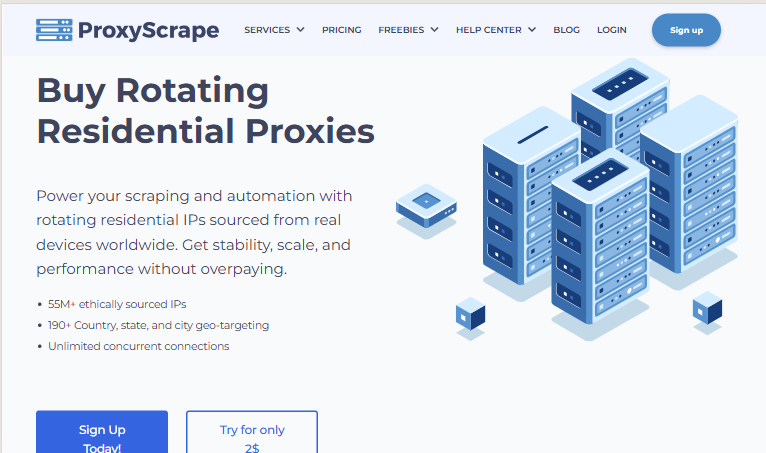
ProxyScrape offers truly unlimited residential traffic from $78.60 per day, the lowest daily price of any provider here. That is roughly half the daily rate of ProxyOmega Premium ($149) and well below ProxyEmpire ($200) and RainProxy ($227.81).
Key specs: 8M+ IPs · unlimited rotating IPs · flexible rotation · advanced geo-targeting · from $78.60/day.
The daily model is ideal for short, heavy projects such as a market research sprint, a product launch or a large data backfill. For always-on work, the math changes: 30 days at the daily rate is about $2,358, so a monthly plan elsewhere can cost less.
 Pros
- Lowest daily price for unlimited residential traffic in this list
- 8M+ IP pool with unlimited rotating IPs
- Advanced geo-targeting
- No long-term commitment
✘ Cons
- Costs more than monthly plans for continuous use (about $2,358 per 30 days)
- 200–1,000 Mbps; no fixed concurrent connection limit.
- Trial via support; refunds subject to plan terms and usage.
My verdict: Verdict: The best value for short bursts of high-volume scraping. If you run scrapers every day of the month, compare it against ProxyOmega's monthly plans first.
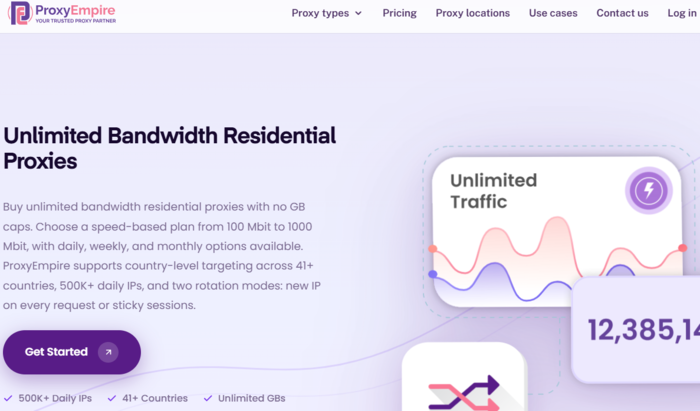
ProxyEmpire sells unlimited residential traffic by speed tier, from 100 to 1000 Mbit, on daily, weekly or monthly terms. Plans start at $200/day, $650/week or $1,500/month for 100 Mbit.
Key specs: 1M+ daily IPs · 85+ countries · country-level targeting · new IP per request or sticky sessions · HTTP, HTTPS, SOCKS5 and HTTP/2.
The unlimited pool is deepest in the Americas and the UK, with 222,000+ daily US IPs and 215,000+ in Brazil. It is smaller than ProxyEmpire's 30M+ main residential pool, and timed rotation is not available on this plan. ProxyEmpire holds a 4.6 rating from 100+ Trustpilot reviews, many praising fast support.
Pros
- Daily, weekly and monthly terms, plus custom speeds above 1000 Mbit
- Wide protocol support, including SOCKS5 and HTTP/2
- Strong support reputation (4.6 on Trustpilot)
- 1-hour trial at 50 Mbit on request
✘ Cons
- Country-level targeting only; no city, region or ISP
- Unlimited pool is about 1M daily IPs, thin outside the top countries
- Pricier per Mbps than ProxyOmega Premium ($1,500/month for 100 Mbit vs $1,549 for 200 Mbps)
Verdict: A good choice if you want to switch between daily, weekly and monthly terms and value responsive support. Check that your target country is in the large part of the pool.
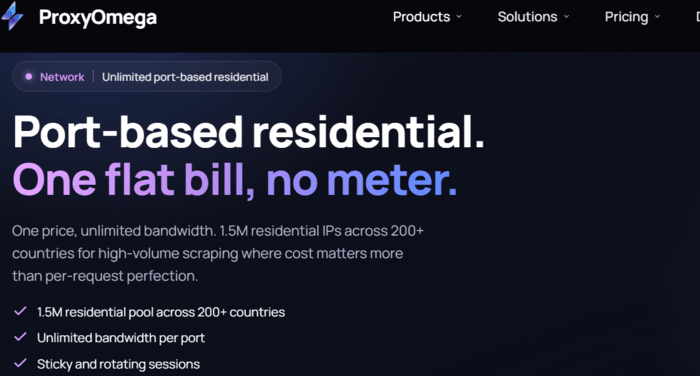
ProxyOmega has two unlimited plans: Budget Unlimited from $51.99/month, the cheapest entry here, and Premium Unlimited with state, city and ASN targeting. Both draw on a 2M residential pool across 200+ countries.
Budget Unlimited (port-based): $51.99/month for 5 ports, $183.20 for 25 and $599.20 for 100. Each port carries unlimited bandwidth, with rotation set per port from 1 minute to 24 hours. Note that the plan page lists a suggested workload of about 500GB/month for the 5-port tier; ask whether heavier use is supported.
Premium Unlimited (speed-based): $149/day, $499/week or $1,549/30 days for 200 Mbps, up to $3,279/30 days for 1,000 Mbps. It adds state, city and ASN targeting, unlimited concurrent connections and a dedicated server. If you hit your speed tier, requests queue instead of failing, and you can change tiers mid-plan with prorated billing.
Pros
- Lowest monthly entry price in this list ($51.99)
- Premium offers state, city and ASN targeting, which is rare on unlimited plans
- Best price per Mbps among monthly speed-tier plans ($1,549 for 200 Mbps)
- Sticky sessions up to 24 hours
✘ Cons
- 2M pool is small for strict targets like Google or LinkedIn
- Pool size smaller than enterprise players
- SOCKS5 on the Budget plan is available on request only
Verdict: Start with Budget Unlimited if cost matters most. Choose Premium if you need city or ASN targeting on an unmetered plan.
Geonode sells unlimited residential proxies on flat monthly speed tiers, from $1,800/month for 200 Mbps to $3,800/month for 1,000 Mbps. It promises your price stays locked for as long as you subscribe.
Key specs: 200–1,000 Mbps tiers · rotating and sticky sessions · separate pool from Geonode's Premium Residential · 1-day trial for $100, credited if you upgrade.
Geonode is unusually upfront about its limits. It states that each tier has a concurrency limit and that usage is subject to its acceptable-use policy. It does not publish a pool size for the unlimited plan, and available locations depend on the live pool, so check the dashboard before buying. Geonode says it operates its own network rather than reselling.
Pros
- Locked flat monthly rate
- Honest about its caps (speed tier plus concurrency limit)
- $100 one-day trial, credited toward a subscription
- Unlimited traffic does not affect Geonode's Premium pool
✘ Limitations
- Smaller IP pool—shows on extended runs
- Newer provider with shorter track record
- Support quality less proven than incumbents
Verdict: Choose Geonode for steady, always-on workloads where a predictable monthly bill matters most. Use the $100 trial to confirm your target locations first.
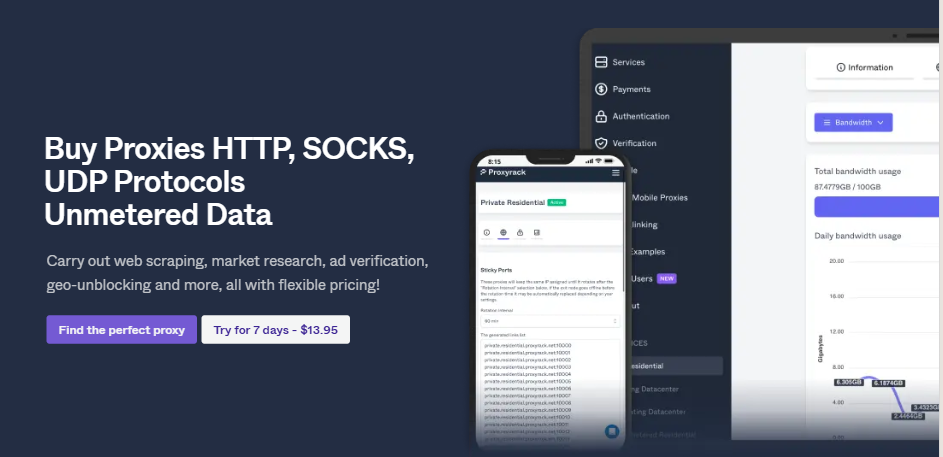
ProxyRack's unlimited residential plans give access to 35M+ monthly IPs with country, city and ISP targeting, the largest pool and deepest targeting in this comparison. You pay per concurrent thread, not per GB or Mbps.
Key specs: 35M+ monthly IPs · 140+ countries · country, city and ISP targeting · HTTP, SOCKS and UDP · rotating and sticky IPs · money-back guarantee.
Build Your Own plans cost $3 per thread, from $300/month for 100 threads. Larger bundles cut the per-thread price: Mega 1000 is $1,250/month ($1.25/thread), Mega 2000 is $2,000 ($1.00/thread) and Mega 5000 is $4,500 ($0.90/thread). That makes ProxyRack strong for teams running many scrapers in parallel.
Pros
- Largest pool here (35M+ monthly IPs)
- City and ISP targeting on unlimited plans
- UDP support, which few residential providers offer
- Money-back guarantee and sub-users
✘ Cons
- $3/thread is expensive at small scale
- "Monthly IPs" counts all IPs seen in a month, not those available at once
- No published speed tier
Verdict: The best pick for strict targets and high concurrency, especially at 1,000+ threads where per-thread pricing drops.
RainProxy sells unlimited residential traffic on a dedicated port by the hour, starting at $15 for 60 minutes at 200 Mbps. That makes it the lowest-risk way to test an unlimited plan on your real workload.
Key specs: 10M+ IPs · 150+ countries · 200–1,000 Mbps dedicated port · unlimited threads · country targeting · sticky sessions of 5–180 minutes · HTTP(S) and SOCKS5.
Longer plans cost $227.81/day or $1,925.63/30 days at 200 Mbps, with terms up to 60 days. Every plan includes an account manager. RainProxy holds a 4.4 rating from 241 Trustpilot reviews and is based in Utrecht, Netherlands.
Pros
- $15 hourly plan for low-cost testing
- Dedicated port with unlimited threads
- 10M+ pool across 150+ countries
- Account manager included
✘ Cons
- Highest daily price among speed-tier plans ($227.81)
- Country targeting only
- No free trial, and the 14-day money-back guarantee covers GB plans only
Verdict: Use RainProxy's hourly plan to test before committing anywhere. For long-term use, compare its 30-day price with ProxyOmega Premium.
Unlimited vs per-GB: when does unlimited pay off?
Unlimited pays off once your usage passes the break-even point: the plan price divided by the per-GB rate you would otherwise pay. At a typical $2.50/GB, ProxyOmega Budget breaks even at about 21GB a month, while the speed-tier plans need roughly 600–940GB a month.
| Plan | Price for 30 Days | Break-Even at $2.50/GB |
|---|---|---|
| ProxyOmega Budget (5 ports) | $51.99 | ~21 GB/month |
| ProxyRack (100 threads) | $300 | 120 GB/month |
| ProxyEmpire (100 Mbit) | $1,500 | 600 GB/month |
| ProxyOmega Premium (200 Mbps) | $1,549 | ~620 GB/month |
| Geonode (200 Mbps) | $1,800 | 720 GB/month |
| RainProxy (200 Mbps) | $1,925.63 | ~770 GB/month |
| ProxyScrape (30 daily passes) | ~$2,358 | ~943 GB/month |
Frequently asked questions
They are unlimited in data, not in everything. You are not billed per GB, but every plan caps something else: speed (Mbps), ports, threads or time. Check which limit applies before you buy.
ProxyOmega Budget Unlimited is the cheapest monthly plan at $51.99 for 5 ports. For a single day, ProxyScrape is cheapest at $78.60. For a quick test, RainProxy's hourly plan costs $15.
A speed tier is the maximum throughput your plan allows. Data is unlimited, but it can only move as fast as the tier. At full use, 200 Mbps moves about 2.2TB per day, which is more than most scraping jobs need.
ProxyOmega Premium Unlimited supports state, city and ASN targeting, and ProxyRack supports city and ISP targeting. ProxyEmpire and RainProxy offer country-level targeting only on their unlimited plans.
ProxyRack has the largest pool here, with access to 35M+ monthly IPs across 140+ countries. RainProxy (10M+) and ProxyScrape (8M+) follow. Note that many providers use a smaller pool for unlimited plans than for their per-GB plans.
Yes. RainProxy sells a 60-minute plan for $15, Geonode offers a one-day trial for $100 that is credited if you upgrade, and ProxyEmpire offers a 1-hour trial at 50 Mbit on request. ProxyRack offers a money-back guarantee.
Yes, once you pass the break-even point. Divide the plan price by your per-GB rate. At $2.50/GB, a $51.99 monthly plan breaks even at about 21GB, and a $1,549 plan at about 620GB.
Rotating residential proxies change your IP per request, on a timer or per session. Static residential proxies keep the same IP for days or weeks. Rotating suits large-scale scraping; static suits account management.
Using proxies is legal in most countries, but what you do with them can create legal risk. Scraping against a site's terms can lead to civil claims, and collecting personal data may trigger GDPR or CCPA obligations. Consult a lawyer for grey-area use cases.
Final verdict
ProxyScrape is the best rotating residential proxy with unlimited bandwidth for most buyers, thanks to the lowest daily price ($78.60) and an 8M+ IP pool. For always-on work on a budget, ProxyOmega Budget Unlimited starts at $51.99/month. For strict targets that need city or ISP targeting, ProxyRack's 35M+ pool is the strongest option.
Before you commit to any monthly plan, test on your real workload. RainProxy's $15 hourly plan or Geonode's $100 credited day are cheap ways to do it. Measure your success rate, latency and data delivered under load; that test will tell you more than any review, including this one.